
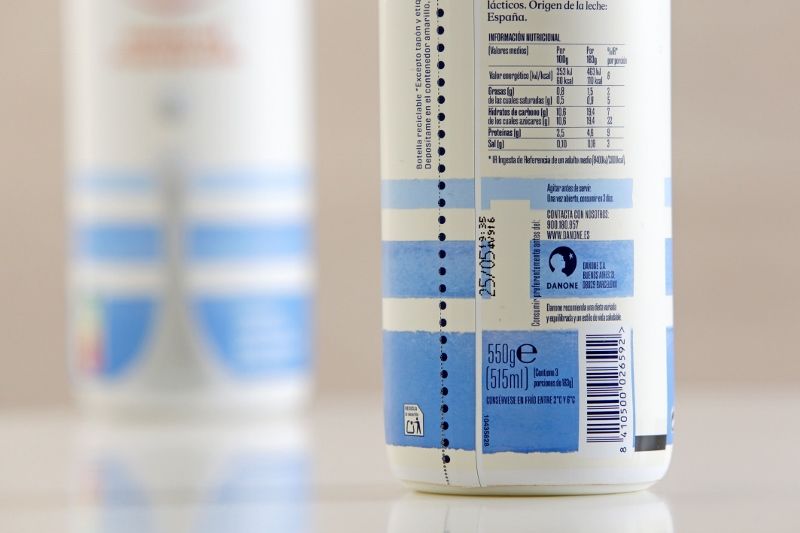
Can expired yogurts be eaten? Some people eat them, like former minister Miguel Arias Cañete, and some throw them in the trash. It is a classic debate in all homes that responds to historical reasons and a regulation that tried to preserve food safety above all else, which in the past was not always guaranteed. Times evolve and this discussion could have its days numbered since, throughout this year, Danone yogurts ---the leading company in the sector--- will no longer inform of the expiration date, but rather of an indicative best-before date.
The idea is to apply common sense and be guided by the "look, smell and taste" rule before discarding, with the aim of reducing food waste. It is not a mere change of name, since behind the replacement of the expiration date with the best-before date is a research work that has been developed at the Isaac and Daniel Carasso R&D center that Danone has on Calle Córcega in Barcelona.
It is one of the main scientific centers that the multinational based in Paris has in the world and, from it, some of the brand's most successful innovations have emerged, with more than 150 innovation projects per year. In the Barcelona laboratory works a team of 47 people of seven nationalities and it is the only Danone center that brings together three facilities in the same place: a pilot plant where about a thousand tests are carried out per year for the development of new products; a packaging design laboratory, and a center for the creation, cultivation and manufacture of its own ferments.
Thus, in this R&D center in Barcelona, Danone produces 60% of the ferments used by its Spanish factories ---located in Parets del Vallès, Aldaya (Valencia), Tres Cantos (Madrid) and Salas (Asturias)--- for the production of yogurts. In the last three years, the company's scientists have selected more robust ferments that are what have now made it possible to switch from the expiration date to the best-before date.
The shelf life given to yogurts leaving the factory does not change, as the best-before date will range between 30 and 40 days, depending on the type of product. However, the new selection of ferments made in the R&D center allows yogurts to keep better and last longer. "The expiration date refers to food safety, so nothing expired should be consumed, regardless of its state of preservation. In contrast, the best-before date has nothing to do with health risk, but rather indicates until when a certain organoleptic quality can be guaranteed, meaning that, once that date has passed, there may be a variation in flavor or texture, as it may become more liquid, but its consumption is equally safe," explain the company.
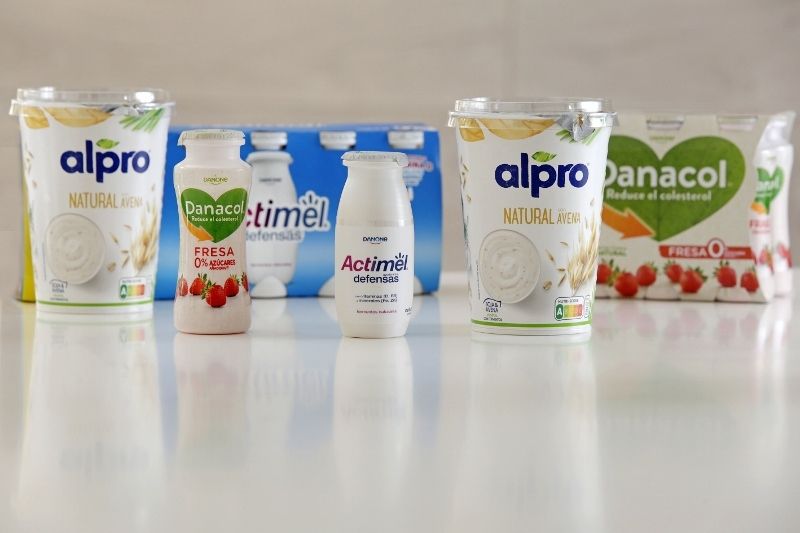
Danone has already eliminated the expiration date on the packaging of Actimel, Danacol, and Alpro, its brand of plant-based alternatives to dairy yogurt. Throughout this quarter, Vitalínea and Densia will join this strategy, while in September the migration will arrive for Activia, Oikos, Danonino, and the entire Danone branded line. The goal is that by the end of 2021, 78% of all Danone products in Spain will have a best-before date. The other 22% will continue to indicate the expiration date, as these are products not suitable for this change as they are not fermented, such as desserts, i.e., custards and rice puddings.
A cross-functional team of 20 people from a dozen departments ---such as production, legal, and marketing--- have worked on this project, which has also been executed by Danone's subsidiaries in the United Kingdom and Germany. Now, work is also underway to eliminate the expiration date in France and Belgium. Present in more than 120 countries, Danone had a global turnover of 23,620 million euros in 2020.
"It is estimated that a third of food is wasted in the world. In Spain, each person throws away 77 kilos of food per year, of which 42% is generated in homes. In addition, food waste is responsible for 7% of greenhouse gas emissions: something has to change. That is why at Danone we have decided to move towards preferential consumption, it is important news for the group, for the Planet and for society," says Paolo Tafuri, general director of Danone Spain. The executive stresses that this commitment to sustainability and to avoiding food waste in the midst of an economic and social crisis has been made without harming the highest standards of quality and food safety.
According to Helena Calvo, from the movement against food waste Too Good To Go, "more than half of Spaniards throw away food when they see that the expiration date has passed." "What we have to do before throwing it away is to look, smell and taste. If it is in good condition, it is better to consume it to prevent 10,000 kilos of yogurt per year from going to waste," highlights Calvo, after pointing out that the population is increasingly aware, although a lot of pedagogy is still needed to learn to differentiate between expiration date and preferred consumption date. It is estimated that saving one kilo of yogurt (8 units) from the trash avoids 1.8 kilos of CO2 emissions.
The Isaac and Daniel Carasso R&D center was inaugurated in 1982 on the site that had housed Danone's first factory in the city of Barcelona. The brand, born in 1919 in Carrer dels Àngels in the Catalan capital ---in the Raval---, launched the factory on Calle Córcega in the 40s, but in 1982 it moved production to Parets del Vallès and those facilities were allocated to the R&D center, which works in a network with the rest of the multinational's scientific facilities, led by the central laboratory in Palaiseau, 30 km from Paris, where the world's most important collection of dairy ferments is preserved. Danone has classified more than 4,000 bacteria (the basic ones for making yogurt are Streptococcus thermophilus and Lactobacilus bulgaricus), and its own collection includes about 1,800, although in its factories it only uses about 36, depending on the type of product (bifidus for Activia or casei for Actimel, for example).
Add The New Barcelona Post as your preferred Google source for free
Stay informed with the latest news.
