Before, the Sun was looked at to know what time it was, and it wasn't just looked up at to know if it would rain or if one needed to bundle up. That distant star told the exact moment and served to organize the day, marking the beginning and end of the workday. When technology made its way and devices like automatic watches came along, the break with the Sun occurred. It was no longer necessary to observe it to adjust the time because they were already capable of self-regulating. Other inventions like maps or compasses also displaced the imposing star in its prominence as a physical guide.
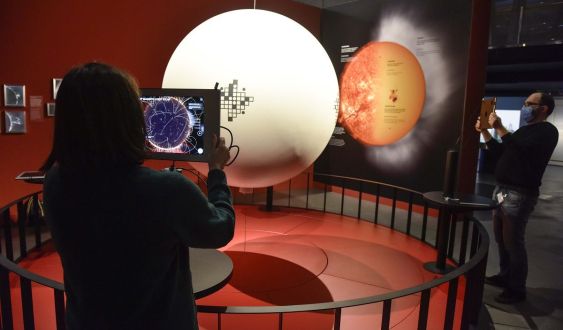
CosmoCaixa wants to end that disconnection with the Sun, the most important star in the system inhabited by humans and not without mystery and surprises, with the exhibition The Sun. Living with our star, which can be visited until October 16. With the climate emergency becoming increasingly pressing and the need to find new energy sources, the exhibition wants to reconcile us with the Sun to better prepare for everything that is to come.
"Look at the Sun again, but don't do it directly," prudently asks the curator, Harry Cliff, "it's time to stop and think about how the Sun affects us." The exhibition is the result of the new collaboration between CosmoCaixa and the Science Museum of London. It is the first time that both cultural institutions go hand in hand, although the deputy general director of Fundación La Caixa, Elisa Durán, hopes that more will come in the future. For now, this joint work has allowed the exhibition to travel outside London for the first time, details the deputy director of the London museum, Julia Knights.
It is the first time that CosmoCaixa and the Science Museum of London work togetherThe Sun. Living with our starIt spans from the first civilizations to the present day and is made up of more than 100 historical and contemporary pieces, some immersive and others equipped with augmented reality, which delve into this star and its secrets, constituting the most extensive exhibition ever projected to explain it. "Knowing the Sun has been a constant concern," Durán explains, still not satisfied and with the need to know it even more and better, taking into account the not fully understood dangers it causes, such as solar storms.
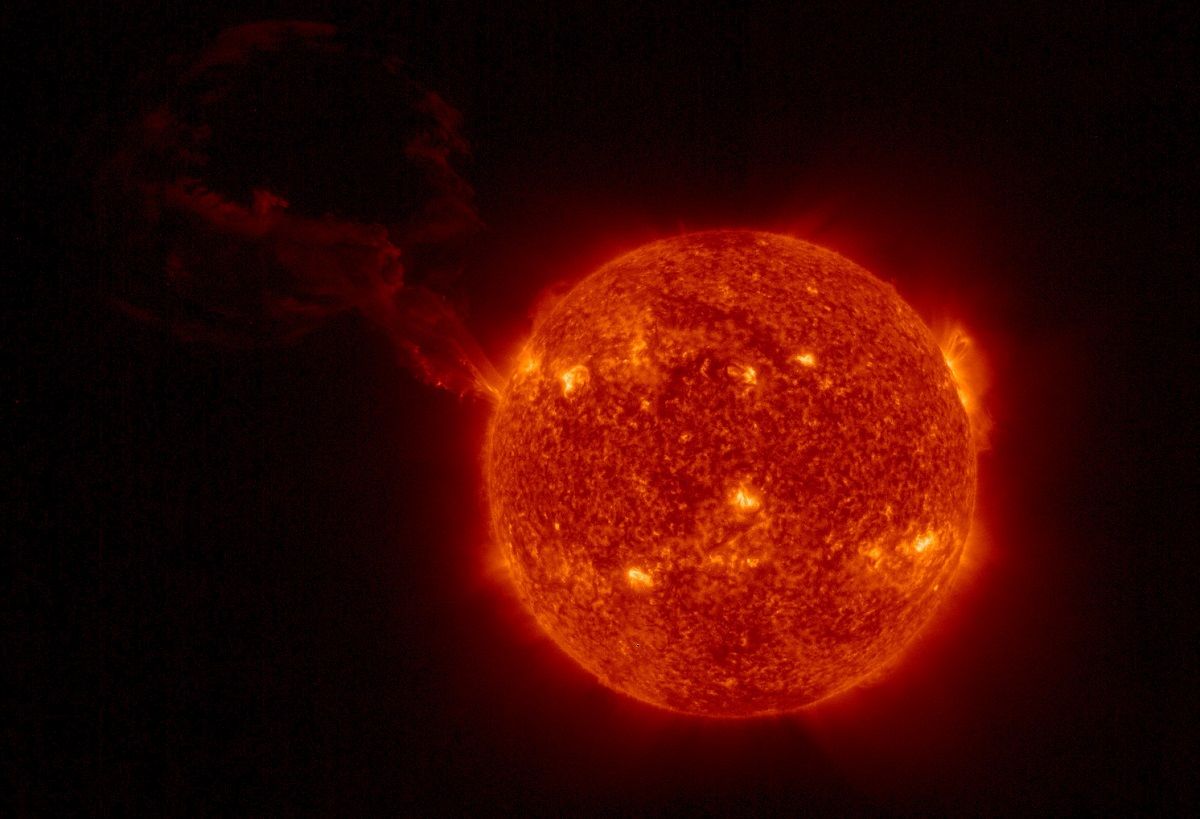
Therefore, solar observation is essential to understand what can happen on Earth, as was already reflected in a Babylonian tablet included in CosmoCaixa, accompanied by the first telescopes and the high-precision observations that can be made now. The exhibition includes the highest resolution images ever obtained of the Sun. Taken in late 2019 from Hawaii, they show the inner workings of this star and reveal its dynamic surface with an appearance resembling lava, Cliff points out. The processes that occur within this star are also explained, such as nuclear fusion, the path followed by photons, or its magnetic field.
To understand the Sun, one must not only observe it, but also remember what relationship it has had with human beings. The exhibition delves into the break that occurred with the Sun when mechanical clock technology became established. The tour begins with different clocks, such as sundials or the first hand clocks, as well as the planetariums that were created to demonstrate the Sun's orbit relative to the Earth. There is also an Islamic astrolabe, dating from 1650, which was used to calculate prayer times and locate the direction of Mecca. For Cliff, one of the most outstanding pieces is the planetary clock that shows the relationship between time and the Earth's movement around the Sun, even including the relationship with the different horoscope symbols.
The human relationship with the Sun also covers its impact on health. While tanned skin was once considered a plebeian sign, that conception changed when it was seen how sunlight could be used to cure diseases like tuberculosis. The exhibition features a bed that was used for patients to sunbathe or graphic material about a clinic that opened in the Swiss Alps, where skiing in underwear was encouraged to better benefit from sunlight. But of course, that relationship between the Sun and health also proved to be dangerous if it was abusive. That is why a bed has also been incorporated that was created for those who suffered sunstroke on their pilgrimage to Mecca, cooling patients with cold steam and hot air.
The Sun as an energy source brings to the exhibition the first solar cells, which were first used in space and then served for calculators and watches. One of the solar panels that the President of the United States, Jimmy Carter, placed on the roof of the White House due to the oil crisis is presented, wanting to already seek alternative energy sources. His successor, Ronald Reagan, removed them and it was not until the arrival of Barack Obama that they repopulated this residence.
The exhibition will be accompanied by multiple parallel activities, which will serve to deepen some of the themes raised through the hundred pieces collected. According to the director of CosmoCaixa, Valentí Farràs, an introductory course to Astronomy will be programmed, workshops to learn how to make soligraphs or use a sundial, and solar fairs where visitors can learn about the different characteristics of the star or try solar cooking. Wanting to reverse the distance with the Sun, the summer solstice will also be celebrated by observing it with telescopes and attending monologues and a musical show. To date and after the impact of the pandemic, CosmoCaixa has registered about 160,000 attendees this 2022, with an average of 10,000 attendees every weekend.
Add The New Barcelona Post as your preferred Google source for free
Stay informed with the latest news.
