
Many remember the introduction of Up, a summary of the life of one of its protagonists, Carl. Beyond the emotions it manages to awaken in a few minutes, few will have noticed how the light changes according to the character's mood, with vivid colors when he gets married and more subdued when something bad happens to him or he is left alone. Something as imperceptible as the work of light in an animated film is one of the stops of the exhibition The Science of Pixar, at CosmoCaixa until September 3.
Lighting, or how to make an animated ray of light look like one seen in real life, is one of the many aspects that the film studio's artists and computer scientists work on. It's all very well if you want to make a movie about a fish looking for its son, but how do you draw water to make it look real? Well, at Pixar they start by looking at how the trillions of molecules that form it interact, then they create a physical model that reproduces their behavior and adapt it to the screen... This way, a certain Nemo can get lost in the Australian reef and make an overprotective Marlin lose his fear accompanied by a forgetful Dory. This is one of the many technical challenges that Pixar workers solve, who make calculations and resort to formulas to make their universe even more real, whether with virtual aqueous meshes that move like the sea or rigged springs to more naturally imitate Mérida's curls in Brave. And, if necessary, calculating how many helium balloons are needed to save a house from gentrification.
These are some of the innovations that can be seen, and learned by touching, at CosmoCaixa, with models that simplify the solutions reached by Pixar's creatives, experts in merging original plot ideas, such as toys having a life of their own and their own troubles, with a scientific-technical scheme that manages to move anyone and instantly turn them into intergenerational classics. As Toy Story was the first film in a long list of successes, Buzz Lightyear is in charge of welcoming visitors to the exhibition.
Now, the work doesn't end with knowing how to represent water or unruly curls. There are no problems when it comes to drawing a child like those in Coco or Luca. It's another thing to imagine the skeleton of a monster. Okay, Sullivan's from Monsters Inc., being bigger, might resemble that of a bear. But what about Mike's? All eye and little else? Anatomy ---often quite imaginative--- also plays its role in the creative process of Pixar films. This part, known as rigging, consists of defining a structure of points that outlines the characters' bodies, their bones, joints, and muscles, which will then be dressed and given hair. The same happens with facial expressions, marking all the lines that define each character, being able to try out with Jessie's face from Toy Story at the CosmoCaixa exhibit, drawing a thousand and one expressions on her face.
As in Pixar films, the exhibition offers several levels of reading, designed, especially, to entertain the little ones, with tests and games, but also for older visitors, reliving scenes from movies they have already seen too many times and discovering the processes behind creating images that are more difficult than they seem. They can even dare to simulate movie spaces like Ratatouille's kitchen, mixing colors and patterns, changing the roughness and texture of surfaces, and deciding how light reflects to realize how much effort it takes to properly make a pot that reflects the objects around it. It's not even easy to imitate a simple orange. For those who want to go beyond the traditional visit, a guided tour with a final workshop is offered where everything learned is put to the test with the help of an educator, allowing them to create a plot and transfer it to the screen.
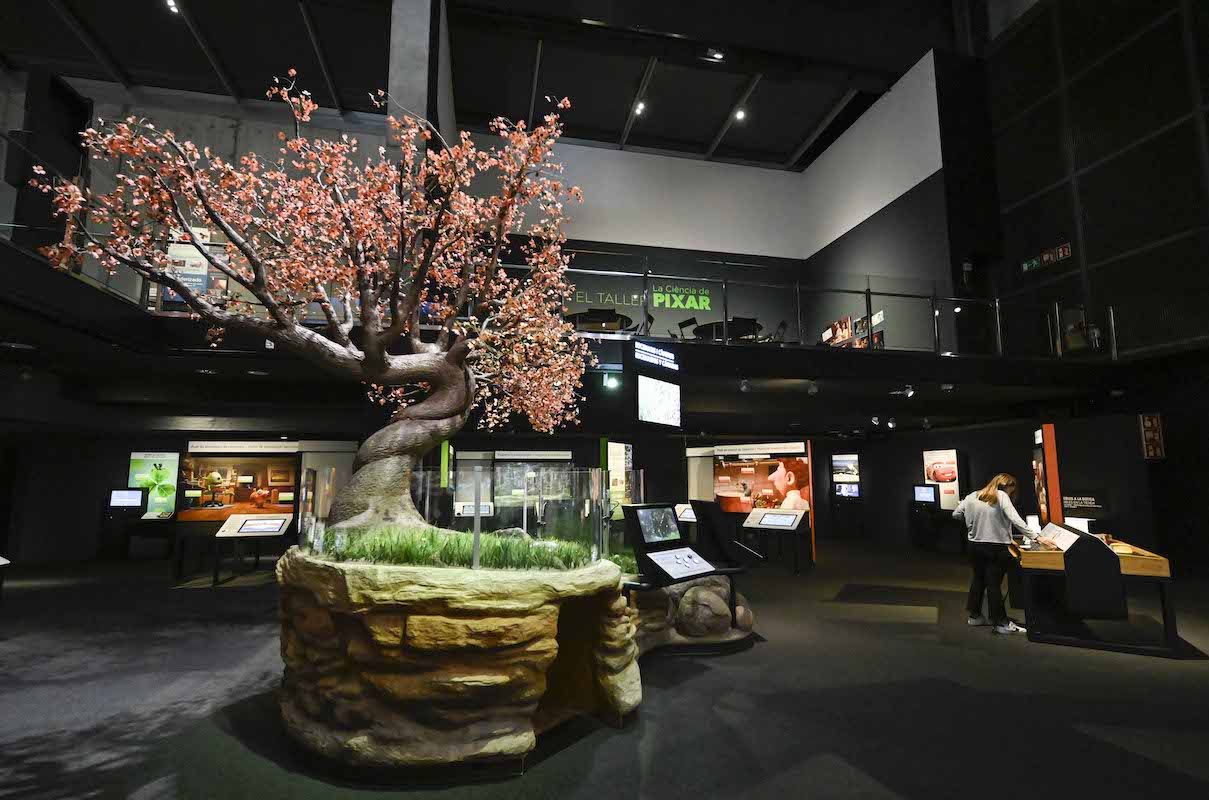
More than 1,000 square meters in which scientific, computer, and mathematical concepts from the main films are revealed, starting with small clay sculptures (there are Anger and Joy from Inside Out), moving through the programs that give movement to the characters and draw the scenarios, until reaching the last part, the rendering of the scenes, a process that consumes a lot of data and takes a long time, learning that details can be removed from parts that are not seen or are less important to make it easier. Simply put, it's putting pixels on everything they've drawn, but knowing that, for a single frame, an average of 89 hours are required. Of course, then for a movie it takes between four and seven years. As a detail, the name Pixar comes from this part of the creative process, slightly changed because its creators thought it was too conventional and theirs was not. For those who don't remember, the immense garden that invades the center of the room is from A Bug's Life, with the possibility of feeling like an ant that wants to protect itself from an army led by an evil grasshopper.
It is not the first time that Fundación La Caixa has focused on Pixar. The Science of Pixar, premiered in Barcelona for all of Spain, comes after exhibitions held in 2015, reviewing the film studio's 25 years, and in 2020, focusing on character construction. This time it is the first time that CosmoCaixa brings an exhibition from the Boston Museum of Science, explains the head of Science Exhibitions at Fundación La Caixa, Javier Hidalgo. For now, as can be seen by walking through CosmoCaixa on any given morning, there is no room for a pin in the room occupied by the exhibition, with Buzz Lightyear monopolizing selfies at the entrance, as well as the rest of the exhibition's guests, among them, the couple formed by Sulley and Mike Wazowski, the always cheerful Dory or the charismatic Edna Mode from The Incredibles. With attendances like that of The Science of Pixar, CosmoCaixa expects to close a record year in 2023, not only fully recovering from the pandemic, but also registering the best figures in its history.
Add The New Barcelona Post as your preferred Google source for free
Stay informed with the latest news.
