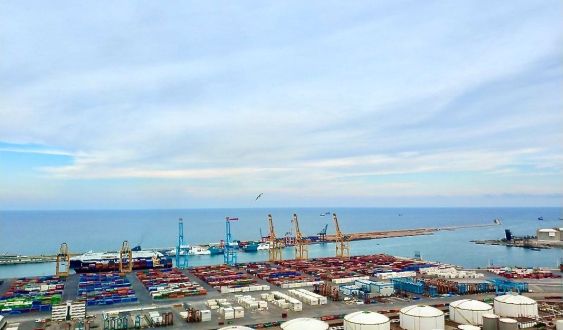
Goods traffic sets the pace of recovery at the Port of Barcelona. On the contrary, the total disappearance of the cruise industry penalizes passenger volume, with a total of 50,020 passengers between January and February, 82% less than in the same period of 2020, before the pandemic broke out. Much better is the situation regarding containers passing through the port of the Catalan capital, where an 18% growth has been registered in these first two months, confirming the upward trend initiated at the end of 2020. In total, container movement has been 595,073 TEUs, the unit of measurement used in the port sector.
According to the infrastructure chaired by Mercè Conesa, there has been growth in both export and import containers, that is, those originating from or destined for the Catalan capital, as well as in transshipment containers or those that are only passing through and will route to other ports. Specifically, in the first case ---the one with the most qualitative value--- growth in January and February was 9.3%. More significant has been the rise in transshipment containers, which have grown by 30.8%. The dynamism of exports from Barcelona destined for the United Arab Emirates (+77%) and China (+58%) stands out. Traffic to India and Morocco also shows double-digit growth.
If traffic of all types of goods is taken into account, not just those traveling in containers, the Port of Barcelona has grown by 3.4%, with a total of 10.5 million tons. This growth is lower than that of containers, as both bulk goods and the import and export of vehicles remain in negative territory. For example, bulk liquids fall by 23% and solids decline by 9%. The drop in maritime transport of vehicles is 26.4%, with a movement of 81,041 units.
Add The New Barcelona Post as your preferred Google source for free
Stay informed with the latest news.
