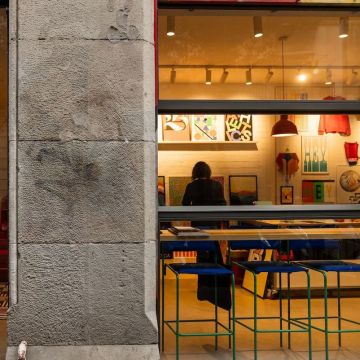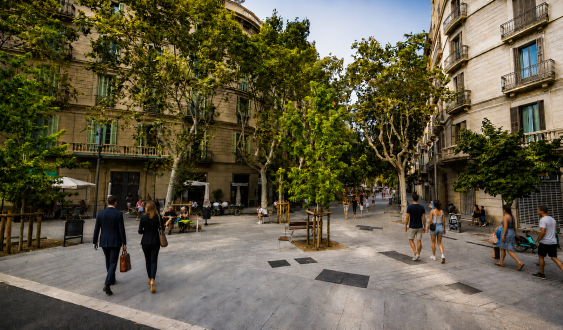
The transformation of Consell de Cent is not only measured in terms of mobility, public space, or neighbors on the street. Four years after the start of its pedestrianization, the street has consolidated itself as one of Barcelona's new commercial hubs, with a market that reflects the growing interest of brands and operators in settling in one of the most unique axes of the Eixample.
So much so that commercial rents in the most prime section of Consell de Cent —between Balmes and Pau Claris— have increased by 96% since 2021, according to a study by the real estate consultancy Laborde Marcet, in collaboration with Grupo ST. In just five years, they have gone from 45 euros per square meter per month to 88 euros, an evolution that, according to both firms, places the street among the commercial axes with the greatest projection in the city.
The change goes beyond the increase in prices. The transformation of the environment has led to a renewal of the profile of establishments, with the arrival of new operators. Restaurants, specialized shops, and cultural proposals have been gaining ground on a street that has stopped functioning as a thoroughfare to become a destination for strolling (and shopping).
Thus, the urban intervention has modified Barcelona's commercial map: "The transformation of Consell de Cent has boosted a new focus of activity and has attracted operators with differential proposals, generating a positive impact on the city as a whole," says Clara Matías, Retail High Street director at Laborde Marcet.
Shops, and also homes
The evolution of Consell de Cent is also reflected in the residential market. Data analyzed by Grupo ST places the average price of housing in its surroundings at 5,865 euros per square meter, a figure much higher than the average for Barcelona, which stands at 3,254 euros. Furthermore, in some sections, year-on-year increases exceed 10%.
In this area, the highest values are concentrated in the central part of the axis, where the average price approaches 6,000 euros per square meter. "Towards the ends, prices moderate, although they remain in any case well above the city average," as highlighted by Grupo ST's Business Development Director, Pablo Pluvinet.
The street thus demonstrates the impact that urban transformations can have on economic and residential activity. The pacification of the street and giving priority to pedestrians over vehicles has configured a new scenario for commerce and restoration, in an operation that, according to the consultancy, "anticipates part of the future of urban commerce in Barcelona, with more walkable axes, more careful proposals and a closer relationship between city, economic activity and neighborhood life."
Add The New Barcelona Post as your preferred Google source for free
Stay informed with the latest news.