
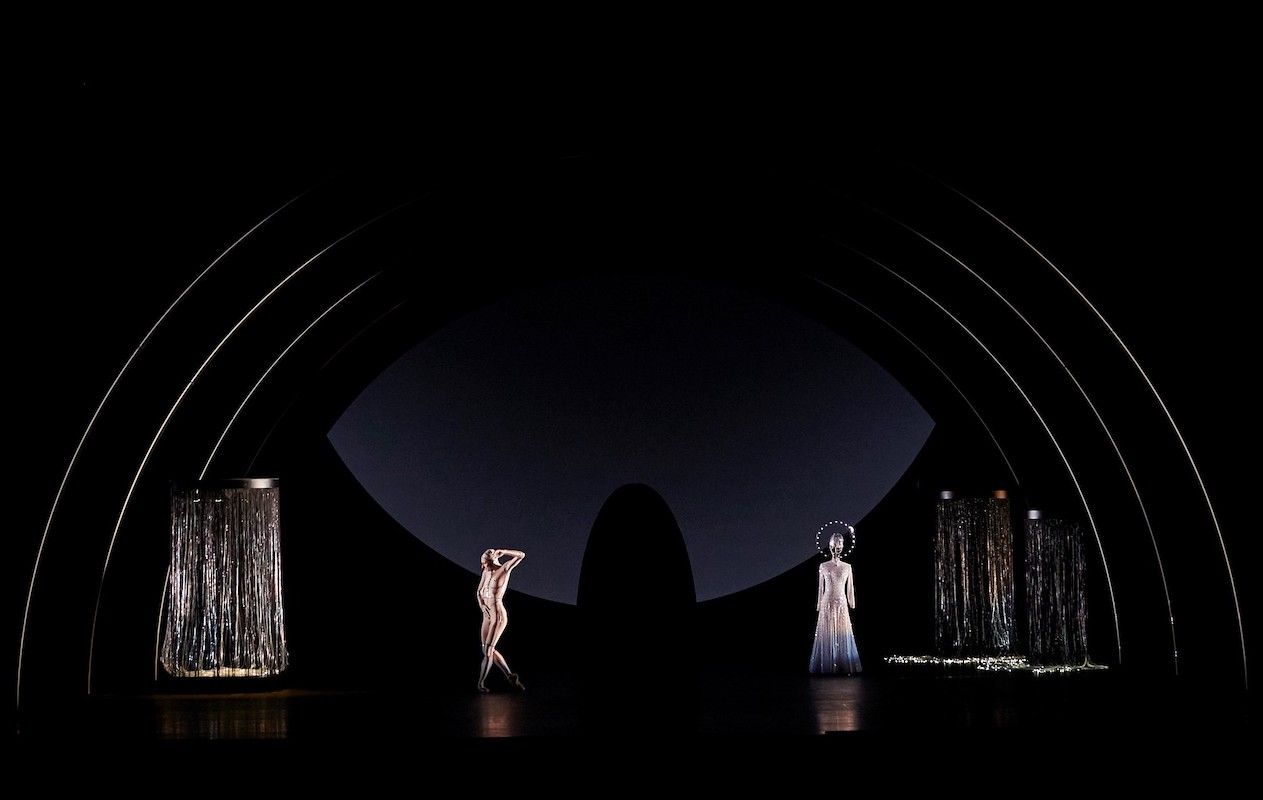
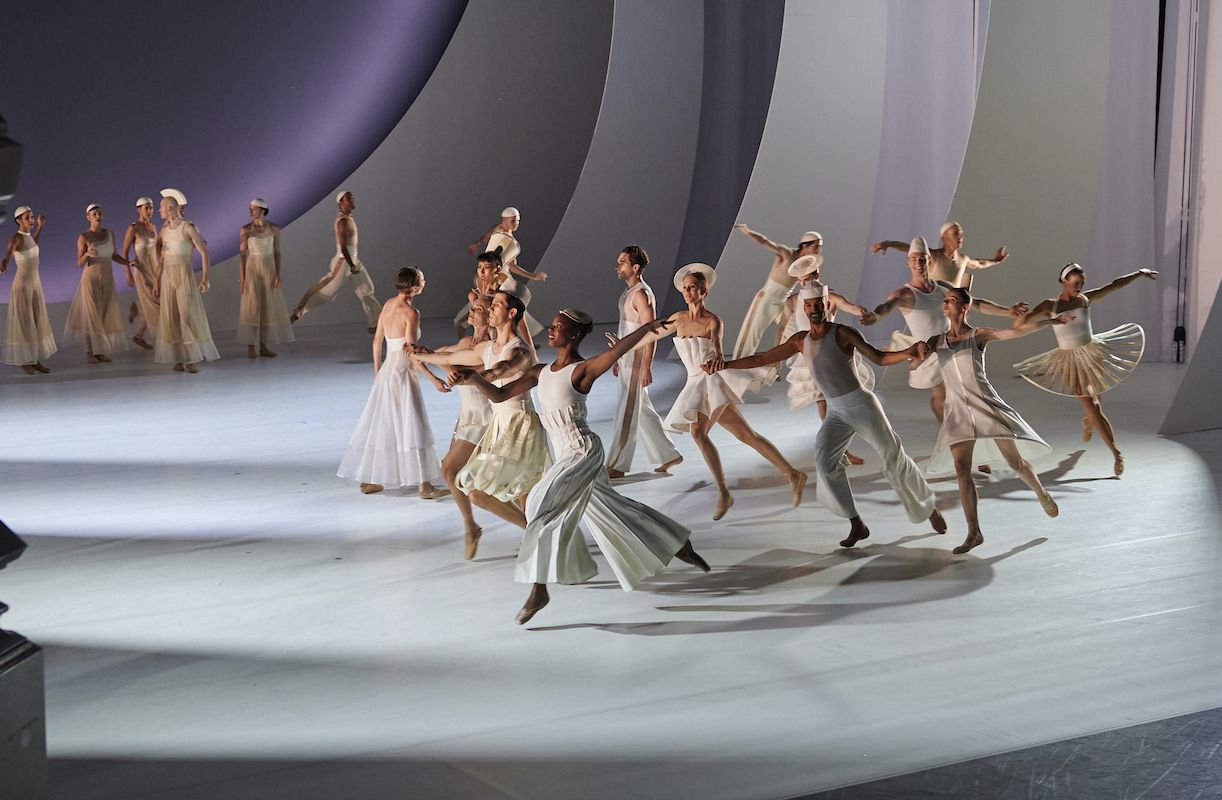
Jean-Christophe Maillot, director of Les Ballets de Monte-Carlo and creator of the adaptation at the Gran Teatre del Liceu of Coppélia ---one of the great classical works, premiered at the Paris Opera on May 25, 1870, and for which Léo Delibes composed the music---, has openly expressed his modernizing will: "Although I was really fascinated by the story of a young man who falls in love with a mechanical doll, I was a bit put off by the romanticism of the original ballet". Very well received by the public, the truth is that his proposal manages to maintain many of the codes of classical dance by modernizing the context of the action and the plot and relying on the complicity of Bertrand Maillot's music. Along with Delibes' score, industrial or dreamlike sounds are incorporated, coming from recordings featuring the glass harmonica ---or the ringing of crystal glasses with water--- and a minimalist aesthetic of great effectiveness, with an elegant play of lights and translucent or moving panels, and costumes by Aimée Moreni that denote the influence of Jean-Paul Gaultier.
The lightness presented by the classic, and in turn rediscovered in this version, departs from the dark story on which it is based ---The Sandman, published by E. T. A. Hoffmann in an even more distant 1815---. In that story, young Nathanel fell in love through a window with a superhuman beauty, who would ultimately be confirmed as maddeningly unreal. The distant contemplation, with hardly any in-person interaction, not only enables the idealization of the beloved, but will be the cause of the male protagonist's mortal anguish once he discovers ---being disemboweled by Coppelius and another inventor--- that her dreamed perfection is made of gears and springs. An exemplarily sinister figure, that of the supposed creator, whom Nathanel semi-consciously links to his father's death, in an eros-thanatos feedback that did not leave Sigmund Freud indifferent. The revelation of the radically strange or alien, that is, sinister (Unheimlich), in the realm that was believed or desired to be most intimate and familiar, dynamites all possibility of relationship, all reciprocity with a being that is not, and therefore cannot reflect one's own identity.
Nathanel's madness shifts in the ballet to the female figure of Swanilda, the protagonist's partner ---here called Frantz---, distressed at having to compete with a perfect machine, immaculate in its disjointed yet graceful movement. From the original mechanism, which is at the base of the worldview of modern thought by Galileo/Descartes, and whose reverse will be revealed by Mary Shelley's Frankenstein ---whose first edition dates from 1817---, the spirit of the Liceu's version brings us closer to the chimerical realm of the metaverse, with the dominance of algorithms that regulate the management of desire; with the promise of instant and lasting gratification, in any case available thanks to digital technology and the meta-physical articulation of 0s and 1s, in a vibration only apparently random, from which hardly anyone manages to escape. Maillot has explained that his purpose was "to revise the score to be able to reconsider this classic work of the current ballet repertoire by updating the narrative: a story of two fiancés whose love would be challenged by the appearance of artificial intelligence".
"The spirit of the Liceu's version approaches the chimerical realm of the metaverse, with the dominance of algorithms that regulate the management of desire"Audiovisual Unfoldings of AI
It doesn't take an archaeological effort to realize that the futuristic aesthetic of Coppél-i.A. ---a title that explicits the intended twist by its director--- evokes the first replicant in cinema. In Fritz Lang's Metropolis (1927), the engineer Rotwang reproduces the beatific Maria to seduce the inhabitants of the first world with her delirious sensuality. The 21st century confirms its continuation of modernity's desires: making the external world controllable, but also the instinctive-affective sphere of the individual. Still in the audiovisual realm, Blade Runner (1982) delved in that direction, by creating automatons with tasks unassumable for those who value their lives ---the uncontrolled replicants that Deckard must retire---, and which the unfortunate sequel, which explicits the zones of ambiguity of its precursor, extrapolates to eroticism with the hologram Joy: without being someone specific, with determined form and character, she spontaneously transforms into whoever the artificial intelligence that governs her understands she must be to satisfy the client.
Although that non-existence may seem trapped in its artificial nature ---the final monologue of the replicant who saves Deckard blurs the line between human and cybernetic, like the Hamletian questions posed by some of the characters in the series Westworld---, it is worth considering to what extent the one who feels satisfied by their services is not subjected, or at least in a situation of dependence. For some years now, the ambivalent reality of these beings has been raising dilemmas of various kinds. For example, to whom do the rights of works of art created by AI belong, or ---more interestingly, in the context of ballet--- if a relationship maintained with one of these creatures, programmed to provide comfort or companionship, can be considered infidelity. We can mention A.I. (2001), by Steven Spielberg, but also ---in the realm of eros--- a film like Her (2013). Spike Jonze makes credible the relationship between a personalized operating system ---named Samantha--- and the protagonist played by Joaquin Phoenix, urged to overcome the trauma of a real divorce. A relationship that will also end with the unsettling revelation that she, in her infinite desire to perfect herself, in turn establishes bonds with so many others.
That display of cybernetic polyamory will perplex his partner, who thought he was exclusive, updating the system failure or bug that 2001. A Space Odyssey already pioneered, with the pathological drift of the supposedly impeccable onboard computer, HAL. The gaze remains predominantly masculine in Coppél-I.A., but the death of the creator at the hands of his creature not only warns about that hubris that characterizes the scientist, (post)modern Prometheus, but also certifies the obsolescence of the nineteenth-century paradigm that understood the existence of women as a projection of masculine desire (Weininger), and that condemns that "you will never have me," whispered by Patricia Arquette's double (of) at the moment of consummation, at the end of Lost Highway. She will never be "her," and the intended possession of her image adopts a form of ghostly submission, which eventually plunges the one who desires into the most extreme possibility, into the reality of non-being. The path that points to the realization of desire leads voluntarily but unconsciously to a place that does not exist, as Hitchcock suggested in Vertigo, originally titled From Among the Dead.
Materialization of drives at the Liceu
Precisely because it is unrealizable, utopian, the principle of desire admits narratives and stagings open to interdisciplinarity. It can be conveyed by music and visualized by bodies in motion that seem to materialize a reality from another world or maximally immanent, affected by instinctive impulses. The Liceu's commitment to dance is by no means new. In the season culminating Coppél-i.A., under the motto Irreversible Cracks ---which points to the constitutive nature of the split between body and spirit--- the public has recently enjoyed a version of Purcell's Dido&Aeneas in which dance and music fed off each other, just as ---even more recently--- the collaboration between Sasha Waltz's company and the Liceu orchestra at the Grec achieved undeniable success, which will see a new episode next season, with the programming of dance classics such as Igor Stravinsky's The Rite of Spring. A still revolutionary work, due to the overwhelming intrusion of rhythms and sounds that awaken bewilderment, and which will coexist during 2023-24 with the ---in principle more peaceful--- Swan Lake, by the Ballet of the Teatro dell'Opera di Roma and the always imaginative A Midsummer Night's Dream, by choreographer Alexander Ekman.
"No less chimerical seems the formation of affective relationships, whose reciprocity is undermined by the proliferation of falsely accessible simulacra"Returning, to conclude, to the Ballets de Montecarlo, to say that the Coppél-i.A. by Jean-Christophe Maillot captures the audience's attention for the careful scenic deployment, but undoubtedly also for the convincing performance of the dancers, both in the solos and duets of the protagonists and in the ensemble numbers, reminiscent of the golden age of classical dance. The cybernetic creature characterized by Lou Beyne admirably comes to life, and even more interesting is the imitation of the imitation by her ---Anna Blackwell and Alessandra Tognoloni's Swanilda--- who wants to convince her beloved Frantz, so that he ---Simone Tribuna or Jérôme Tisserand--- ends up preferring her to the cybernetic creation, of an unreal beauty. The happy end may ooze imposture, from the perspective of digital reality, in which the implementation of AI and the use of filters triumph that constitute the image of who one wishes to be. Symptomatically, plastic surgeons receive in their consultations patients who want to look like the version of themselves that the use of mobile devices has accustomed them to. No less chimerical than the control of one's own image seems the formation of affective relationships, whose reciprocity is undermined by the proliferation of falsely accessible simulacra.
Add The New Barcelona Post as your preferred Google source for free
Stay informed with the latest news.
