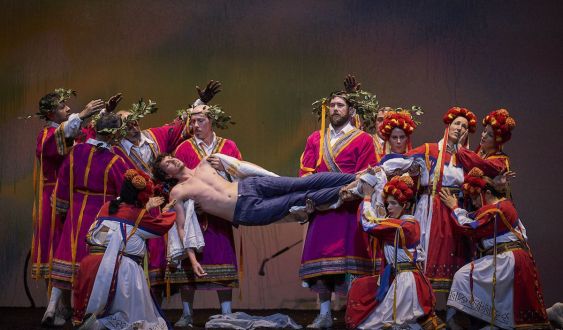
Accustomed as I am to witnessing the Requiem in churches or temples or music palaces, with no additions other than orchestra and choir and perhaps candles and crucifixes, it was a new challenge to witness it at the Liceu and with modern staging. However, Romeo Castellucci was not content with Mozart's Requiem, but rather it seemed more like a Requiem for Mozart: hence, beyond the mass for the dead, the repertoire fit in the middle the Meistermusik, the Miserere Mei, the Ne pulvis et cinis, the Solfeggio F-Dur, the Quis Te comprehendat or the O Gottes Lamm, all religious pieces by the same annoying child with the giggle, as if what was intended was an encyclopedic treatise on death.
Yes, we will become extinct: the letters projected at the back of the stage remind us of this every second, with an infinite atlas of lost things. From dinosaurs to lakes and passing through cities, towns, languages (here the heart of all Catalan public skips a beat), civilizations, architectural buildings and even reaching the Liceu itself, the Sagrada Família, Barceloneta beach, me, you, music and words themselves, everything will become extinct. What we witness movement after movement, prayer after prayer of the Requiem and with the other religious pieces interspersed, is a new ritual: Castellucci wanted to make a pagan, secular, almost heretical Requiem, focused on a folklore that is half traditional and half never-before-seen, with popular dances but with metaphorical virginal sacrifices (painting the girl's body and hanging her with her back to the audience), a kind of disruptive anthropological experiment: what would a mass for the dead be like without a mass, without Christ, without chapels or priests. The experiment is interesting, it even shakes a little to see traditional little jumps to the rhythm of the Dies Irae. And while the orchestra seemed somewhat rushed, with too little solemnity, the choir (that of the Liceu) seemed to me to excel at all times, especially given the numerous and difficult choreographies that the director imposes on them to execute while singing.
Castellucci intends to provoke, clearly, and I would say he succeeds. Sometimes it's more laughable, sometimes more poetic and transcendental: everyone is left with the impact of the floor platform that rises diagonally, exposing itself to the public, letting silence mark the fall of sand, ashes, and the dresses that the choir had previously left abandoned (yes, the choir is also required to undress). The audience's applause is directed mainly here, as well as to the resource of the baby exposed alone to life and death and the public, at the end of the work, and especially the voice of Miquel Genescà, a very young member of the Escolania de Montserrat who performs a beautiful In paradisum for us.
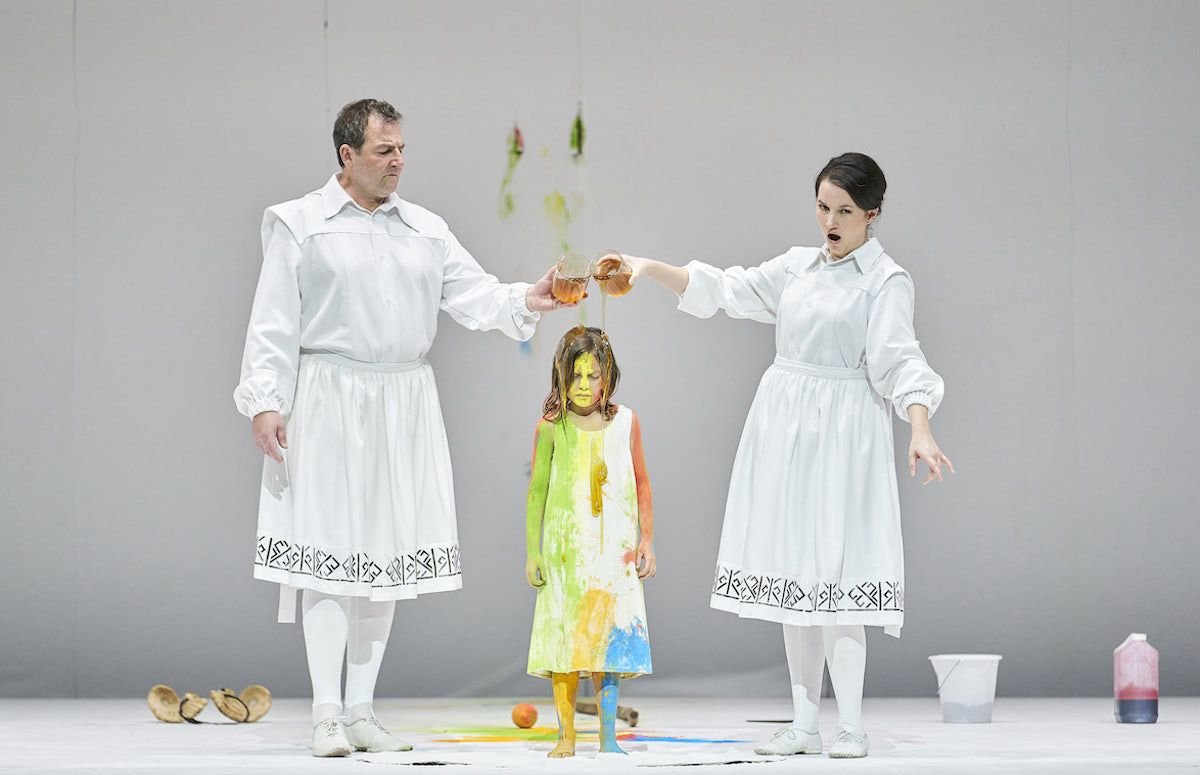
One would say that resurrection does not interest Castellucci much: he is interested in the vertigo of death, as I would say musically was what interested Mozart most, so for me, no problem. But perhaps Castellucci should be more interested in the concept of salvation, even that of transcending, of redeeming oneself, because taking so many risks (a dented car, the same girl painted and hung, the endless list of past and future extinctions) can give the impression that the only intention is to scandalize. The Liceu does well to take risks, to experiment, to fuse, to try new things. It must try not to overshadow Mozart's Requiem, which is where this work might not have a saving resurrection, but I leave with a new vision of the concert that incorporates above all a new element for me: color. Paradoxically, color. Life.
Add The New Barcelona Post as your preferred Google source for free
Stay informed with the latest news.
