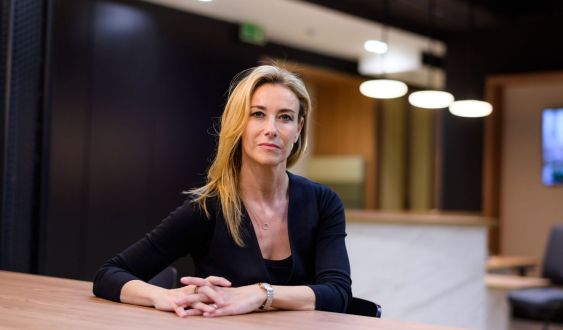
Anna Gener (Barcelona, 1974) is the CEO of the real estate consultancy Savills in Barcelona, but she combines her business activity with multiple responsibilities in entities, institutions, and associations. She is part of the Editorial Committee of El Periódico, of the Board of Directors of MC Mutual, of the Board of Directors of Pimec, she is a consulting member of the Barcelona Chamber of Commerce, a member of the International Advisory Board of the UPF Barcelona School of Management, a member of the Board of the ACG Barcelona association and a Board member in Spain of the Royal Institution of Chartered Surveyors (RICS).
She is also a trustee of the Picasso Museum Foundation of Barcelona, a trustee of the Cares Foundation and a member of the Patronage Council of the Catalunya Cultura Foundation.
--- How is Barcelona?
--- Very interesting things are happening in Barcelona. And Barcelonans, who love our city, must value them and spread the word. We must do so because the economy is a state of mind and, if we all start saying "how bad everything is," the prophecy will end up being fulfilled. Without hiding that there are negative elements, ---because we also have to say the things that can be improved---, I always try to be a loudspeaker for everything that adds up. And regarding our professional activity, which in the end is a reflection of confidence in the economic and business fabric, things are going very well in the office and logistics segments.
--- Give me data.
--- Yes; let's put data. In the volume of investment in offices in 2021, which is the year we have closed, Barcelona has been able to capture 70% of the investment of the entire Spanish State. And this is an extraordinarily meritorious situation, if we take into account that the size of the office park in Barcelona is half that of Madrid, reaching a volume of about 1,700 million euros, largely explained by the attractiveness of 22@.
--- Good news, yes.
--- And with an added point: it is an investment that remains rooted in the territory, you cannot take it away, you cannot delocalize it. It is based on confidence in the business fabric, since an office building will be occupied by companies established in the territory, which will pay rents in exchange for occupying the property. This is real economy and is absolutely linked to GDP. Barcelona is recovering from the pandemic at a good pace.
"Barcelona is recovering from the pandemic at a good pace"--- It does not seem, however, that this is the feeling of ordinary people.
--- In Barcelona, something very curious happens: we should distinguish between "how are we doing?", ---and here we have to look at the data--- and "how do we feel?". And, certainly, I agree that we are going through a situation, in general terms, of low self-esteem. It's true: there are things we can improve and opportunities we could have taken better advantage of. But I think this very depressive feeling is unfair. And, then, there is a third variable: "How do they see us?". And here I think there is a fairly large disparity between how they see us in the international world, where they still see us as an attractive city; and how they see us in the rest of Spain, where, at the moment, they have the feeling that we have declined.
--- Is comparing ourselves to Madrid a mistake?
--- It is because we are two very different cities. In a way, it's inevitable because Barcelona and Madrid are the two most relevant cities in the State. In the investment market, we do it constantly, since the main opportunities for attraction go through these two cities. We should be comparing ourselves more with Berlin or Amsterdam, which is a league of extraordinarily competitive, attractive cities with a very defined personality.
--- We used to do it more, perhaps.
--- Indeed. Our competition is much further than Madrid. That said, I believe Madrid and Barcelona should establish much smarter strategies than the ones we are currently having. And instead of looking at the French model, we should look at the German model.

--- And what is this?
--- Germany has been able to configure a country in which it has 5-6 extraordinarily attractive cities that have specialized in very specific economic industries and do not compete with each other. The pharmaceutical industry is located in Frankfurt, the automotive industry in Munich, the creative industry in Berlin, etc. And they are conveying a clear image to the world about the talent, companies, and investments they want to attract. Here, between Barcelona and Madrid, we are not quite doing things well enough for both cities to do better. This situation, although we have often sold it this way, is not a zero-sum game.
"Between Barcelona and Madrid, we are not quite doing things well enough for both cities to do better"--- A few weeks ago, Richard Florida published an article in Bloomberg explaining that previously in the U.S., if General Motors won, the United States won. And this happened in almost all major countries. Now, however, that is no longer the case, as the strategy involves competition between large metropolises.
--- Clearly it is so. Talent settles in cities and cities, beyond states, are competing with each other to attract it. It is proven that when talent settles in a territory, companies emerge, innovation emerges and, finally, opportunities for the entire society emerge. And talent has a wonderful quality: it is mobile. Therefore, it is logical that we participate in this global competition. There are cities that have it very clear and establish strategies for retaining and attracting talent and others that do not have it so clear.
"Talent settles in cities and cities, beyond states, are competing with each other to attract it"--- Where are we?
--- We are in a privileged situation because we are an extraordinarily attractive city for international talent. The latest data from the Barcelona census stated that 26% of those registered in the city were born outside of Spain, and this group has a higher level of academic studies than locals. This is extraordinarily positive for Barcelona, as it generates a series of opportunities for the entire territory.
--- You said that there are cities that know where they are going and others that don't. Where does Barcelona stand?
--- Barcelona knows quite well where it's going, but it could do things better. Specifically: at a bureaucratic level, it is still too complicated for companies to hire an international profile. All of this should be much simpler. Another: fiscally, we are not efficient compared to what other cities we are competing with offer. And another, more conceptual point: we must define what type of industries we want to attract. Companies want to know what talent they will find here. Because talent wants to be surrounded by talent. These three pillars are where we should act: improve all bureaucratic aspects, improve taxation, and define in which industries we want to excel.
"Fiscally, we are not efficient compared to what other cities we are competing with offer"--- What should Barcelona stand out for?
--- Barcelona has great potential in several sectors. One is the medical, scientific, biomedical world, etc. In this field, we are strong and should be much stronger. Another: creative industries linked to technology. Here we also have the capacity to form a very powerful ecosystem. Another aspect that is fundamental for me: the world of architecture. For the simple fact that an architect has developed their training in Barcelona, an extraordinarily architecturally rich city, it should be a first-order competitive advantage. And, a fourth: culture must be a great dynamizer of our city; a culture that is connected to the economic world, that becomes an industry and that asserts itself as an economic engine.
--- What is the culture that is linked to business? Recently we have had some controversies with private investments around culture.
--- No project should be said 'no' to any cultural project. And even less if it aims to generate jobs and create wealth. I wish there was more money willing to invest in culture. In Barcelona, we came from a few decades in which almost everything was said yes to. It welcomed any initiative that wanted to establish itself in the city. And it went quite well for us. Barcelona, now, already has a place in the world and, out of responsibility, we must be more selective. That said: neither in a city, nor in a company, nor in an association are opportunities usually presented that are perfect and without negative externalities. Never. This is impossible. This happens in the ideal world. The real world always requires a cost-benefit analysis of each opportunity and deciding accordingly. What cannot happen to us is to reject opportunities due to a priori assumptions without doing the proper economic analysis.
"Culture must be a great dynamizer of our city, a culture that is connected to the world"--- To assume negative externalities, is it fundamental, apart from the project, that there be strong leadership?
--- I have a lot of respect for people in political life. Right now, it's not an easy field at all. This is the truth. They find themselves in a situation of an extraordinarily complex world. Technological advancement means that the public world always lags behind. The challenge for the political world, right now, is immense. Because it constantly receives new disruptive initiatives that it must analyze quickly and that, moreover, do not have a regulatory framework to accommodate them. And that will happen more and more.
--- And they must respond quickly to avoid losing opportunities.
--- Very quickly, indeed. Because, as we discussed earlier, cities are competing with each other and innovation seeks where to establish itself. And there is a risk here: cities that are very rigid will lose opportunities compared to those that are fast, flexible, and more open to innovation.
--- There are also many people who, perhaps due to Olympic nostalgia, miss a collective city project.
--- Micro-projects are important because they weave neighborhoods together and have a very direct impact on people's lives. I would put two big projects on the table: one more practical and another that might be more difficult to carry out.
--- Go ahead. The first one?
--- Barcelona, before the Olympic Games, experienced a transformation situation that is rarely talked about. We all talk about the seafront, the ring roads, and the Olympic Village. Projects that were fantastic. But there is another great transformation that began with a campaign called Barcelona ponte guapa (Barcelona, make yourself beautiful) and that encouraged, in public-private collaboration, to adapt building facades, install elevators, and dignify common areas, among other proposals. It was such an extraordinary transformation that a third of all the properties in Barcelona were transformed. It had a direct impact on people's lives, but also on the perception of Barcelona in the world, since it was not only a city that, suddenly, had beaches with clean water, but also had extraordinary architecture. Barcelona is a true open-air museum. And this was a great transformation. Now it's our turn to go from Barcelona ponte guapa to Barcelona be environmentally friendly or Be sustainable or Be energy efficient.
"Now, it's time to go from Barcelona get pretty to Barcelona get sustainable"--- Let's be specific.
--- Now what we must do is a campaign for the farms of Barcelona, especially the residential ones, to transform to the new times and new needs. To make, for example, buildings more energy efficient through solar panels or through enclosures that insulate them from cold and heat. We should establish the same dynamic of public-private collaboration that was carried out. Barcelona already achieved it once and now we must do this plan again. In this sense, the Next Generation funds can be a great opportunity.
--- And the second, the most complicated?
--- A great plan to structure ourselves at a metropolitan level. From mobility to services. To structure this great Barcelona of 5 million inhabitants, which goes from Mataró to Vilanova and includes all of Vallès. And I am not talking about a centripetal effect of Barcelona but the inverse: that the opportunities that Barcelona is capable of capturing can be better distributed in a much wider territory.
--- And why this radius?
--- Well, because, thanks to mobile phones, we know that the population living in this area moves in a very high percentage practically daily in Barcelona. And urban planners, when this type of urban continuum occurs, speak of community urban centers. The problem of access to housing or mobility cannot be solved if we do not look at this broader territory. An adequate functioning of Rodalies is essential.
"The problem of housing or mobility cannot be solved if we do not look at this broader territory"--- I see you don't idealize the '92 Olympic Games.
--- It's just that I believe the wonderful memory of the Olympic Games works against us. The illusion we experienced at that moment is very difficult to repeat. The alignment of the stars that occurred was almost a miracle. This is like someone who has had a movie-like romance and then, as is usual, has had more normal relationships. Happiness may be more stable, more normal, and give you a more stable life. Now we should focus more on a city that offers opportunities and has quality of life. It's surely less exciting. I know. But this leads us to have a much more socially cohesive society with many more possibilities for progress. And, in the end, a successful city is this.
Add The New Barcelona Post as your preferred Google source for free
Stay informed with the latest news.