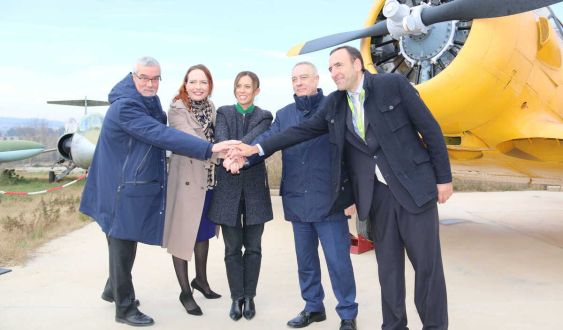
Celestia Aerospace has announced that it will create in Sabadell the first facility in all of Europe that will manufacture and send nanosatellites into space from airplanes instead of using rockets. This is an initiative that will involve an investment of 100 million euros and also involves the Lleida-Alguaire Airport, from where the airplanes that will put the nanosatellites into orbit will take off.
According to Celestia, this system allows reducing the deadlines for launching the devices, since currently, with rockets, one has to wait an average of two years. "Access to low orbit ceases to be a merely research space, to become a space for commercial use. Low orbit is the new America," highlighted the president and CEO of Celestia, Glòria Garcia-Cuadrado.
To finance this investment, the Catalan company closed a few months ago a financing round of 100 million euros that was subscribed by the British group Invema, which has seen strong future potential in the business of solutions for the development, orbiting, and operation of nanosatellites.
Celestia will be located on a 10,000 square meter plot that has been acquired by the Consorcio de la Zona Franca de Barcelona (CZFB), in the Sant Pau de Riu-sec industrial park, which is next to the Sabadell airport. This land, which until now was owned by the Sabadell City Council, has a building of up to 6,700 m² and in the next three years, the facility where Celestia Aerospace will be installed will be built. The initiative will give a strong boost to the Aeronautical Innovation Hub, promoted by the Sabadell City Council, Aena, the Universitat Politècnica de Catalunya (UPC), and the CZFB.
Celestia's nanosatellite center in Sabadell will have a production capacity of up to 100 units per year and will initially employ a team of 40 scientists, engineers, and technicians. The objective is to expand the activity in a scalable way, with a five-year expansion plan that will include the hiring of up to 350 people.
"From Sabadell, we will carry out all design, manufacturing, and data monitoring operations obtained with the launch, from a control and mission monitoring room," explains Glòria Garcia-Cuadrado. The final operations of fuel loading and nanosatellite launch will be carried out from the company's headquarters in Lleida-Alguaire.
The great novelty that Celestia presents is that it dispenses with rockets to put nanosatellites into orbit. "We do it from a demilitarized fighter jet that flies up to 20 kilometers high, releases the launch rocket that puts the nanosatellites into orbit and then lands back at the airport," adds the company's head, reports ACN. The entire process is carried out over the sea, with the aircraft taking off from Lleida-Alguaire Airport and transporting the artifacts created in Sabadell.
"For the CZFB, being able to support the impulse of the Aeronautical Innovation Hub is a key commitment for the territory, for the generation of economic activity, the attraction of investment and the development of specialized talent. We want to connect the entrepreneurial fabric and talent with the aim of developing a solid industry 4.0," added Pere Navarro, special delegate of the State in the CZFB.
Add The New Barcelona Post as your preferred Google source for free
Stay informed with the latest news.
