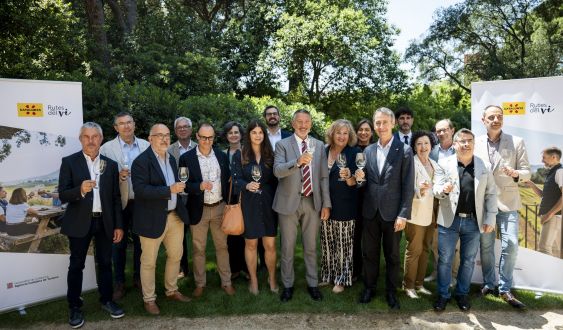
Catalunya takes another step in its commitment to wine tourism. The Government, through the Catalan Tourism Agency (ACT), has promoted the creation of the Catalonia Wine Routes Network, an initiative that for the first time brings together the nine active wine tourism routes in the territory with the aim of strengthening their promotion, improving coordination among sector agents, and consolidating Catalonia as a reference destination in this field.
The new network is born at a time of growth for wine tourism in the territory. According to data from the wine routes, Catalonia annually receives nearly 700,000 visitors to wineries and generates a direct economic impact of 46 million euros, including wine tourism activities and direct wine sales. The initiative currently brings together 244 wineries and a total of 633 companies linked to the sector, including accommodations, restaurants, wine shops, and guided tour companies.
The project was presented this Monday in Barcelona at an event presided over by the Minister of Business and Labor, Miquel Sàmper, who defended the need to jointly explain Catalonia's wine wealth. "Catalonia is today a wine tourism powerhouse, with a high-quality offer that attracts hundreds of thousands of visitors every year," he assured.
Wine tourism has become one of the main ways to discover the Catalan territory beyond its main urban centers. Catalonia has eleven wine designations of origin, including DOQ Priorat, the only designation of maximum qualification in the State along with Rioja, and is one of the country's main producers of quality wine.
From the sparkling wines of Penedès, cradle of cava, to the mountain wines of Priorat, passing through the Mediterranean vineyards of Empordà, the wine routes have become a gateway to landscapes, gastronomy, and cultural heritage that are increasingly attracting visitors. The new network will be made up of the wine routes of Alella, Empordà, Lleida, Penedès, Pla de Bages, Priorat-Montsant, Tarragona, Terra Alta, and Conca de Barberà, the latter focused on the indigenous trepat variety.
The roadmap for the new network is structured around four main areas: networking, product structuring, joint promotion, and shared data management. Regarding the tourism offer, one of the novelties will be the creation of a quality manual that will establish common criteria for all members of the routes. The objective is to guarantee a homogeneous experience and reinforce complementarity with other tourism products such as gastronomy, culture, or outdoor activities.

The network also launches a new visual identity and a digital guide that includes the main attractions of each of the nine routes. In addition, joint promotional actions will be launched in the main source markets and familiarization trips with specialized international operators. According to the president of the Alt Penedès Regional Council, Xavier Lluch, the initiative will allow "to work cooperatively, sharing strategy and promotion projects that position wine tourism in the world."
Technology to anticipate trends
One of the most innovative aspects of the project is the creation of a common data platform developed by Eurecat. The system, called Tourism Data System (TDS) Winetour, will allow collecting and analyzing information in a centralized manner to better understand visitor behavior and anticipate market trends.
The initiative is part of a broader strategy to professionalize a sector that has gained weight in recent years. According to the most recent data from the Wine Routes of Spain, wine tourism exceeded 2.9 million visitors in 2023 at the state level and continues to consolidate itself as one of the tourism modalities with the greatest capacity to generate economic activity in rural areas.
The philosophy of the new network goes beyond a simple visit to a winery. The project advocates wine tourism as an experience that combines wine, landscape, heritage, gastronomy, and local identity. This is the philosophy around which the new network is articulated. With this alliance, Catalonia aspires to strengthen its position within the European wine tourism map and to make wine one of the great gateways to discover the territory 365 days a year.
Add The New Barcelona Post as your preferred Google source for free
Stay informed with the latest news.