Tomás Cusiné is a restless person. The owner of the Castell del Remei, Cérvoles, Tomàs Cusiné and Cara Nord wineries overflows with passion for the world of wine and is constantly looking for new opportunities to grow his business group and offer consumers alternatives that adapt to different consumption moments. Now he has ventured, and done so very successfully, into the field of sweet wines made from raisined grapes.
He has just launched a nectar extracted from the fruits of a late harvest of a very uncommon grape variety in Catalonia, the petit manseng, of which he has one hectare planted and which until now he used to give acidity to other wines. According to Cusiné, this sweet wine is the result of the continuous innovation process carried out by the enology team of the Lleida winery, which every year commits to different research projects. "Castell del Remei in the past had already produced rancid wines and muscatel; now we recover this tradition with a type of sweet wine that we really wanted and that allows us to enhance the brand," explains the wine entrepreneur.
The Vi Dolç de Verema Tardana Castell del Remei comes from an overripe grape that was hand-harvested at the end of October 2019 and then left to raisin on a bed of reeds for 70 days, in a shed in La Pobla de Cérvoles with good ventilation. This drying process reduces the volume of the grapes to a minimum, which once pressed offer a yield of only 30%, with a high concentration of sugars and a powerful complexity in aromas. This low yield is a typical characteristic of this type of wines, which have as a great example of international fame the Sauternes wines ---within the French region of Bordeaux---, led by the very famous Château d'Yquem.
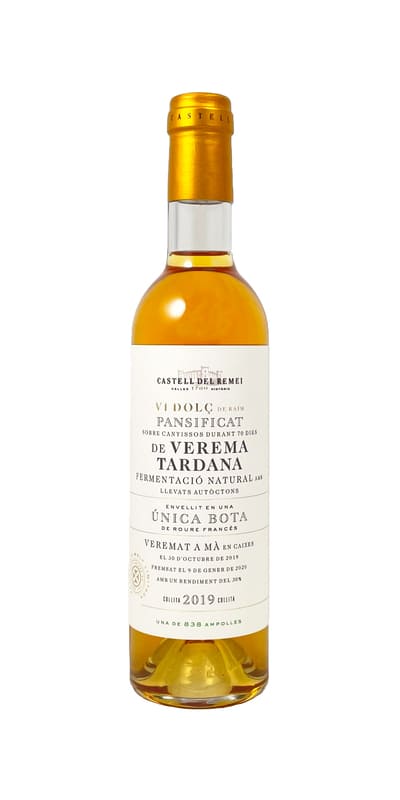
"We dried 1,200 kilos of grapes and, with the help of a vertical press, we obtained just over 300 liters of a very thick nectar that we subjected to a natural fermentation process with indigenous yeasts for almost a year," highlights Cusiné. This first sweet wine from Castell del Remei has been aged in a single French oak barrel and presents a dense and bright amber yellow color, with an alcohol content of 10.5% and a concentration of 250 grams of sugar per liter. This is a very limited first edition, since only 838 bottles of 37.5 cl could be filled, which have now just been released to the market at a price of 43 euros. This sweet wine is not covered by any designation of origin.
Castell del Remei is one of the oldest wineries in Catalonia and the second largest producer in the Costers del Segre designation of origin, after Raimat. The company is the producer of the wine Gotim Bru, a commercial success, with an annual production of 400,000 bottles. The winery also produces the wines Gotim Blanc, ODA Negre and ODA Blanc, and Castell del Remei 1780.
These five wines are the result of the blending of different indigenous and foreign varieties, but now the historic winery has expanded its range with the production of its first single-varietal red Grenache wine, from the 2020 harvest. It is a wine made with grapes from a single estate, called Alts del Castell, of 5 hectares, organic and located at 717 meters of altitude. As a characteristic, it stands out for having been partially fermented with stems and in a 4,500-liter wooden vat.
Castell del Remei produces a total of 800,000 bottles annually, a figure that grows to 1.1 million bottles if the other wineries owned by Cusiné are added: Cérvoles (Costers del Segre), Tomàs Cusiné (Costers del Segre) and Cara Nord (Conca de Barberà). The group exports 40% of its production, to more than 40 countries and has 15 hectares of vineyard on the Castell del Remei estate ---located between Tàrrega and Balaguer, in the Noguera region--- and 85 hectares planted at altitude, in the Les Garrigues region.
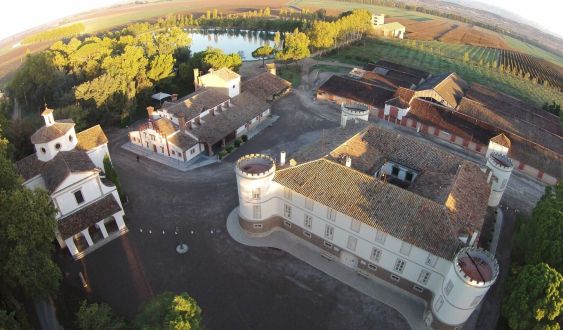
Before the pandemic, Castell del Remei received 60,000 visitors each year, attracted by the spectacular nature of the historic agricultural colony, founded by the Girona family ---promoters of the Urgell Canal--- and which features a castle with 2,800 square meters of habitable space, a church, a lake, a 6,000 square meter winery, and a large shop. To boost wine tourism and preserve all that historical heritage, Tomàs Cusiné has made investments of three million euros in the last six years.
Add The New Barcelona Post as your preferred Google source for free
Stay informed with the latest news.
