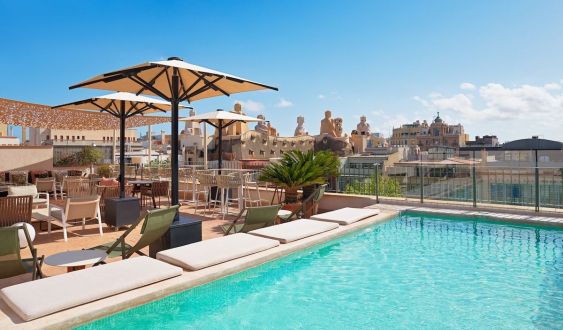
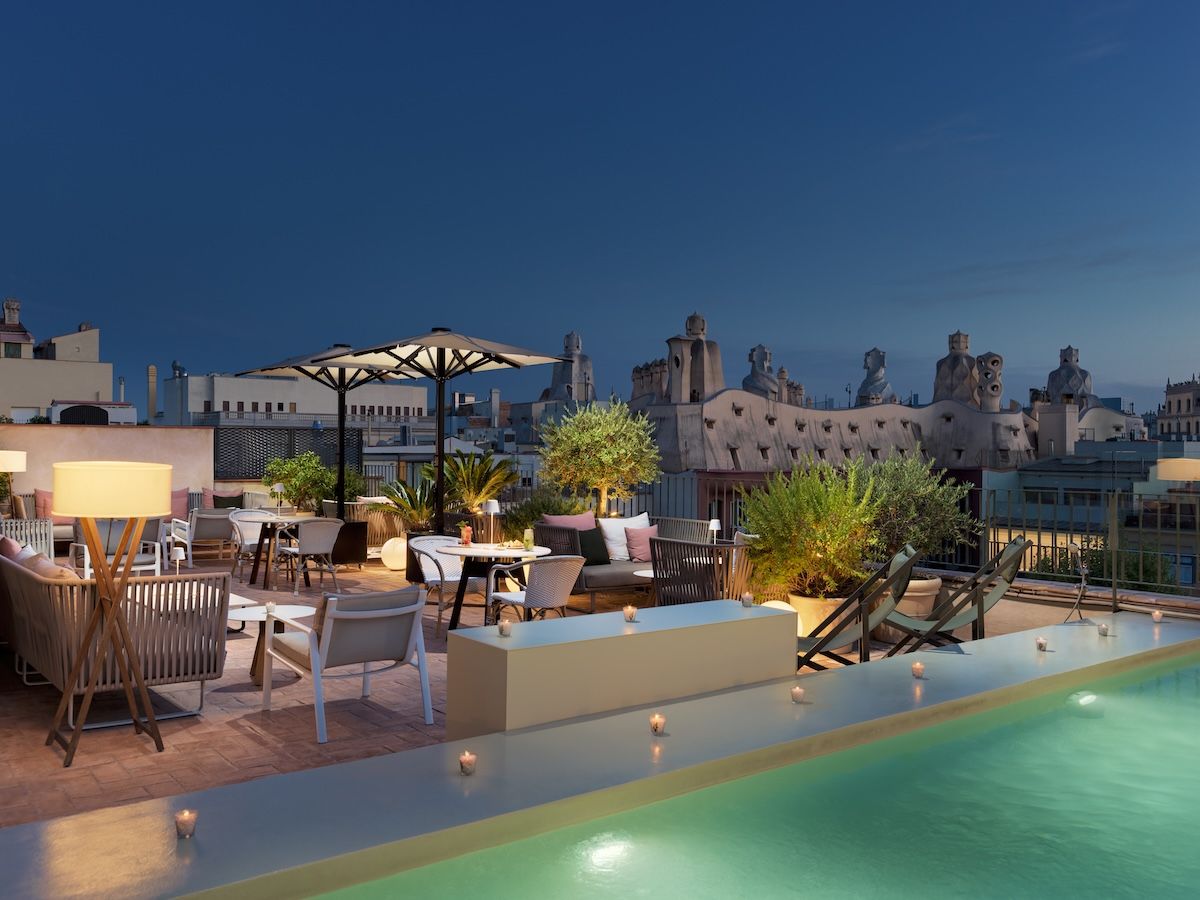
There is a terrace at Pau Claris 179 from which La Pedrera can be seen as almost no one else sees it. It is not the undulating facade that everyone photographs from Passeig de Gràcia, but its rear part: the same concave-convex rhythm, the same trencadís warriors at eye level, though from a different perspective.
The most curious thing is that the building from which this view is contemplated was designed by the man who made Gaudí himself possible. The master and the disciple, together on the same block and separated by decades, look at each other from here. That is the H10 Casa Mimosa. And it is also chapter 17 of Hotels with History, the series we publish every fortnight in The New Barcelona Post.
To understand the house, one must start in Igualada, capital of Anoia, and one must start with sacks. The Godó family was, above all, a family of textile industrialists. Carlos and Bartolomé Godó Pié arrived in Barcelona around 1860, and opted for the trade of jute fabrics, a fiber almost unknown then in the Catalan industry. They founded Godó Hermanos y Compañía, built factories in Sant Martí de Provençals and Santa Eulàlia, and turned a risky bet into a splendid business: they manufactured the sacks with which a large part of the country's agricultural and industrial production was moved.
With the money from jute and the political capital accumulated in Sagasta's Liberal Party, in 1881 they took the step that would forever change the family name: they founded La Vanguardia. What began as an organ of political struggle would end up being the reference newspaper in Catalonia.
The Eixample was then the place where the industrial bourgeoisie displayed its success. Modernist architecture served as the language of power. In 1892, Carlos Godó Pié commissioned the construction of a residence at number 179 Pau Claris and, for the project, chose Joan Martorell i Montells, the most influential and respected architect in Barcelona at that time. The choice spoke as much of good taste as of connections: Martorell was the undisputed master of an entire generation.
Here appears the red thread that is the common denominator of our series. Martorell not only designed the house that is today a hotel: he was the one who, in 1883, recommended Gaudí to take charge of the works of the Sagrada Família when the original architect retired. Martorell himself had declined the commission before proposing his most advanced disciple. It was also he who, that same year, introduced Gaudí to the industrialist Eusebi Güell, the patron who would finance his most ambitious works. Without Martorell, the Barcelona we know today would simply be different.
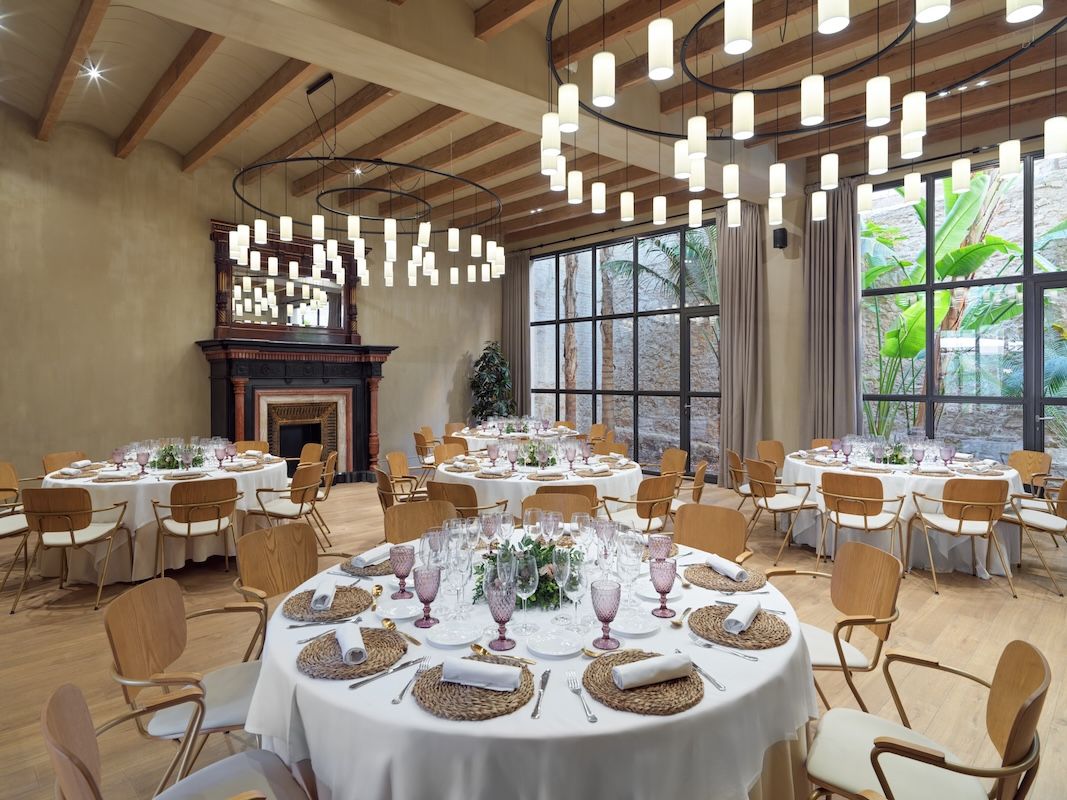
A necessary note about the Palau Robert on Passeig de Gràcia, today home to institutions of the Generalitat: the building was designed by the French architect Henri Grandpierre and built under Martorell's direction between 1898 and 1903. The two properties thus share the same hand. And they share a revealing detail: the interior coach houses that Martorell executed in both are practically identical. Those of the Palau Robert are today an exhibition hall. Those of Pau Claris 179 are the Les Cotxeres meeting room of Casa Mimosa.
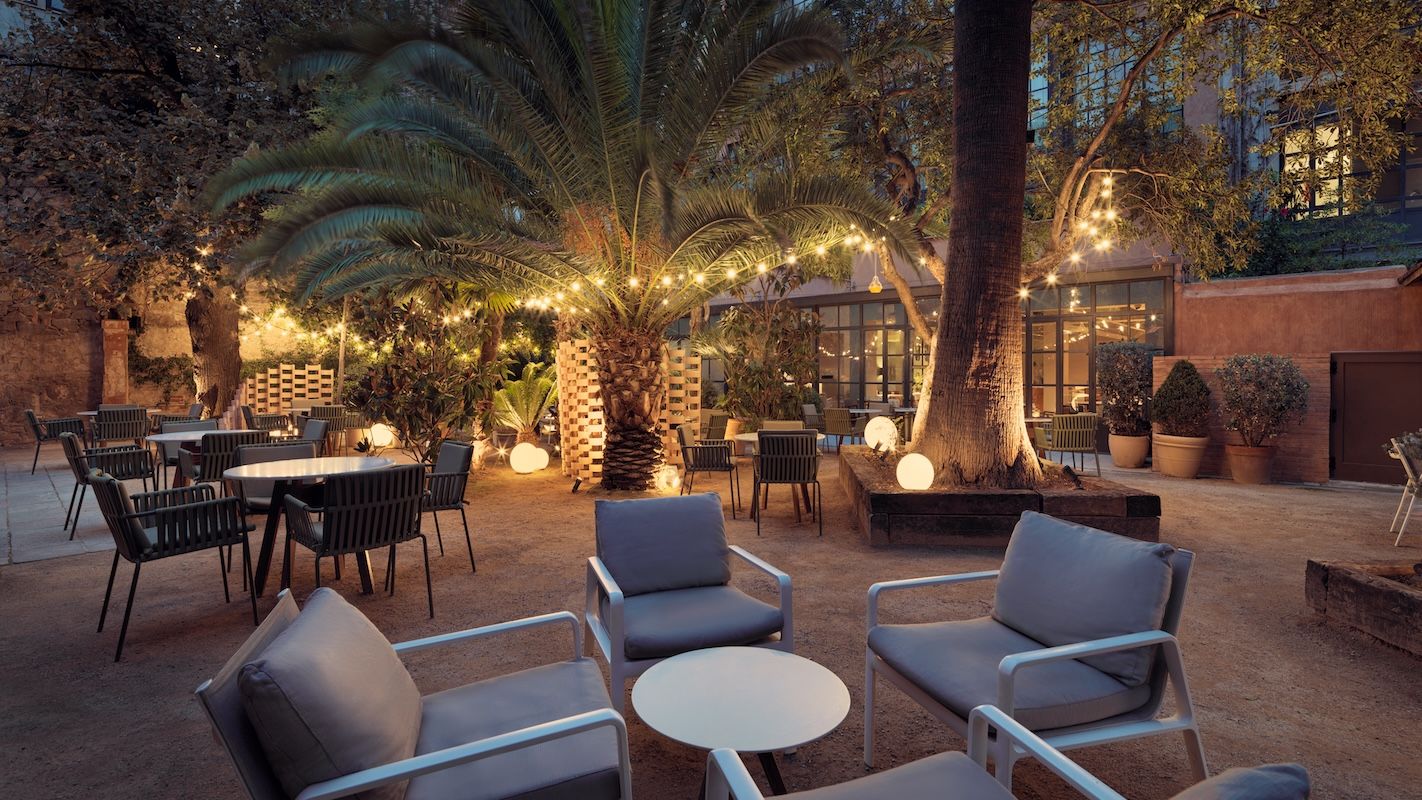
What Martorell built in 1892 was exceptional for its time: a sober modernist facade and, inside the block, an exuberant secret. A lush garden with winding paths, a large magnolia, a centenary linden tree, and a washingtonia palm tree that remains one of the protagonists of the interior patio. It was in that building that the Godó family lived during their years of greatest splendor.
Ramón Godó Lallana, Carlos's son, was the one who turned La Vanguardia into the reference newspaper of modern Barcelona. Not as a director, a role held by writers of the stature of Modesto Sánchez Ortiz or Miquel dels Sants Oliver, but as a visionary editor who understood that a newspaper was not a party pamphlet, but a mirror of a thriving city.
Those who knew him described Ramon as a man with considerable physical difficulties: lame, almost deaf, and with one eye practically lost. However, he was endowed with financial intelligence and a determination that did not need good health to assert itself. He was a deputy for Igualada in four elections and, in 1916, Alfonso XIII granted him the title of Count of Godó. 179 Pau Claris was, in those years, the address of one of the most influential figures in the city.
Decades later, already unoccupied as a residence and fragmented into various uses, the property went up for sale. The tenants' contracts expired in December 2014, and its possible conversion into a hotel was almost an open secret. There was a moment when the garden was in danger (only the facade of the building was protected). It didn't happen. When H10 Hotels bought the property and commissioned the renovation to the Tarruella Trenchs studio, preserving that green lung was an implicit condition.
Before starting the works, the studio commissioned photographer Emilio Lecuona to do an exhaustive report on the building: the lobby with its coffered ceilings, the garden with the light of another era, the coach houses with their large slabs. These black and white images are today the graphic work that covers the walls of the hotel. A form of memory that no one explicitly formulated but that was, from the beginning, in the spirit of the project.
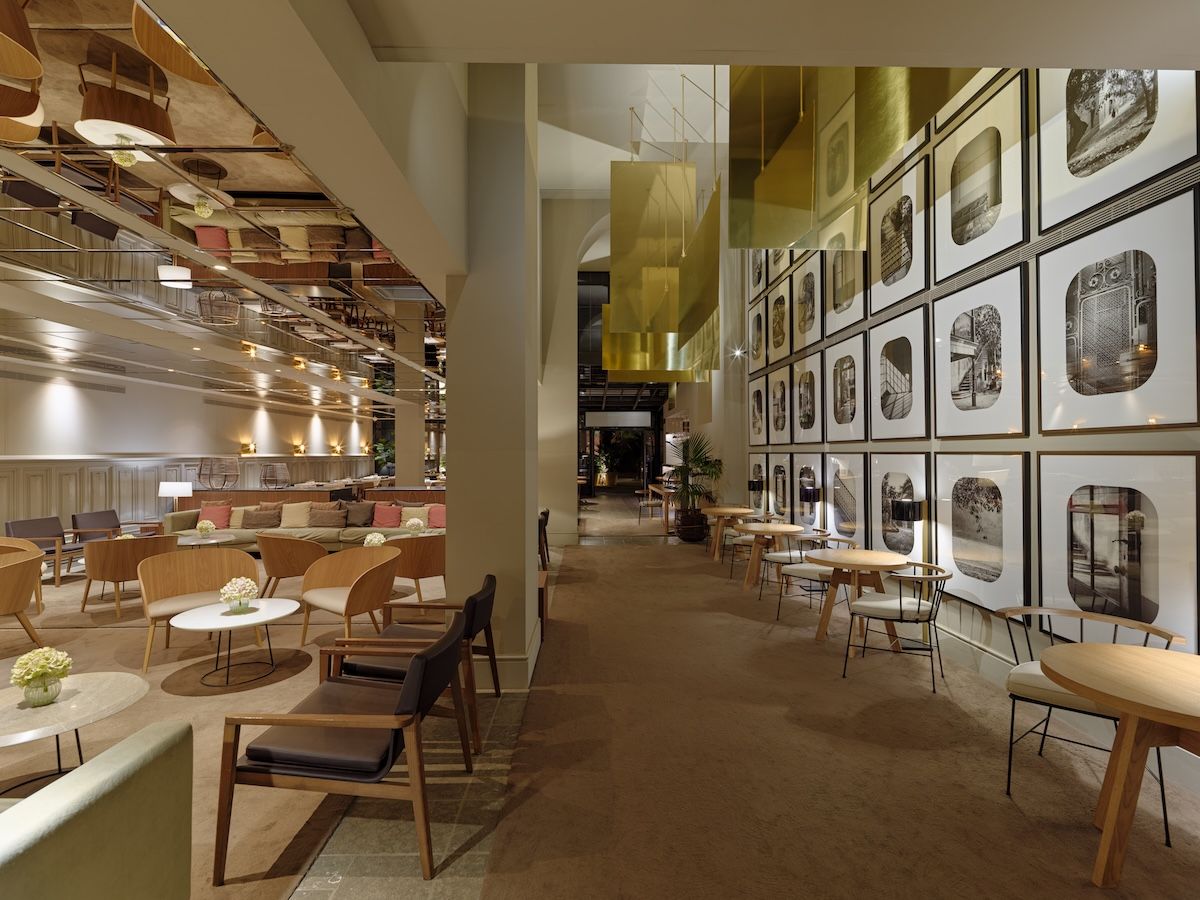
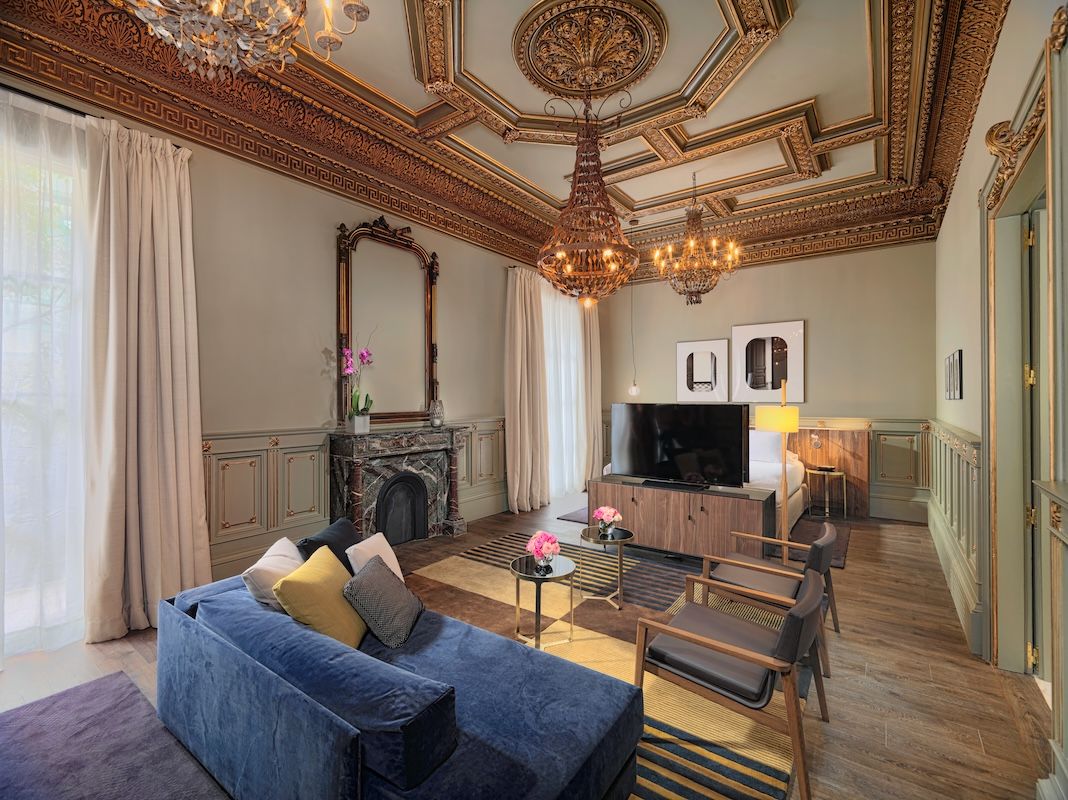
The H10 Casa Mimosa opened in 2016. Forty-eight rooms, all exterior. The Condal Suite preserves the original modernist fireplace and the coffered ceiling. Those on the first two floors maintain the period ceilings. The rest is contemporary sobriety: matte brass, natural light, and yes, also photographs by Lecuona.
H10 is also, in its own way, a Catalan family saga founded in 1969, in Salou by Josep Espelt Civit, today with his children in the highest responsibilities. Casa Mimosa was their thirteenth hotel in Barcelona when it opened. A city, a street, two business families separated by more than a hundred years. The Godós came from jute and built a newspaper. The Espelts came from tourism and built a hotel chain. Each in their own way, each in their own time.
Above, from the terrace named El Cel de Gaudí, the master's chimneys within reach. The architect who built this house was the same one who took him to the Güells and put him in charge of the Sagrada Família. From here, that doesn't seem like a coincidence. It seems like a pending thank you between two men who never stopped looking at each other from opposite sides of the same block.
Add The New Barcelona Post as your preferred Google source for free
Stay informed with the latest news.