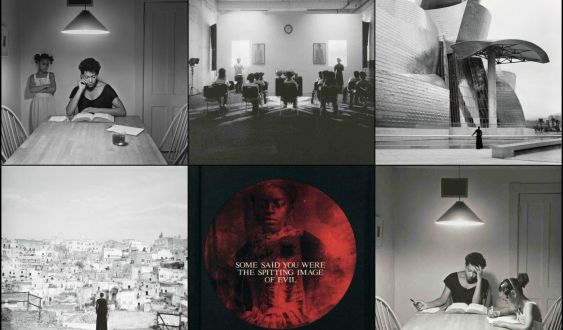
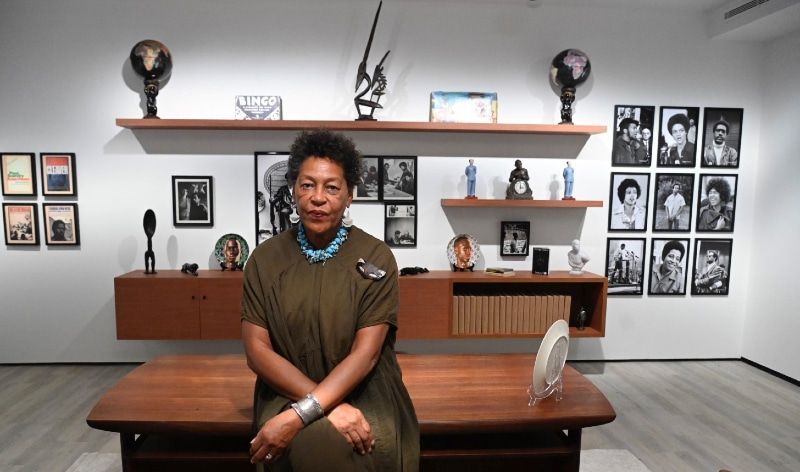
We could start by saying that Carrie Mae Weems is the great photographer of Blackness. "I'm determined to find new models to live by, and you?" With this declaration of intent, we delve into the work of a woman who has always tried to recover and reconstruct those Black references overshadowed by the dominant white culture, as a photographer, woman, Black.
Considered one of the most influential contemporary American artists, her works have focused on investigating family relationships, cultural identity, sexism, class, political systems, and the consequences of power, themes she has approached from a narrative rather than a documentary perspective.
Now, thanks to Elvira Dyangani Ose, the current director of Macba who already curated her back in 2010 in Seville, a comprehensive retrospective exhibition featuring 20 series titled Carrie Mae Weems. A Great Turn of the Possible, arrives at the KBr Photography Center of Fundación Mapfre and Foto Colectania until January 15, in addition to the installation Lincoln, Lonnie, and Me (2012) by the same artist, which can be seen at the Macba Chapel as part of the exhibition.
"I'm determined to find new models to live by, and you?"Born in 1953 in Portland, Oregon, she studied Art at the California Institute of the Arts in Los Angeles, but her true vocation as a photographer was not revealed until her participation in 1978 in the The Black Photography Annual, a book of images made by African-American photographers and in which she worked as an assistant to Anthony Barboza, one of the pioneers of commercial photography inspired by African-American thought.
Determined to always enter the scene ---both literally and metaphorically---, Weems has maintained a continuous dialogue within contemporary discourse for over thirty years, which has allowed her to develop a complex body of work in which she employs photographs, texts, fabrics, audio, digital images, installations, and videos. Weems's artistic practice transcends the particular and reflects on a complex past that projects with hope into the future and connects different generations.
Thus, her work traces a red thread that, over several centuries, connects the transatlantic slave trade, as a place of origin, with 20th-century African-American political activism and current struggles against structural and systemic racial violence.
There is no series or installation that can leave the viewer indifferent ---not even the wallpaper---, because in each of them there is a deep reflection on one's own identity and that of others, on what is close to us and what occupies the space of the other. That other who is black in a world of whites, seen precisely from the perspective of that so-called other.
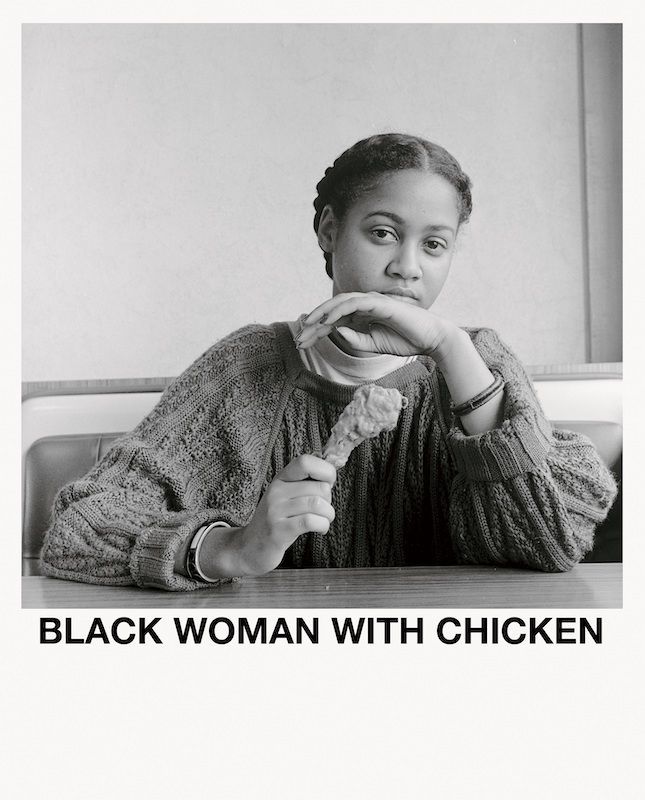
Already in the more familiar series such as Family Pictures and Stories (1978-1984), she tries to offer a new point of view of everyday life, of that personal identity of hers and of the African-American community, which becomes a denunciation in the more intimate series, such as Not Manet's Type (2010), where she manifests how art history, once again, has left aside black creators and specifically women, based on a sequence of images, where we see Weems's own body in her bedroom, accompanied by sharp phrases that refer to artists like Picasso or Duchamp.
Weems's artistic practice transcends the particular and reflects on a complex past that projects with hope into the future and connects different generationsIt is worth highlighting what is perhaps the most moving of all the series presented in this retrospective,From Here I Saw What Happened And I Cried(1995-1996), her most in-depth investigation into racism. In it, based on a selection of red and blue-tinted daguerreotypes from 1850—portraits of African slaves commissioned by a Harvard scientist, Louis Agassiz, whose goal was to prove that Black people were an inferior race—Weems pays homage to the men and women who lost their lives under the yoke of slavery, valuing those images that she dresses with phrases like "you became a whisper, a symbol of a mighty voyage & by the sweat of your brow you laboured for Self, Family & Other".
Carrie Mae Weems is the photographer of the black muse. A female character, a spectral presence that almost always appears from behind, and acts as a demiurge of a specific scene. Although in some series she dresses in white, as is the case in Dreaming in Cuba (2001), in most, black is the color that dresses her and emphasizes her in an environment that diminishes her. We see her in Museums (2006) and also in Roaming (2006) where she tells us about the insignificance of the human being before those buildings that also symbolize some power: "This woman can stand for me and for you; she leads you into history. She is a witness and a guide."
As the curator, Elvira Dyangani Ose, says, throughout her career, Carrie Mae Weems has been interrogating history and questioning the visibility or invisibility of those who have contributed to its construction, trying to subvert, reconfigure, and influence the dominant discourse. And this is palpable in The Kitchen Table Series (1990), a narrative project in which we see how a black woman empowers herself, and we participate in the encounter with herself, through a performative action by Weems herself staged around a kitchen table. And so, as a new narrator in a great turn of the possible, as an anonymous character, a black muse present and absent, she reconfigures the idea of photographer, woman, black.
Carrie Mae Weems has been interrogating history and has questioned the visibility or invisibility of those who have contributed to its construction, trying to subvert, reconfigure, and influence the dominant discourseWe leave out the colorful and optimisticColored People(1980/90-2019); or the work he did with his students from the Savannah College of Art and Design inConstructing History: A Requiem to Mark the Moment(2008); or the irony ofAnd 22 Million Very Tired and Very Angry People(1989-1990), because we don't want to stop inviting you to take an immersive stroll through the work of this powerful photographer.
An essential retrospective for photography lovers that can be seen until the beginning of next year in the city.
Add The New Barcelona Post as your preferred Google source for free
Stay informed with the latest news.
