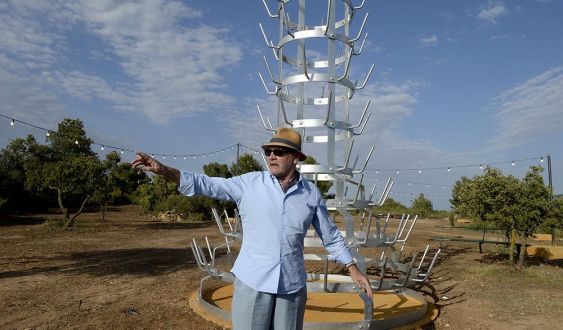
Duchamp's Egouttoir, filtered through the artist Carlos Pazos, now watches over the vineyards and olive trees of the Mas Blanch i Jové winery. This is the ninth sculptural piece that can be seen in what is known as the "Vineyard of Artists" of En Mas Blanch i Jové, where large-scale sculptures and installations can be found, created by artists such as Carles Santos, Guinovart, Joan Brossa, Susana Solano, Evru (Zush) or Frederic Amat, among others. These unique pieces coexist freely among vines and olive trees and with the tasks and tools typical of field work. The winery, which has a spectacular barrel room decorated with Gregorio Iglesias' mural painting, is the culmination of this particular artistic itinerary, the last stage of a journey that becomes an experience for any visitor. The latest addition to this walk is the work of Carlos Pazos, a modern dandy born in Barcelona in 1949 who lives much of the year in Paris, considering that "art there has a social role and the public values artists in their proper measure, quite the opposite of Spain." Even so, Pazos, an expert in swimming against the current, has also been recognized at home. His resume includes the National Plastic Arts Award, the most prestigious Spanish award, which he received in 2004 for an artistic career as fascinating as it is personal. Now he has brought his Egouttoir to La Pobla de Cérvoles and we talk to him, tasting one of the excellent wines born from these vineyards. It is a beautiful wine-growing redoubt located where Les Garrigues, Conca de Barberà and Priorat meet, which has opted since its beginnings for the fusion of art and wine in the midst of an idyllic rural landscape. This project was born from an idea of the painter based in Agramunt, Josep Guinovart, which a local family made a reality in this place in Les Garrigues more than 10 years ago.
In Mas Blanch i Jové there are sculptures and installations of large proportions, created by artists such as Carles Santos, Guinovart, Joan Brossa, Susana Solano, Evru (Zush) or Frederic Amat, among others. These unique pieces coexist freely among vines and olive trees and with the tasks and tools typical of field work. The winery, which has a spectacular barrel room decorated with Gregorio Iglesias' mural painting, is the culmination of this particular artistic itinerary, the last stage of a journey that becomes an experience for any visitor. The latest addition to this walk is the work of Carlos Pazos, a modern dandy born in Barcelona in 1949 who lives much of the year in Paris, considering that "art there has a social role, and the public values artists in their proper measure, quite the opposite of Spain." Even so, Pazos, an expert in swimming against the current, has also been recognized at home. His resume includes the National Plastic Arts Award, the most prestigious Spanish award, which he received in 2004 for an artistic career as fascinating as it is personal. Now he has brought his Egouttoir to La Pobla de Cérvoles and we talk with him, tasting one of the excellent wines born from these vineyards.
What does it mean for an artist like you, who has exhibited in the best galleries, to have a work in such a special open-air space as this? Well, it's an honor. I created another work for an open space, but it ended up inside the Antonio Pérez Foundation in Cuenca. Therefore, this No et prometo res—I promise you nothing—is my first outdoor work. I make more intimate pieces, more for being collected and semi-dark, and here it's the opposite, but I'm very satisfied. Due to my depressive nature, I'm more of an indoor person and prefer to be in the dark, but colors harmonize in a certain way. In the Pantone of mood nuances, you can find that light or gray suits you better. I'm a gray person.
How did you prepare the work "No te prometo nada" (I Promise You Nothing)? I took it as a challenge, but what I didn't want was to make an extension of an indoor piece outdoors. I liked the place I chose to locate it because it was the place that made a connection between La Pobla and the vineyard. It's the belvedere of the vineyards, where you look to be looked at. From there I began to refine the initial idea, making it easier to read and with more refined connotations, and that's what we achieved.
"No te prometo nada". Why? A wine, if it could speak inside the bottle, would say "I promise you nothing" because you would have to open the bottle and... see what happens. An artist has to do the same, they must do it as best they know how, and then the spectator or the public are the ones who will say whether this work works or not. For me, it is an object that I return to its function: it is an object that served to dry wine bottles. Nowadays, with the cultural information we have, everyone relates this piece to Marcel Duchamp, but in reality, it is an egouttoir that returns to its origins among the vineyards.
You understand culture as an accumulation. Is that why you dedicate yourself to collecting objects and use the collage technique? I think that collecting has a value of evocation and in my case, it comes from family. In reality, I consider myself more of an accumulator of objects, since I buy everything I like and use it for my work. In the case of "No te prometo nada" I have transferred the collages I would do indoors to the outdoors and I have done it in situ. I have placed the neon sign hanging from the rocks, we have found a cave where I have made an installation that I call The Chapel of Junk, and so I ended up making a collage within the landscape. I have to do more than one thing because austerity is not my strong suit.
Your work has sometimes been labeled as kitsch and even Pop Art. Well, I start from Pop Art, but more English and not so much American. I feel closer to a Richard Hamilton than to an Andy Warhol. Notice that the former has a more direct link with Duchamp and I feel very close. Hamilton was a great intellectual and Warhol a great philosopher who took tremendous conceptual bases and transformed them into art. I also like other artists like Chris Burden or Bruce Nauman.
Do you believe that art reaches the general public, or does it stay only in museums or art galleries? Here we have a very uncultured public and the Catalan bourgeoisie is also very uncultured. Nothing is done from education, in general the way art is taught in this country is quite sad. Not always have the good intentions on the part of certain layers of education been fruitful enough. I blame the viewer and the power and the politicians, but I can also say that I have not found an easier way to reach everyone. In Paris there are fantastic budgets for culture and the way of teaching and bringing people closer to art is very different. That's why I think it's not so much that it's not taught in museums and galleries, but that we have to do it differently.
In fact, you consider bar counters almost as your studio. Bar counters and everything they entail inspire me a lot. You always meet friends and the situations that this entails, or you meet someone who tells you very interesting things. Besides, I believe that without drugs art is not interesting at all and the minimum expression of drugs is alcohol. I don't know any good artist or one that interests me who doesn't do drugs, for example Hamilton. To make art you have to be a little sensitive and the world is so terribly horrible that you would leave everything.
Your depressive character has helped you shape your works. For you, life is suffering and art a lifeline? Depression is the artist's fuel and many friends who know me well tell me that they don't like me to be depressed, but they know that when I come out of a depression is when I do the most interesting things. Unfortunately, it is quite true and I find the world more horrible every time. Also there is the issue of children who horrify me and I find it a total irresponsibility of parents to bring creatures into the world just because it's expected.
At first glance, your works seem fun, cheerful, colorful, but when you start to look closely, your smile ends up freezing on your lips. In my works there is a deep melancholy. What happens is that I try to bring out my sense of humor, as acidic as I can and in this way tell things. Brutalism or vomit I don't like either. I try to be as elegant as I can to explain horrible subjects. Humor is very important and helps to save you.
Do you consider that life has gone well for you? Do you feel that you can be happy? I consider that I live well, but living and happiness is an antagonism. I have had a lot of fun, I have had a very good time and I try to enjoy myself, but I do not consider myself happy. It could be dangerous, because happiness is related to indolence and I am not indolent at all.
Featured image: Carlos Pazos in front of the "Vinya dels Artistes" installation at the Mas Blanch i Jové winery. Photo by Santi Iglesias
Add The New Barcelona Post as your preferred Google source for free
Stay informed with the latest news.