CaixaForum Barcelona and the Centre Pompidou inaugurated this Thursday the new exhibition Art and Nature. A Century of Biomorphism, a show that premieres internationally at this venue with some eighty pieces by artists such as Picasso, Miró, Kandinsky, and Le Corbusier.
The exhibition ---conceived by both entities--- will be open to the public until January 14. Afterwards, it will move to CaixaForum Madrid. The proposal combines different disciplines such as painting, sculpture, photography, cinema, design, and architecture. In this sense, it reviews 20th-century and early 21st-century art to ultimately reflect on current challenges regarding the environment, reports ACN.
The exhibition
highlights the dialogue between art and nature in the artistic creation of recent centuries as a starting point to rethink current links with the world of living beings. At a time when the world is reeling under multiple crises. In parallel, it is a proposal that, beyond its "exceptionality" for having arrived in Barcelona, has a second particularity, and that is that
it will be the last time these works can be seen for a long period of time. As Ignasi Miró, corporate director of the Culture and Science Area of "la Caixa" Foundation, recalled: "when its itinerancy through Spain ends, these works will become part of warehouses for a significant period of time, before they are presented again at the new Centre Pompidou in Paris."
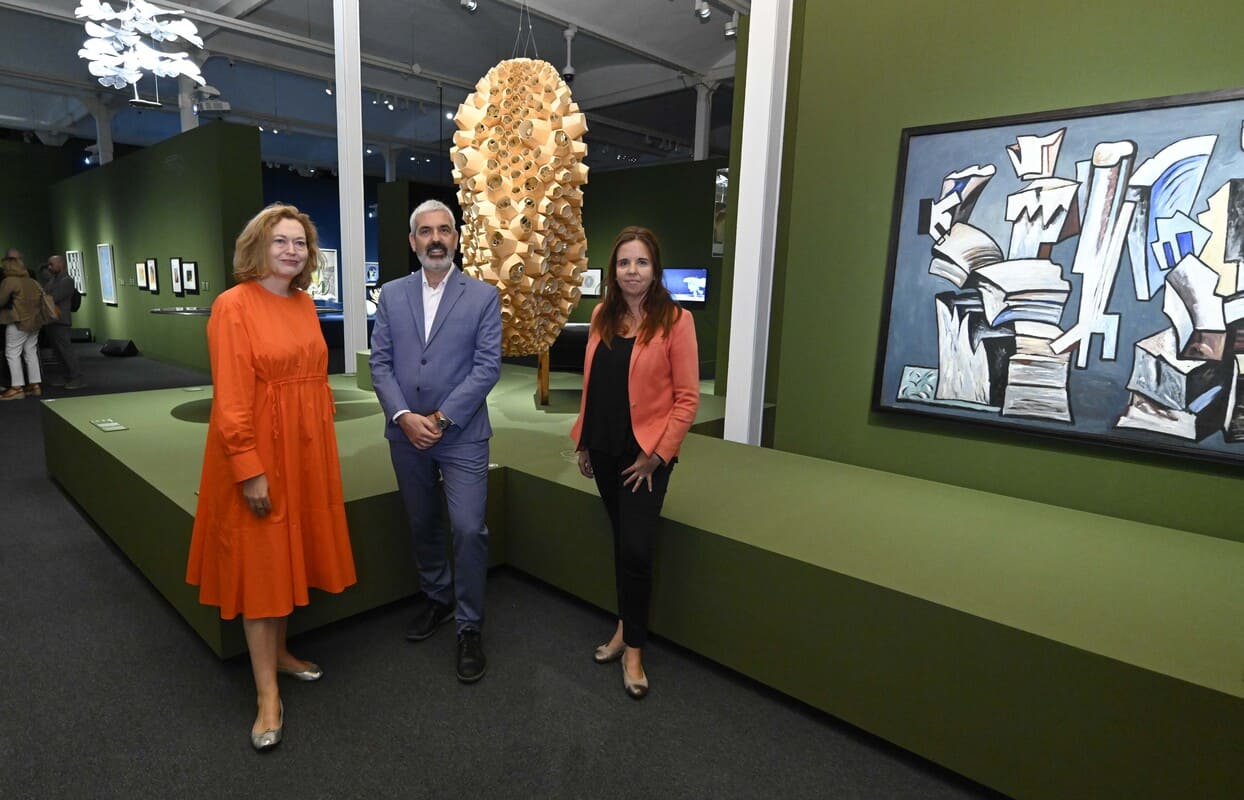 The exhibition curator and conservator of the Centre Pompidou, Angela Lampe; the corporate director of the Culture and Science Area of "la Caixa" Foundation, Ignasi Miró, and the director of CaixaForum Barcelona, Mireia Domingo.
 The exhibition curator and conservator of the Centre Pompidou, Angela Lampe, pointed out that future exhibitions that can be seen at the new center will surely follow this same line, with an "interdisciplinary" approach that allows for a "dialogue between all arts." "It is the DNA of the Centre Pompidou," she emphasized during the presentation event.
Metamorphosis, mimetism, creation, and threat The CaixaForum proposal aims to highlight the fact that
the forms of nature have fascinated artists of all eras, as they have recognized in animals and plants the beauty and mystery, the strength and harmony of life. During the first third of the 20th century, this fascination acquired new meaning thanks to the development of microscopic photography techniques, which unveiled a dimension of life previously invisible. Thus, a fascinating aesthetic based on the biology of microorganisms emerged. Photographers, artists, architects, and designers developed new ways of observing and showing nature.
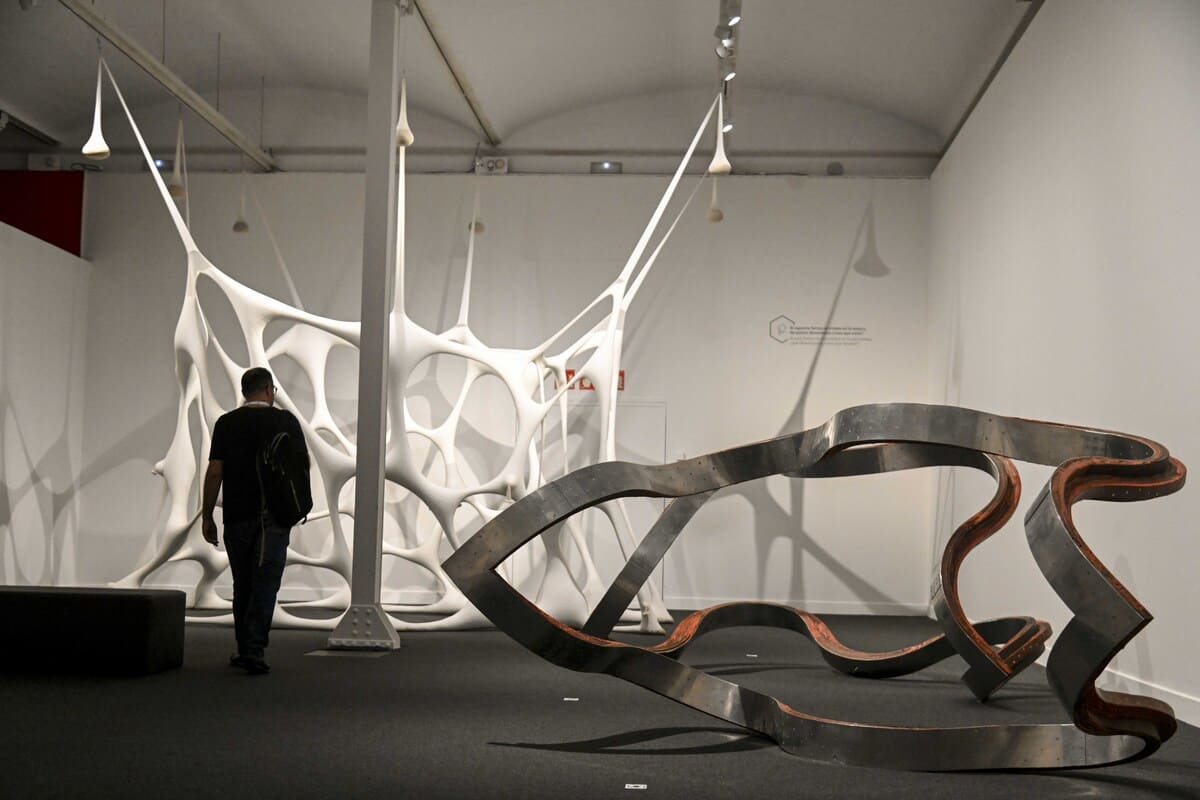 Some of the exhibited works inspired by the organic forms of nature.
 In the second half of the 20th century, plants, forests, and landscapes began to be part of artworks, and movements such as Italian
arte povera (poor art) or American
land art (nature art) emerged, playing with different natural elements. The collection of forms and visions of nature in 20th-century art offers an inexhaustible spectacle, which this exhibition also widely covers. In parallel, in recent years, new scientific technologies and biotechnology have burst into artistic creation to bring forth new forms of political and social ecology. Artists create works with biomaterials or organic matter and work with natural processes to create conceptual artworks that evolve like living organisms. Their works echo environmental problems and the need to preserve the environment.
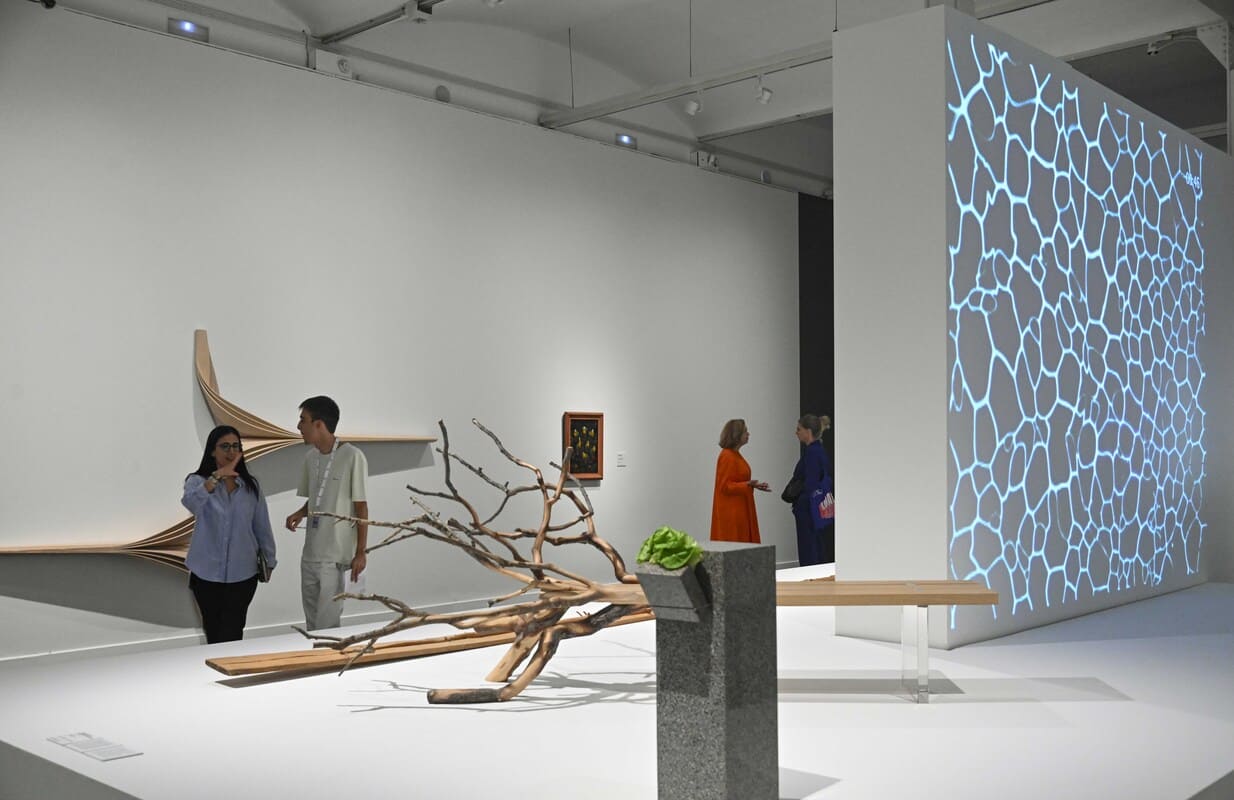 The exhibition forces reflection on current environmental challenges. A Century of Biomorphism offers the opportunity to reflect on the past and present of the relationship between art and nature, between culture and science,
 based on the rich collections of the Centre Pompidou. The exhibition presents a top-level selection of works from the last century across all disciplines: painting, sculpture, photography, architecture, cinema, and design, with names such as Salvador Dalí, Raoul Hausmann, Vassili Kandinsky, Joan Miró, Le Corbusier, Paul Klee, or Alvar Aalto. Also Alberto Giacometti, Jean Arp, Alexander Calder, Georgia O'Keeffe, and Max Ernst, among others, with a significant presence of artists from recent decades who have contributed new committed viewpoints, such as Pamela Rosenkranz or Neri Oxman. In this sense,
the exhibition includes more than eighty pieces distributed in four areas: metamorphosis, mimetism, creation, and threat. Together, they speak of the attraction to organic forms, the discovery of new microscopic forms, the creation of natural elements, and the danger of irreversible change that could end beauty and diversity.
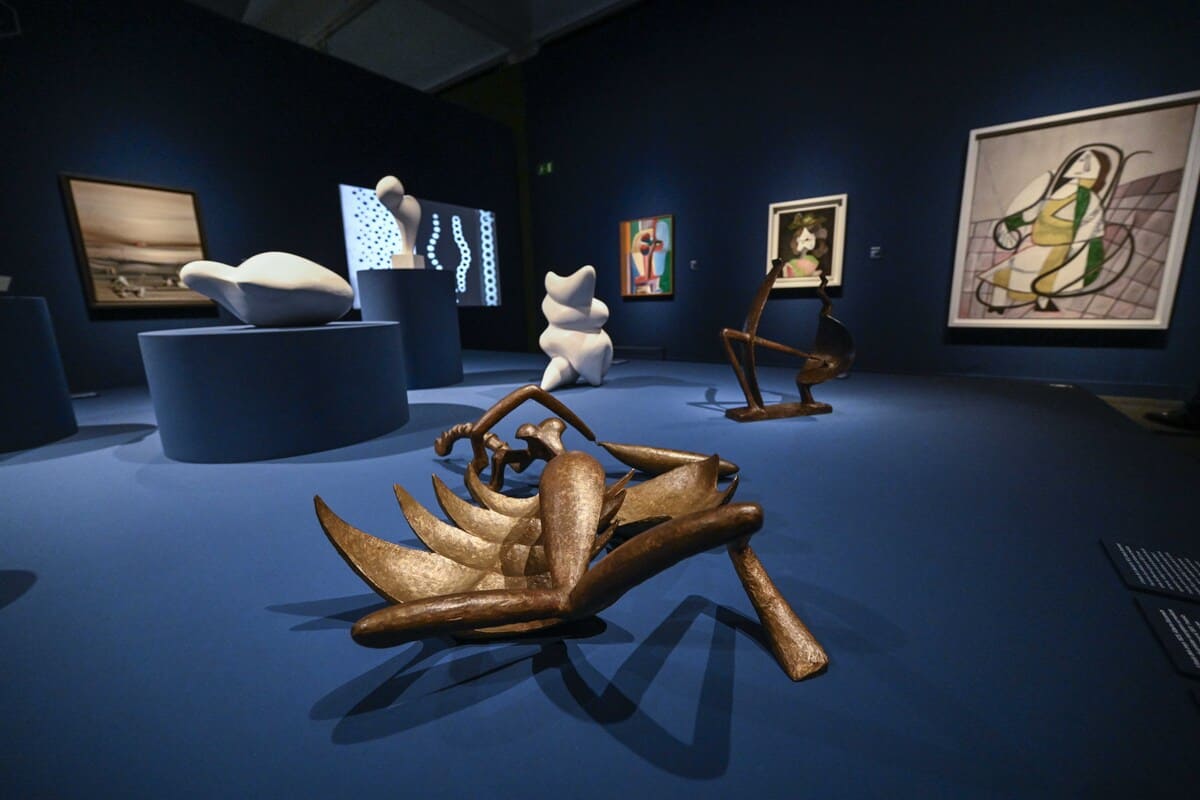 The exhibition represents a new approach to great modern artists, such as Picasso, Kandinsky, Miró, or Le Corbusier. A mediation project with a scientific perspective
 The exhibition is complemented by a mediation project that allows for the development of the concepts discussed in the show. In this case, at the entrance, next to the title, visitors can find a large biomorphic wall on which hexagons with images are projected, each with a concept that appears in the exhibition. These hexagons are combined to create chains of meaning to address up to sixteen concepts. The second section shows how the main concepts of the exhibition manifest in nature. Furthermore, spectators are also invited to sharpen their gaze on some works in the exhibition with several questions. Finally, all of this is complemented by conferences, talks, and workshops that will be held over the coming months.

