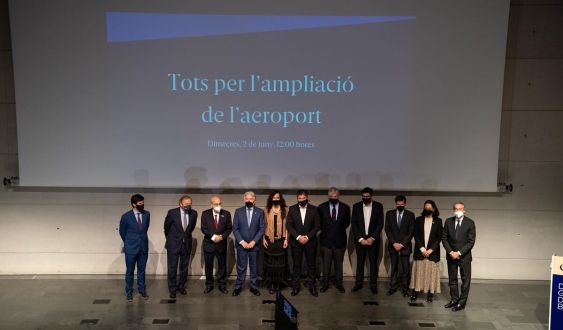
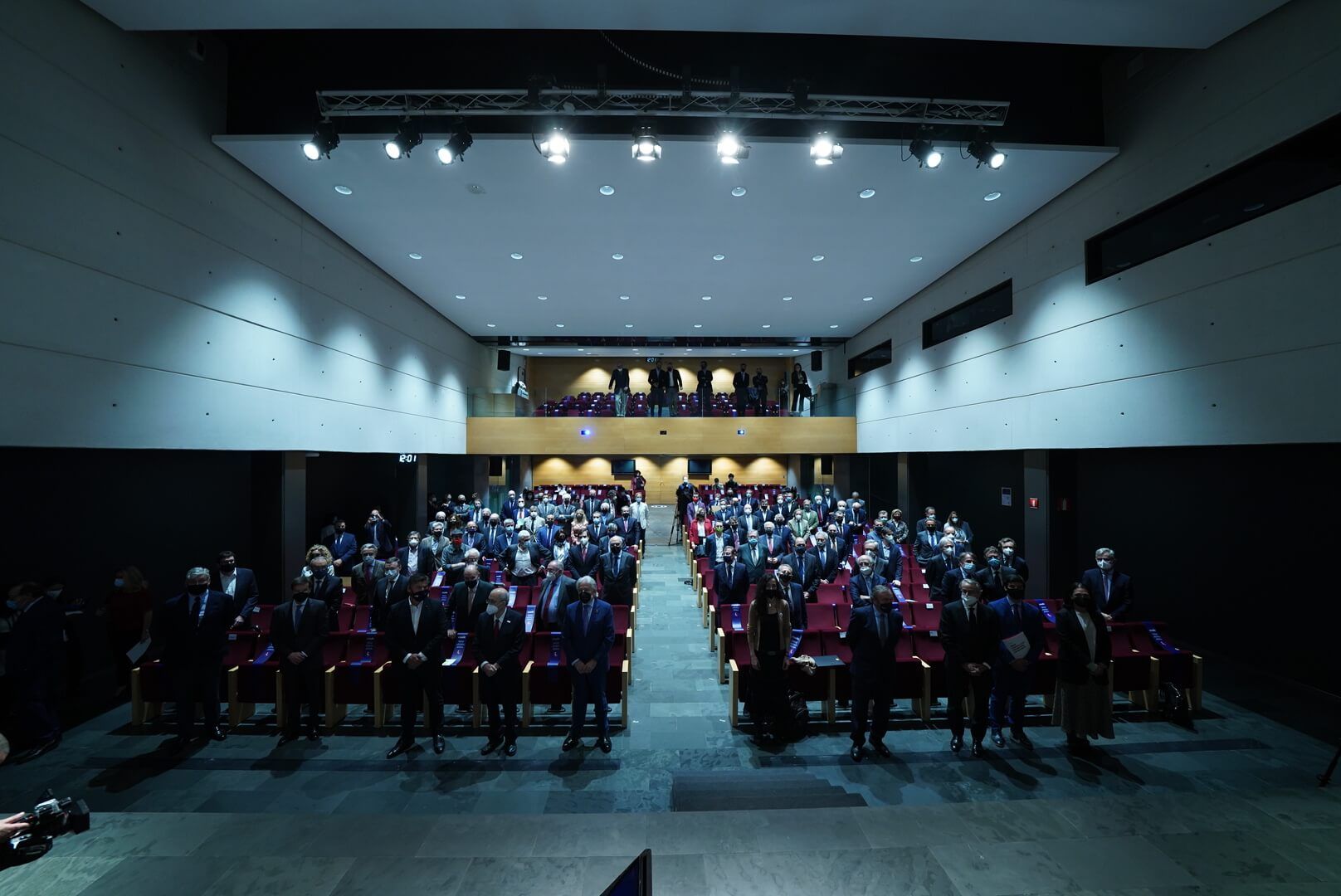
Given the lack of a shared position among administrations on the future of Barcelona Airport, the business world has once again shown its unity, exhibiting its support for the expansion project proposed by Aena at the event Todos por la ampliación del aeropuerto (All for the airport expansion), held this Wednesday at Esade. More than 200 entities and economic agents have supported the manifesto drafted by the conveners, who see the extension of its third runway as essential and urgent, considering that the infrastructure was close to reaching its capacity limit in 2019.
Foment del Treball, Pimec, the Barcelona Chamber of Commerce, the Círculo de Economía, the Associació de Joves Empresaris de Catalunya (AIJEC), Barcelona Global, and the Círculo Ecuestre have been some of the entities that have joined. Actors from the mobility sector, such as Vueling, the Association of Airlines (ALA), and Racc, have also done so.
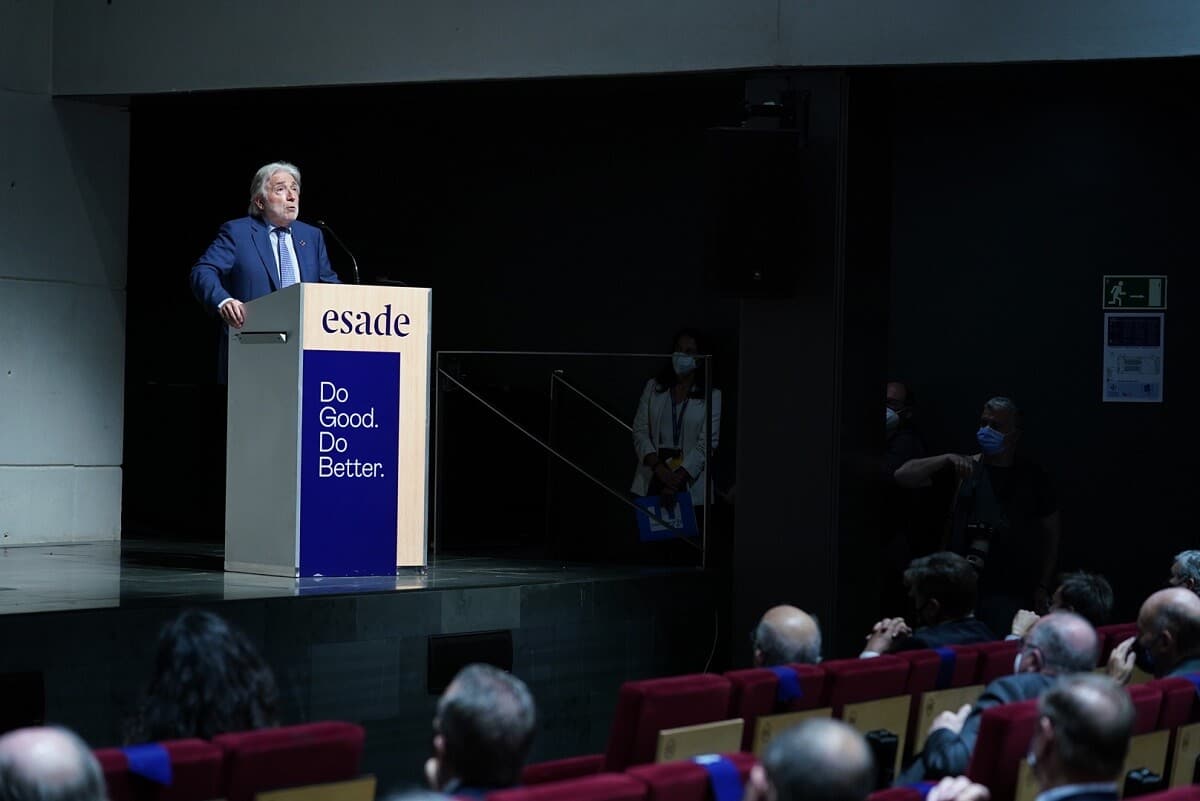
The need to guarantee the competitiveness of El Prat Airport and improve its connectivity to turn it into a reference hub has been the common thread of the shared demand by the different participants. "We need a first-class airport," defended former minister and economist Andreu Mas-Colell.
It must be so to guarantee Barcelona's growth as a research city and host of international events such as the Mobile World Congress (MWC) or Integrated Systems Europe (ISE), but also to continue attracting talent, added the president of Barcelona Global, Aurora Catà. "Let's make it happen," she requested. In short, this airport leadership will benefit future generations with more business opportunities, as emphasized by the president of the Círculo de Economía, Javier Faus, and the president of Racc, Josep Mateu, who called for responsibility "not to mortgage their future."
Achieving a great institutional pact
However, to make it possible, an understanding between the different institutions involved is needed, which is still far from being a reality. Both the president of Foment del Treball, Josep Sánchez Llibre, and that of Pimec, Antoni Cañete, have called for all of them to agree and make possible the 1.7 billion euro investment proposed by Aena. This involves the Government, the Generalitat, and the different municipalities affected by the expansion, especially those of El Prat de Llobregat, Gavà, and Viladecans.
The environmental impacts that the expansion project, as it has been proposed, will have are the issue that generates the most opposition and could lead to rejection by the European Union, taking into account that it is planned to invade La Ricarda, included within the Natura 2000 Network, which provides it with community-level protection. Precisely, before the business event, the Zeroport platform, formed by environmental, social, and neighborhood organizations, demanded the paralysis of any expansion project and the protection of the natural and agricultural spaces of the Llobregat Delta.
The environmental impacts that the expansion project, as it has been proposed, will have are the issue that generates the most opposition and could lead to rejection by the European Union, taking into account that it is planned to invade the protected area of La RicardaOn this point, the different representatives of the business and economic world have demanded that the extension of the third runway be accompanied by a compensation of the affected spaces in a ratio of 1 to 10 and the creation of a new natural space in the Delta, expanding the protected area by 25%. In this regard, the president of the Barcelona Chamber of Commerce, Mònica Roca, has demanded full compliance with these commitments, already accepted by Aena, and to ensure that they are carried out within the appropriate deadlines.
Does not harm other Catalan airports
Economic agents do not see the expansion of El Prat harming other airports such as Reus and Girona, according to Cañete and Faus. This question has only been answered by Roca, who has called for "a broader and more inclusive vision" in the discussion to define the future of El Prat. The president of the Chamber has advocated for the intermodality of the different airports through a high-performance railway network.
[separator type="thin"]
Manifesto Yes to the expansion of Barcelona-El Prat Airport
Josep Tarradellas Barcelona-El Prat Airport is one of the main drivers of competitiveness, employment, and future for Barcelona, Catalonia, Spain, and the Euro-Mediterranean Region. The successive expansions of the Airport in 1992 and 2009 have demonstrated the importance of having a competitive airport for all that it means in terms of quality employment, Mediterranean capital status, industrial, logistical, innovative development, and the visitor economy.
Barcelona-El Prat Airport, with its current design and configuration, is exhausting its capacity. The figure of almost 53 million travelers registered in 2019 approached its maximum capacity of 55 million.
To increase its capacity, the already planned satellite terminal and the lengthening of one of the runways must be built; additionally, these works would give the airport an adequate dimension to achieve a prominent role as a hub. In this sense, the "flight field" of 90 flights/hour with which its current Master Plan was made and conceived, which is now fully deployed, must be maintained.
Only the reduction of economic activity, people's movements, and flights generated by the pandemic has provided an undesired respite that, fortunately, seems to be coming to an end. Now the aim is for Barcelona-El Prat Airport, through its latest expansion, to contribute to Catalonia's economic recovery and growth.
With its expansion, Barcelona Airport will be able to strengthen its role as an intercontinental hub, for which we have been fighting for years, and give meaning to the work that has been done for years to attract intercontinental and long-haul flights. A hub that requires it to be located in the same airport, while reinforcing the airports of Reus and Girona-Costa Brava as point-to-point destinations, in the same way that it is done in other major European cities.
Barcelona must be able to choose the type of visitor that brings it the most added value in terms of knowledge, investment, technology, culture, etc. In the current situation, the airport is limited by its infrastructure, causing interesting destinations for Catalan society not to be addressed due to these limitations. Km 0 airport management is necessary.
The expansion of the Airport allows Catalonia and Barcelona to be positioned in the world, and not only become a sustainable tourism destination, but also boost economic activity by generating employment, attracting and retaining talent and international investment, necessary elements to make other policies launched for the growth of the new green and blue economic sectors a reality.
With the current situation and the historical infrastructure deficit denounced by Catalan civil society, an investment of 1,600-1,700 million euros cannot be renounced in an infrastructure that contributes 7% of Catalonia's GDP, and which, with the expansion, would reach a contribution of 9%.
For all this, the entities that sign and adhere to this manifesto consider that:
The expansion of the Airport is essential not only from the perspective of the "visitor economy" and the city of Barcelona, which we in no way want to despise; but also, and very fundamentally, for the location in Barcelona, in its Metropolitan Area, in the surrounding regions and throughout Catalonia, of international business initiatives.
The expansion of the Airport responds to an imperative of general public interest, of a social and economic nature; of the citizens of Catalonia, both entrepreneurs and the rest of the citizenry; and demands the consensus of all administrations and the populations involved.
Despite its obvious tourist dimension, it is also for deepening the development of high value-added activities, which demand, in an increasingly global and urban world, the need for a first-class Airport, to attract talent and investment. This airport needs to be characterized by its connectivity with Europe, and especially with the rest of the world, with a growing importance of transatlantic flights, which has occurred in recent years hand in hand with its Air Route Development Committee.
The expansion of the Airport must be perfectly compatible with the protection of biodiversity, through the adoption of adequate and proportionate compensatory measures. A sincere dialogue is necessary between the administrations and the associations involved to allow for the search for consensus and the adoption of a solution that improves the initial economic and environmental situation. In a green economy context, both go hand in hand, and need each other.
Aena must also commit that the planned actions for the consolidation of the Josep Tarradellas Barcelona-El Prat Airport entail not only mere restoration, but also compensation for the affected natural spaces in a 1 to 10 ratio, as well as the creation of a new natural space in the Llobregat Delta with an increase in the protected area greater than 25% of the current one, in accordance with a demanding procedure established by the European Commission that the Generalitat de Catalunya must process for the modification of the Natura Network, where the lands that Aena would acquire would be included.
The expansion of the Airport must be carried out with full respect for Catalan, Spanish, and European legal frameworks in general, and especially for the protection of biodiversity, with full legal certainty.
The expansion of the Airport must be fully reconcilable with the Port of Barcelona, and we demand it, and it must allow for the harmonious development of both relevant infrastructures.
The decision on the expansion of the Airport is urgent, not only from the purely economic aspect of its contribution to wealth generation, but also from the budgetary and regulatory aspect of the airport system.
The opportunity and image cost of not carrying out this investment would be extremely high for the economy of Catalonia, which would lose competitiveness, on the one hand, and connectivity in an increasingly global world, on the other. At the same time, it would be simply unacceptable in times of such great need for economic recovery.
The expansion of the Airport is a neutral decision in relation to its specific management system and does not prejudge it. It simply improves the infrastructure.
Barcelona Airport must take advantage of the windows of opportunity that open up to it, and, even more so in times of crisis like the current one, it must know how to exploit its potential to promote high value-added activities.
The signatory entities of this manifesto demand an Agreement between AENA, the Generalitat, the Barcelona Metropolitan Area, and the City Councils of Barcelona, El Prat, Gavà, Viladecans, Sant Boi (and the rest of the affected City Councils), to send a clear and forceful message of consensus to the European institutions regarding the public interest that justifies the expansion, and the environmental compensation measures that must be adopted; in order to facilitate its execution; and the fastest obtaining of the positive economic and social returns derived from it.
On the other hand, in an interconnected world, it is necessary to deepen the capacity of Barcelona-El Prat Airport to consolidate it as an international hub, while it will also be necessary to deepen its railway connectivity, both in commuter trains and AVE trains, to bring this infrastructure closer to the territory.
Likewise, Aena must maintain its commitment to the future plans of Girona-Costa Brava and Reus Airports, for which significant investments must continue to be made, which, in addition to their own international mobility, must be complementary to the development of the Barcelona hub, since they are essential airports in the Catalan airport system and fundamental socioeconomic engines for Catalonia.
The entities that sign and adhere to this manifesto, state that:
The country needs growth policies that allow for economic revitalization while promoting social cohesion. Without wealth creation, its redistribution is not possible, neither personal nor territorial. Without wealth creation, the Welfare State will be unsustainable.
It is necessary to prioritize public and private infrastructures vital for the country and for its development, which allows it to compete internationally and helps reduce its historical deficit denounced by Catalan civil society. We cannot renounce the progress that infrastructures bring, and even more so when we need them, so we must work to achieve the necessary consensus to carry them out.
In short, to value the general interest of the country and all its citizens.
Add The New Barcelona Post as your preferred Google source for free
Stay informed with the latest news.
