[dropcap letter="A"]
Amadeu Cuito, eminent Proustian, was born in Barcelona into a Catalanist and liberal family that lived in exile in France after the civil war. He lives in Perpignan and Paris, where he studies law and economics. After New York and Madrid, he has lived in Barcelona since 1976. He has written El jardí sense temps, Contes d'un carrer estret and Memòries d'un somni. He presides over the Societat d'Amics de Marcel Proust.
For what reason should we read Proust in 2016?
Reading Proust is opening the door to an unrepeatable world. It is great literature and, from a point of view that is not at all decisive, today it may be incompatible with instant Twitter because Proust speaks of a long duration of time, of perenniality and at the same time of the destructive capacity of time. He affirmed: "The real life, the life at last discovered and clarified, the only one therefore truly lived, is literature." And so it is in the 20th century or in the 21st century. Now there is a question of tempo. Whoever feels the passion to read, to live literature, will have time to read Proust. And that has permanence, although In Search of Lost Time is a work that must be read in its entirety, thirteen volumes, with a beginning and an end. It has one and a half feet in the 19th century and in many aspects is constructed like the great classic novels. Contrary to what people think, it has a plot. He speaks of his useless years until "the invisible vocation" was concretized, of which period In Search is its history. Of course, the reader must understand that Proust manages to make the description dynamic and that, therefore, it becomes the true action. When you understand it, Proust is a boundless territory.
Does 'online' reading, digital immediacy, pose obstacles to reading Proust?
It is a problem but not an insurmountable one if we truly want to enter the continent of great literature. Certainly, Proust's world exists in contrast to speed. It is, let's say, a system of seemingly static descriptions that link very diverse plots, characters with contradictory identities, perceptions of all kinds, constant temporal transitions. Everything linked by an artifice of symmetries and perfections. And to read it, time is needed. The basic reason for a work of art —like Proust— is pleasure, the pleasure of the spirit. It is like One Thousand and One Nights with inexorable time —a tutelary divinity interpreted by the narrator— which ultimately reveals the worm-eaten faces of the characters. Here we have the novel as an invisible world, in contrast to the mirror-novel, according to Stendhal.
[caption id="attachment_5298" align="alignleft" width="288"]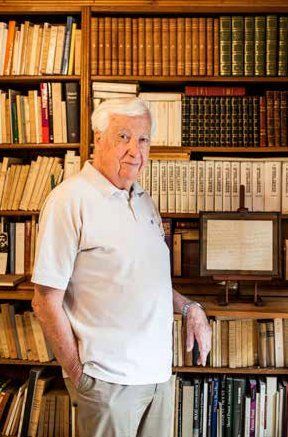 Amadeu
Cuito, in his
extraordinary
library
dedicated to Marcel
Proust which contains
unique copies
[Photo by Flaminia
Pelazzi][/caption]Read it starting from the beginning and ending at the end?
Like all great literary works, In Search of Lost Time has a first reading —that of youth, after adolescence— and then come the readings made from maturity. The first time it should be read from beginning to end. Afterwards, we come to rereading and it is no longer essential to do it linearly. With the characters and themes in memory, you can choose and savor the parts that initially led you to Proust's secret landscapes and discover new approaches. There is a philosophy of time, Proust with a sense of humor that is not always taken into account. We have the analysis of jealousy, the ambivalence of human relationships, the power of names, the transcendence of art. An irrefutable truth is that it is a novel that immediately, personally, interrogates you. It makes you converse with yourself, even if it speaks of an era that today seems very distant to us. This is irrelevant because the important thing is that it will lead you to converse with yourself, from Swann's Way to Time Regained. And the unquestionable argument of the novel is the literary vocation of the central character.
What was your first contact with Proust's work?
My father knew French correctly and it was he who became enthusiastic about Proust's work. He really liked me to read pages of Proust aloud to him, because of my Parisian accent. Before that, I had to read it myself to know how to respect the punctuation, an essential resource in Proust's prose. It seemed like a perfect way to hate Proust but one day I read it alone and I have done so to this day. I was in Paris and must have been 17-18 years old. The first reading is from that time. For many years now, nothing that has to do with Proust seems alien to me. That's why I wrote La biblioteca proustiana de Ferran Cuito, in homage to my father.
How can Proust change our lives?
After reading as a young person, comes the reading of a person who has already suffered the same disappointments as everyone else. It is fundamental because a degree of maturity is needed to be able to fully absorb the novel, each theme, each episode, each character. The other day, a friend of mine, an opera director, told me about his mother's death and I thought about re-reading the part about the grandmother's death in In Search, which is essentially the mother's death. I rediscovered an extraordinary staging. People come and go and each character is drawn with an unmistakable touch. It is no coincidence that my friend had the same experience.
Now that Proust's homosexuality is known, does the fact that his protagonist's loves are masculine converted into feminine characters maintain credibility?
It is one more of the complexities of In Search. He lived it as it was lived in that era, as a simulation and a guilt, unlike a vindicative André Gide. But the female characters are magnificently drawn, intensely unforgettable. The novel was made in 1913, practically finished, but its publication was interrupted by the war and he broke up with his secretary—his lover—who fled and died in an accident. And that caused Proust great trauma, so he wrote The Fugitive and then The Prisoner. He goes backward. According to Proust, there is no love without jealousy. He invents the character of Albertine and reintroducing her into the novel from the beginning forces him to rewrite almost the entire novel and introduce the character. In the entire first part, the narrator's alter ego is Swann, who has an affaire with the famous Odette. And, in the second part, the alter ego is Charlus. These are the prodigious Proustian symmetries, of a work constructed in a millimeter-precise way, with a very precise constructive and architectural rigor. They are a thousand unparalleled symmetries. There is the Guermantes part and the Swann part, correspondences comparable to the structure of a cathedral. In short, the novel is composition. And at the moment of composing In Search, he has to fight against time and illness.
How do Proust's characters come and go?
At the origin of the novel is Contra Sainte-Beuve. It is the true embryo of In Search of Lost Time. It begins with a first part of memories and reminiscences and about how one should write, according to his understanding of literature. Then, in the form of a conversation, it proceeds to refute the ideas of the critic Sainte-Beuve. After all, what truly allows him to write a novel? It is the invention of this ambiguous character whose identity is unknown, who has no name and has two voices. That is, there are two characters: the "I" who explains a series of adventures and alongside another who is himself and intervenes from time to time. Then the two voices dissociate. There is a voice that comments, that draws conclusions, that tries to elaborate laws, that makes mistakes, that returns until finally it reaches a conclusion about what the work of art truly is. That is, the key to his vocation. That is, the key to his vocation. Everything starts again. In summary: "Truth does not begin until the writer takes two different objects, establishes their relationship, and binds them with the indestructible bond of an alliance of words." Without it, there is no literature. And, at the same time, the visible world is not the real world. We live among the waves of memory. After all, only metaphor can give eternity to style, Proust said in one of his last articles.
How does the theory of memory intervene?
My good friend the novelist Claude Simon, Nobel Prize in literature, used to say that when you read the description of a wounded body, blood doesn't fall on you. If you read about a fire, you don't get burned. The word fire is not fire. Proust's subtle cunning and great virtue is that he knows that words are deceptive and that to discover the reality behind an object or a feeling, one must proceed by way of metaphor. It is something quite general for the time. Tocqueville writes about American democracy and, in fact, he is writing about European or French democracy. This is how Proust understands that human motivations can produce effects contrary to their purposes. To reconstruct another reality, he knows — as he insists — that the visible world is nonexistent. To understand it, we have to create another, and it is possible thanks to the evocative power of the word. The narrator confronts lost time, and fortuitous, involuntary reminiscences return. Involuntary memory. Unconscious memories, he says.
Proust was not too interested in politics... but what did he believe in?
Let's remember that he was Jewish, French, and therefore very integrated as an assimilated Jew. He knows religion, but he hasn't lived it. And this allows him to assimilate everything from a more distant and critical point of view. Politically, I think he was a liberal man. He took sides in favor of Dreyfus, in the famous case that divided France. He has an idea of France but nothing chauvinistic. Even with the Great War, he tries not to fall into the total rejection of German civilization, as others did. For this reason, some considered Proust not very French, probably due to a certain antisemitism in quotation marks.
What is Proust's gaze like, how does he see his characters?
He is ruthless. He is direct. Realistic. Some characters are cruel, but the cruelty that can result from some descriptions of French society is always balanced by the positive side. Ruthless, yes. The decadence of the last volume is the inexorable passage of time that destroys everything. In the final ball of the Guermantes, he opens the door and finds the devastating result of the passage of time.
From the point of view of religion, his religion is art.
It has been said that he was a mystic. I believe he was not religious, neither Catholic nor Jewish, but he knew religions well. He is a reader of Pascal, of the Bible. But his life is art and salvation is to write and create a work of art, which is the only thing that can fight against time because in the end it will endure.
When does Proust decide to become a writer?
When he is young he already has the vocation to write. He is looking for his path and deep down all his life he seeks this path, he seeks it through the authors he reads and the critics. He tries to do literary criticism, he writes the pastiches and the novel Jean Santeuil, which is an early and very incomplete version of In Search. Was he a snob? He lives in an era in which there is a shift in society, the aristocracy disappears and the bourgeois enter the scene, another great Proustian symmetry that culminates when the narrator returns to Paris, after a stay in a health center. The Princess of Guermantes invites him to her salon. There he finds again the characters of In Search. Social climbing and decadence, the passage of time undoes everything.
He is a 'voyeur'.
Proust is a voyeur. We return to the two dissociated voices: Marcel and the narrator self, a voyeur who is not presented in the work and whose identity is unknown. He is an ambiguous character with an extraordinary capacity for analyzing people and social situations, and he analyzes them with great acuity. He is a voyeur not only of sinful scenes but also of society. He examines everything with a magnifying glass, and the result is great literature.
There is a moment between 'Jean Santeuil' and 'In Search' when Proust achieves a special understanding of human nature...
The young Marcel Proust guides himself through the darkness, searching for the path. I believe Proust becomes Proust when he invents the character of the narrator. The narrator—he says—who recounts and says "I." The narrator who says "I" and it's not always me. When he finds the narrator, he finds the key to writing a novel. It is the solution that allows him to enter and construct the novel. And, I believe, it happens when he finishes Jean Santeuil and realizes it doesn't work for him. He needed to discover the tone and the structure. Proust finds the tone when he becomes aware that a second narrator can exist. And, then, these two voices direct the entire novel.
If we read 'In Search of Lost Time,' do we find keys to understanding the current world?
Proust is relevant today because when he criticizes society and its changes, it turns out that these changes are conceived in one direction but often produce others, in a sense that can even be contrary. It is an unalterable lesson from Proust's work, for the last century and for the current century. Lost time, time regained. When you read Proust and see how one social class disappears and another appears, isn't that an indirect portrait of a society like ours?
Add The New Barcelona Post as your preferred Google source for free
Stay informed with the latest news.