
It was the first day of 1895 and Paris dawned under a leaden sky. While for some, a day's work began that would take them all over the city, papering the walls of the boulevards, the doors of the Moulin Rouge closed behind the last stragglers of a night marked by the famous Fée Verte. These late-nighters must have been the first to spot a Byzantine goddess in the distance, thinking they were still under the influence of alcohol. But, little by little, as the city woke up, it was the other Parisians who discovered that it was, in reality, the poster announcing Sarah Bernhardt's new play, La Divina Sarah, who, characterized as the protagonist of the production Gismonda, would mark a before and after, not only in the career of the artist Alphonse Mucha, but in an entire artistic movement.
Alphonse Mucha was born in 1860 in Ivančice, in what is now the Czech Republic. At 19, he was already working as an apprentice stage painter, and, a few years later, he received a commission from Count Kart Khuen of Mikulov to carry out the mural decoration of his castle, Emmahof. The count was so pleasantly impressed that he agreed to sponsor Mucha's formal training at the Academy of Fine Arts in Munich, and later, also paid for his trip to Paris.
It was in the city of light where Alphonse Mucha took his first steps alone, first as an illustrator for various publishers, then receiving a mention honorable at the Paris Salon for his oil studies for Charles Seignobos's Scènes et épisodes de l'histoire d'Allemagne, and finally, consolidating his success with Sarah Bernhardt and the creation of posters for her productions, along with set and costume designs.
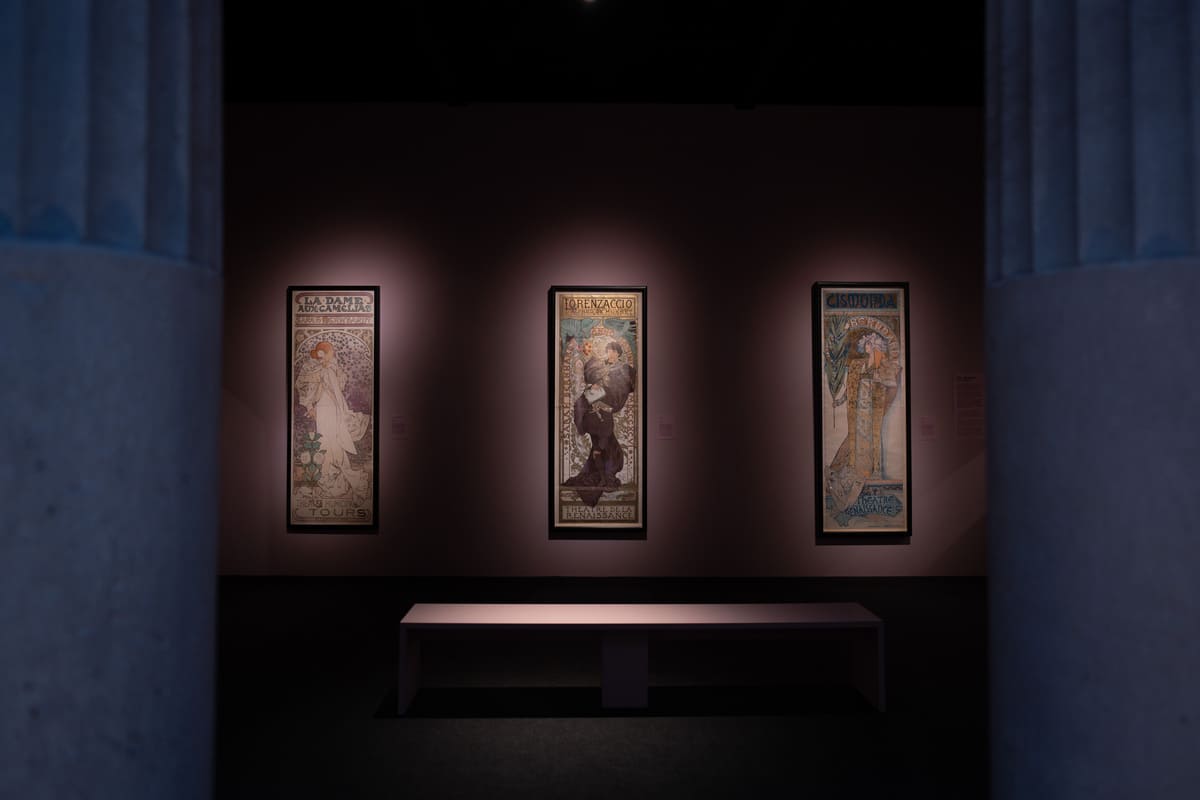
It is on this stage of hatching in Paris that the exhibition at Palau Martorell, which can be visited until October 15, focuses. The result of the most recent research examining the theoretical aspect of Mucha's work, especially the idea of beauty, a central principle of his art, the exhibition is composed of more than 80 pieces, among which are his famous theater posters, commercial objects with his unmistakable designs, as well as photos and preparatory drawings of his works. And we will also find a projection on the canvases of The Slav Epic, one of the most important projects he wanted to carry out throughout his life.
We will find a projection on the canvases of The Slav Epic, one of the most important projects that Mucha wanted to carry out throughout his lifeThe exhibition is organized into three thematic axes:
The first, focused on women, the undisputed protagonists of his pieces, focuses on his work for Bernhardt's theatrical productions and on advertising posters for famous brands such as JOB (rolling paper), Lefèvre-Utile (LU biscuits) or Waverley bicycles, as well as on his designs for perfumes or magazine covers such as Les Maîtres de l'Affiche.
The second block is centered on the so-called style Mucha, a kind of visual language developed by the artist whose objective was the expression of beauty through the harmony between internal contents (ideas, messages) and external forms, based on the combination of the image of a woman ---the symbol of his message of beauty--- with flowers and other decorative motifs of an exotic nature and from his native Bohemia.
And the third, dedicated to beauty, shows us how, through this style Mucha, he was able to work for the political freedom of his country and turn his art into a message, which culminated in the canvases of The Slav Epic, painted between 1912 and 1926, where Mucha wanted to tell the history of the Slavic people.
Alphonse Mucha not only created his own style characterized by harmonious compositions, sinuous forms, organic lines and a muted palette, which would give rise to Art Nouveau, but, as stated in his notes, he believed that the artist's role was to inspire people with this harmonious beauty and elevate the quality of their lives through his art, and that is what he tried to do throughout his existence: portray beauty and bring it to the general public.
Mucha believed that the artist's role was to inspire people with this harmonious beauty and elevate the quality of their lives through his artAn example of this are decorative panels, posters produced in large quantities, without text, purely designed for decoration, which ordinary people could have in their homes. "I was glad to participate in an art for the people and not for private salons. It was cheap, accessible to the general public, and found a home in poor families as well as in more affluent circles..." he would write in his notes.
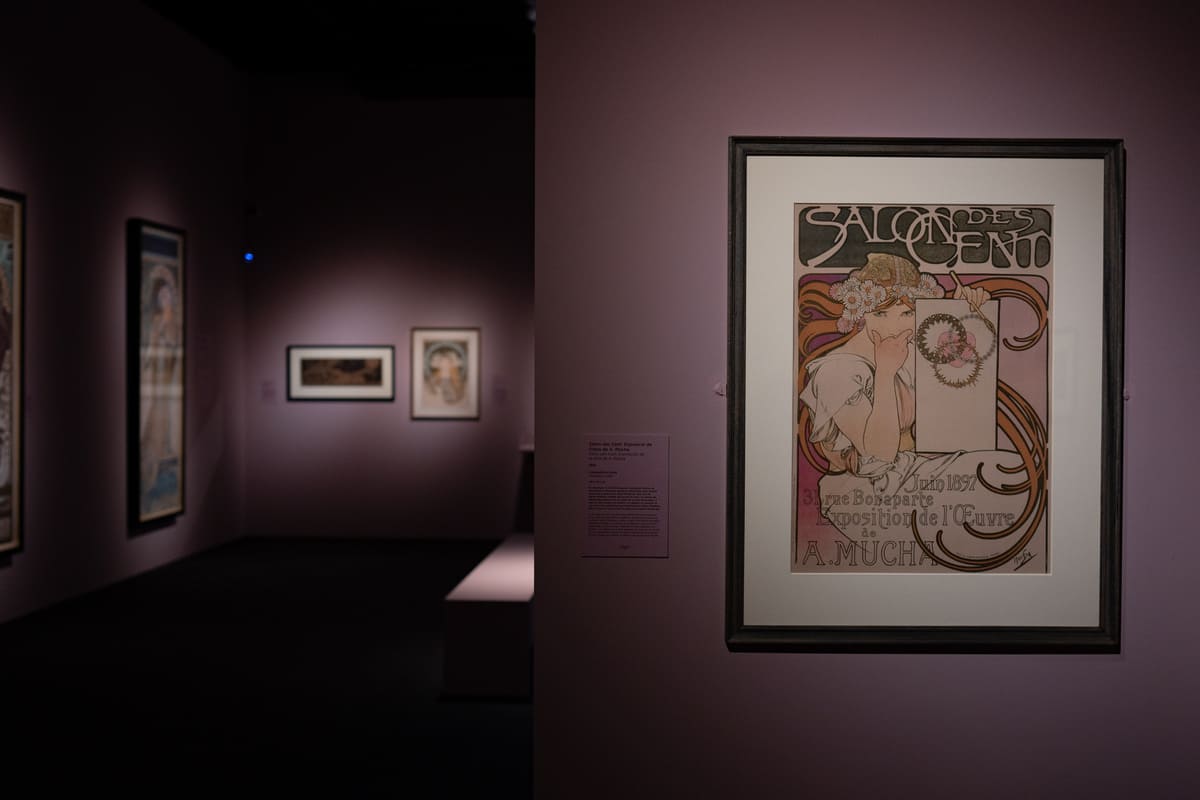
Perhaps that was the success of his art, that democratization of his work, that desire to reach everyone with the sole ambition that beauty ----that vast and complex concept---, could reach all corners and could be contemplated by all eyes.
Perhaps that is still the true triumph. That today, still, we are moved by those women with long hair, adorned with flowers, jewels and ornamentation. Or by that girl with braids and a fixed gaze who firmly holds pencils, whose story Mucha painted.
Do not miss the opportunity to immerse yourselves in the beauty of the creations of the father of Art Nouveau, Alphonse Mucha. There is still time to visit the Palau Martorell, next to the Basilica of La Mercè, until October 15.
Add The New Barcelona Post as your preferred Google source for free
Stay informed with the latest news.
