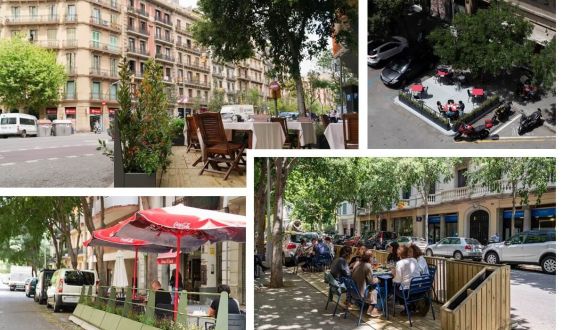
The streets of Barcelona are about to undergo a major transformation. The concrete blocks and yellow bollards that have served to protect the terraces that have moved to the roadway during the pandemic are about to disappear. The health emergency forced their expansion, invading a space previously destined for cars to ensure that a safe distance was maintained between customers. Once the crisis begins to subside, the well-known New Jersey barriers will be replaced by modular platforms designed to be more aesthetically pleasing, as well as functional, after the animosity aroused by the tactical urban planning furniture.
The Restaurant Guild expects that in the coming weeks, operators will begin the procedures to make this change, pending the City Council's final regulation, introducing the necessary modifications to make it possible in the terrace ordinance, which will enable the roadway as a space to place tables and chairs. It is expected to be definitively approved in the last municipal plenary session of the year and come into force at the beginning of 2022. "Work will begin to be advanced so that results start to be seen from January," explains the association's director, Roger Pallarols.
Not all terraces that have grown during the COVID era will adopt these new platforms. During this period, the City Council has granted more than 3,600 licenses for new terraces and expansions, of which 1,588 have been located in parking lanes, traffic lanes, and chamfers. These will be the ones that can opt for the change, but it remains to be seen how many will finally want to do so.
Those who do want to consolidate the space gained during the pandemic will be able to choose between four models of platforms, with several options available, depending on whether they are located in parking lanes and traffic lanes or in chamfers. Urbadis, Escofet, IAAC-Alberch-Hortalia, and Leku Studio-Durbanis have been the companies chosen by the council to design the platforms, without excluding the possibility of incorporating more in the future. At the beginning of June, eleven prototypes were installed in different parts of the city, with the aim of testing them. A month and a half later, a total of seven models were approved, which have already been incorporated into the municipal urban furniture catalog.
The platforms designed by the four companies are different, but not by much, considering that all of them comply with common characteristics set by the City Council. The furniture is modular, allowing it to adapt to the number of tables and chairs corresponding to each license. They will have to be placed prioritizing the front of the establishment and have been conceived to be accessible from the sidewalk.
The characteristics they share, basically, are the maximum dimensions and the colors that the elements that configure them can have. The maximum dimension for platforms to be located in traffic lanes or parking spaces will be five tables, while for those on street corners it will be seven. The different models also share the color that the planters can have, which will be gray, dark blue, dark red, dark green, and green. The only exception is that of IAAC-Alberch-Hortalia, which is made of wood.
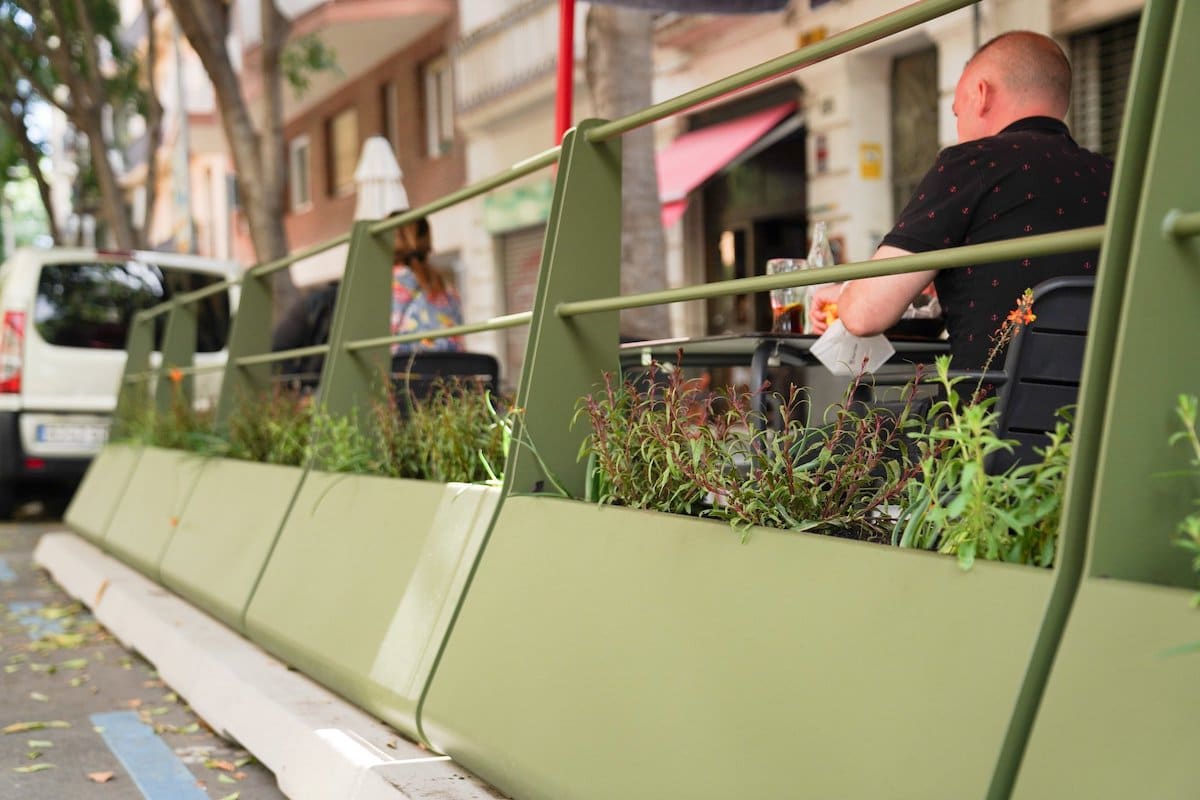
The platforms that will serve as terraces are modular, allowing them to adapt to the number of tables and chairs corresponding to each license, and will have to be placed prioritizing the front of the establishmentThe big difference between the four models is the material they use. The platforms from Escofet and Leku Studio-Durbanis use concrete, while those from IAAC-Alberch-Hortalia and Urbadis resort to wood. On this matter, the producers of the concrete ones highlight their resistance and durability, emphasizing that they will not need much maintenance, according to the general director of Escofet,Andreu Gomà, and Durbanis' product director,Francesc Crous. From Urbadis, its founder and director,Josep Amor, points out that its platform has wood on the pavement to give it a warmer feel, while the base and planters are made of steel to gain resistance.Joan Chavarria, partner and marketing director of Hortalia, explains that their project, shared with the Institut d'Arquitectura Avançada de Catalunya and wood producer Alberch, aimed to bet on a product that was comfortable and as sustainable as possible, minimizing its ecological footprint, without ceasing to treat the wood to protect it against humidity and insects. He also believes that using only wood gives a sense of spaciousness.
The different platform models, one by one
ESCOFET
Analyzing each one in more detail, the Escofet platform is made up of a base of concrete modules (30% recycled) with a gray finish. The planters and the railing, with a very careful design according to Gomà, are made of lacquered steel. There are three models available, whether it is located vertically or on a chamfer: high (90 cm), low with railing, and low. The connection between the platform and the sidewalk is made through an aluminum ramp, which Gomà indicates provides resistance and does not deform. The general director of the company also points out that the platform has a mechanism to level the different modules. The company will produce the platforms in Martorell.
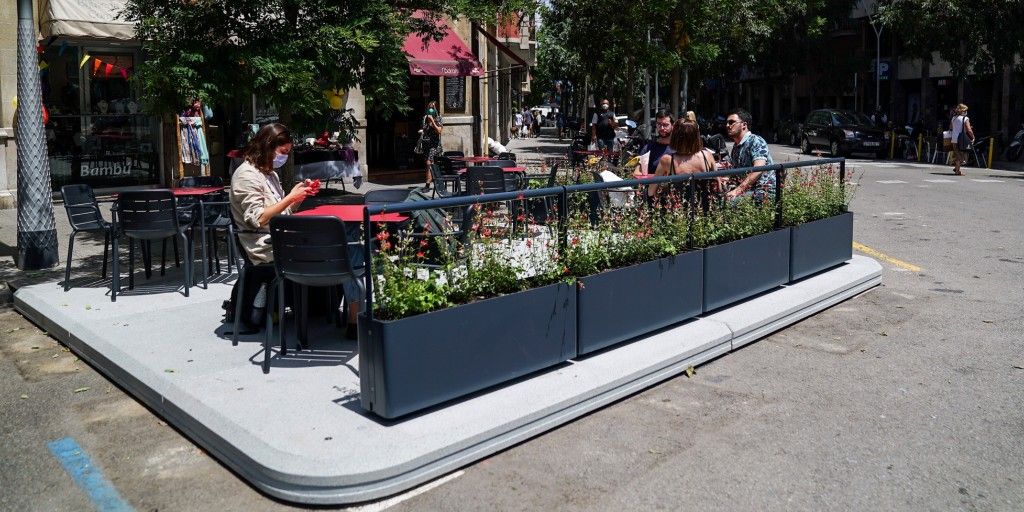
IACC, ALBERCH Y HORTALIA
The entirely wooden platform, that of IACC, Alberch and Hortalia, is characterized by having the pavement, the planters and the ramp that connects to the sidewalk made of wood, Swedish red pine with PEFC certification, and only the feet are made of galvanized steel. The elements are completely integrated and only the high platform option (90 cm) is available. For now, the City Council has approved the version that is placed in a service cordon or a parking space, and the version for chamfers is in the process of being approved. In this project, the IAAC was the one who designed the platform and chose Alberch as the wood supplier. Hortalia will be in charge of producing the platforms in Manresa.
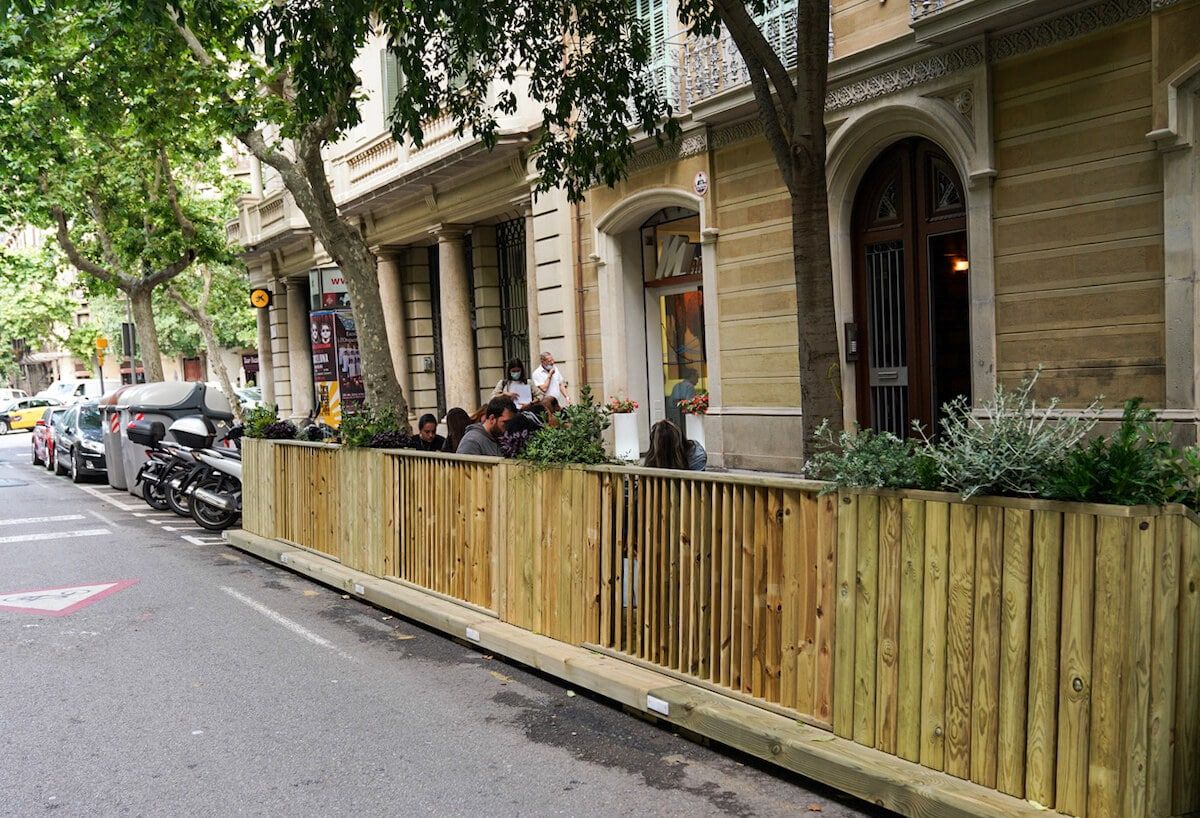
URBADIS
Continuing with wood, Urbadis treats it to protect it from water and fungi, and combines it with iron. For Josep Amor, the wooden base with steel planters gives it an urban touch and, furthermore, he points out that it is very thin and has adjustable feet, guaranteeing that it will be flat with respect to the sidewalk. There are three models: a high platform (90 cm), a low one with a wooden railing and handrail, and a low one, both for curb and for chamfer. In their case, the ramp that serves as a transition between the terrace and the sidewalk is hidden in the platform itself. This Barcelona-based company will produce the platforms in Vilanova i la Geltrú.
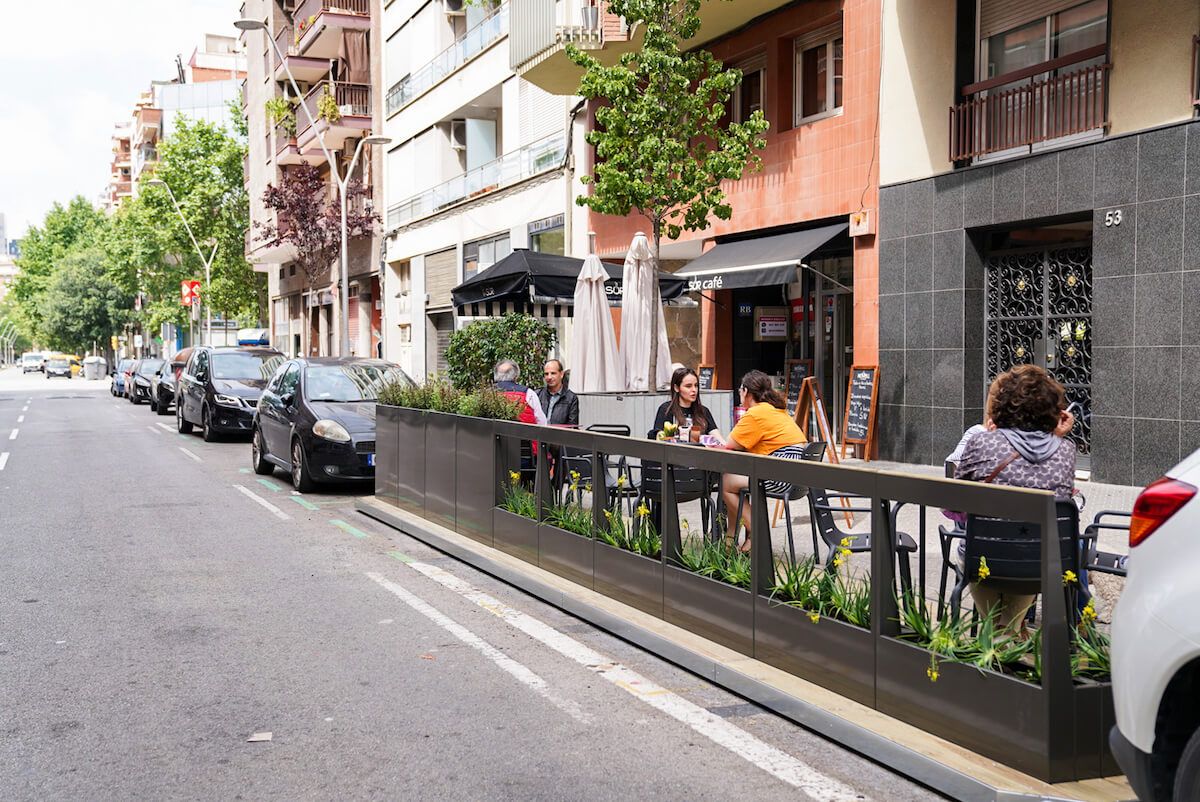
LEKU STUDIO AND DURBANIS
Finally, the platform co-designed by Barcelona-based Leku Studio and Girona-based Durbanis is made with UHPC concrete, of very high resistance. The planters and the railing are made of lacquered steel, while the ramp that connects to the sidewalk is made of galvanized steel. Crous emphasizes that the platform can be leveled to ensure continuity with the sidewalk. He also highlights that the materials that make up the platform can be reused, both steel and concrete, with the aim of promoting circularity. Complementary elements such as a protective barrier or a bench can be added. Durbanis, based in Banyoles, will outsource production to other companies.
The investment will be amortized with the tables that will be gained
One of the unknowns of this imminent transformation that the city will experience will be how many of the almost 1,600 terraces that have moved tables to the roadway want to acquire a platform. The Restaurant Guild has detected great interest from restaurateurs in incorporating them, but believes that not all those who have the right to do so will end up doing so.
One of the variables that will determine this will be the price. How much it will cost to acquire and install one of these platforms approved by the city council is still the great unknown today, but the Guild indicates that it will be announced shortly. For now, the municipal government has announced that it will create a two-million-euro fund to help establishments in this process, with aid that could cover up to 50% of the budget.
One of the unknowns of this imminent transformation that the city will experience will be how many of the almost 1,600 terraces that have moved their tables to the roadway want to acquire a platformTaking into account that almost 1,600 terraces can resort to this subsidy, Pallarols sees it as unlikely that the council can afford to pay half of everyone's bill. Be that as it may, the director of the Guild emphasizes that the investments will be amortized."The great help will be the expansion of the terraces park in Barcelona," he defends. In fact, with only the licenses approved during the pandemic, the city has gained 10,000 more tables and 45,000 more chairs, according to the association's calculations.
Although restaurateurs are starting to advance procedures pending the definitive validation of the modification to the terraces ordinance, Pallarols maintains that the paradigm shift that the restaurant industry in the Catalan capital will experience will last for almost the entire next year. "It will be a long process," he emphasizes. First, authorization will have to be obtained from the City Council and, then, establishments will have to order the platforms from companies, which will have to manufacture and install them at the destination, in addition to replacing the unpopular New Jersey barriers. Despite everything, Pallarols is convinced that in January new terraces will already begin to appear.
Barcelona residents want more terraces
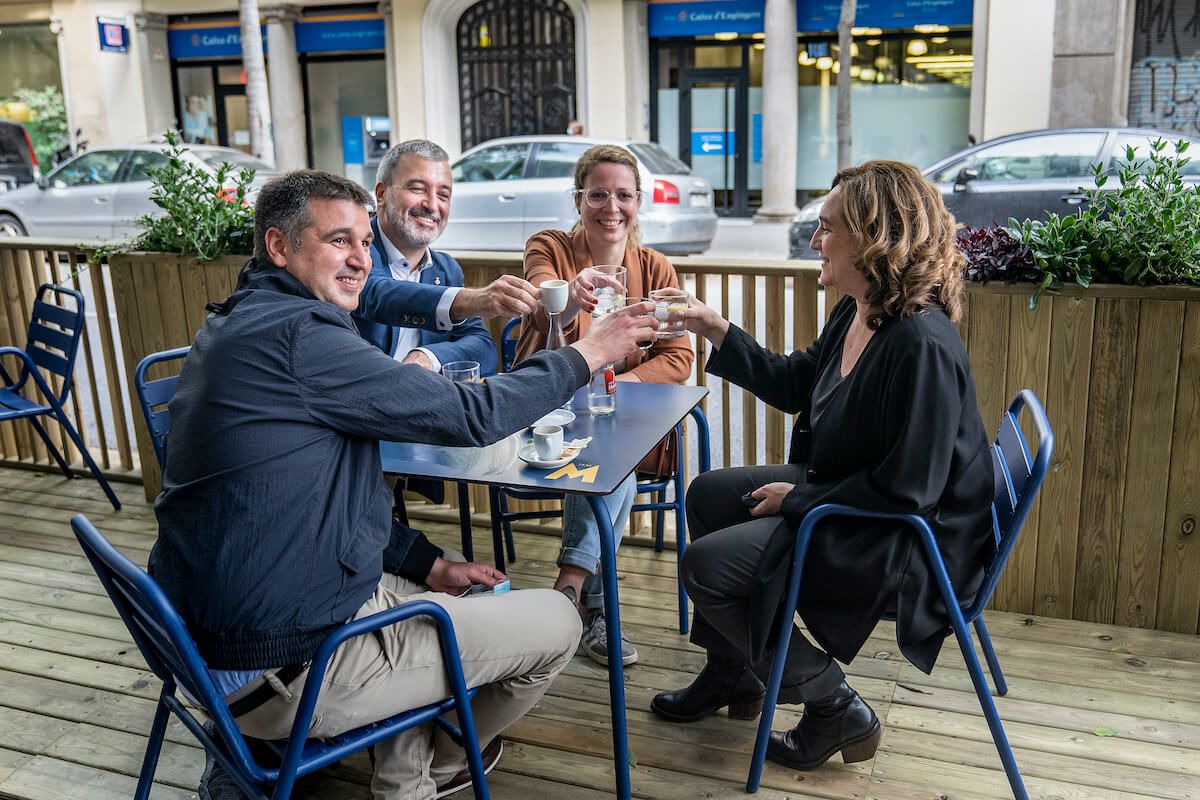
The City Council's commitment to maintaining terraces on the roadway is supported by the good reception this measure has had, temporarily promoted to respond to an emergency that gave rise to new needs, such as guaranteeing safety distance and generating spaces that minimized contagion. This provisional measure has proven to be a great success: the granting of more than 3,600 licenses for new terraces and expansions has allowed almost 1,875 jobs to be saved, according to a study by the University of Barcelona (UB).
On the other hand, according to a recent survey by the Restaurant Guild, Barcelona residents have increased their use of terraces, a space they continue to prefer, even in winter if there are heaters. 62% of respondents say they leave a place if there is no table available outside and only 18% are content to stay inside. "A demand that was already important before the pandemic has accelerated," Pallarols remarks. The association has also detected great acceptance for replacing concrete blocks with approved platforms, with 60% approving the change.
Add The New Barcelona Post as your preferred Google source for free
Stay informed with the latest news.
