Despite the history of chess dating back to the first century AD, it seems that it wasn't until 2020 when, thanks to the popularity of the Netflix series The Queen's Gambit, it became fashionable. The media impact, with over 65 million viewers, has been one of the most significant in the history of this sport, only comparable to the Fischer-Spassky world championship match in 1972 or the game starring Karpov-Kasparov in Seville in 1987, which was broadcast by TVE.
Barcelona has a significant and long-standing relationship with the world of chess, which continues to this day. Whether you are a novice or a passionate player of this game, we are going to show you, with the basic movements of the pieces, how we can move around the city as if on a board, and visit some of the main places in this history.
The first chess club in Spain, the Club d'Escacs Barcelona, was founded in the Catalan capital in 1921. Like pawns, which can advance two squares on their first move and then only one, it was members of this club who founded the Catalan Chess Federation in 1925 and, in 1928, the Spanish Chess Federation. Currently located in the Gothic Quarter, we also owe to them the organization of the I International Tournament of Barcelona in 1946, which not only attracted the first foreign players to the city but also laid the foundations for what is today one of the most important international open tournaments in this discipline.
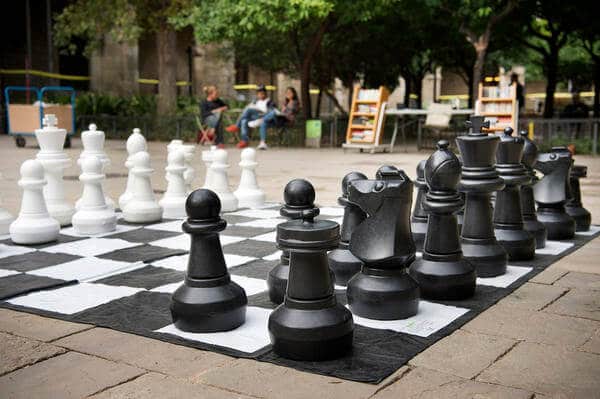
In the gardens of the Biblioteca de Catalunya, you can play a game of chess with a giant board and piecesWe move three steps in an L-shape like knights, until the Library of Catalonia. Here is preserved the reproduction of a manuscript from the last third of the 15th century, disappeared during the Civil War, called Scachs d'amor, a poem of 64 stanzas ---as many as squares make up a board---. But, also, the library has a wide collection of chess books and magazines, nourished especially in the 1940s, by the widow of Josep Paluzie i Lucena. Editor and passionate about this game, he not only wrote several books and articles for international magazines, but he was also responsible for the chess problems section of the Barcelona magazineThe Artistic Illustrationat the beginning of the century. With all the collected material, which included manuscripts of works and copies of texts, press clippings about plays, chess player contests and correspondence, in 1943 a bibliographic exhibition was organized in the library with the copies from the Paluzie collection. But the relationship of this center with chess goes beyond the newspaper and media library they have on it: it crosses the walls to go out into the garden, where since 2010 we find a giant board and pieces to be able to play a game at any time of the year.
Another cultural center in the city, which we will reach by drawing a diagonal imitating the movement of the bishops, is the Fundació Joan Miró, where the year in which Magnus Carlsen (current world chess champion) was playing for the title against another of the greats, Sergey Karjakin, the exhibition Endgame: Duchamp, Chess and the Avant-Gardes was inaugurated. The passion that the father of the ready-mades felt for this sport led him at one point in his life to put aside art to dedicate himself fully to the world of chess and even to be part of the French Olympic team. Thus, the exhibition was articulated around the chronology of Marcel Duchamp and his connection with chess as a common thread, to talk about "the constant presence of chess in multiple artistic currents," especially the avant-gardes.
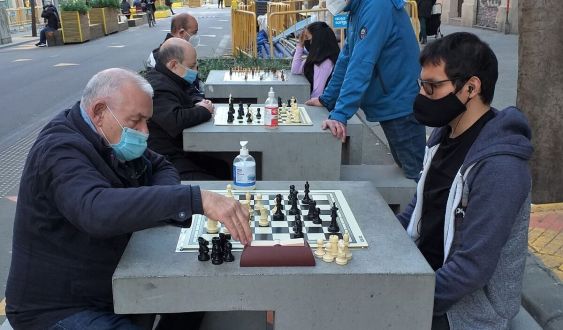
Let's go out into the street now with a resounding straight-line movement like the towers. In Barcelona, there are currently 25 chess clubs, four of them in the Division of Honor, which, together with the Catalan Chess Federation, organize more than 100 tournaments throughout the year, especially visible during major festivals. But just as happens in other cities ---Amsterdam and its Max Euwe Square, New York's Washington Square Park, or next to the beach in Zelenogradsk---, for a long time, Plaça Catalunya and its surroundings were an improvised meeting place for players who brought down their boards and pieces to play with anyone willing. But as with so many other things, the pandemic has forced them to change plans, which they have managed to transform, and thus, taking advantage of the only move in chess where a player moves two pieces at once, they have castled towards the superblocks of Sant Antoni, on one side, and towards Sant Martí, on the other. Thanks to the stone tables installed by the city council, Sundays are the designated days to meet following all safety measures, and to feel again the excitement before the board and the opponent that online games do not allow, despite the boom experienced on various platforms.
In Barcelona, there are 25 chess clubs that, together with the Catalan Chess Federation, organize more than 100 tournaments throughout the yearAnd just as in a game there are two kings, one on each side, also in Barcelona there are two major international open championships: the Sant Martí International Open, organized by the Club d'Escacs Sant Martí; and the Sants, Hostafrancs and la Bordeta International Open, organized by the Secretariat d'Entitats de Sants. Its importance is such that in the last edition that could be held, Sant Martí attracted some 300 participants and in Sants depots, a whopping 500 players from all over the world gathered, thus becoming the most powerful tournament in the country. Although in the past 2020 and in this 2021 they cannot be held, their value is like that of the king's piece: incalculable, it must be protected since the entire game depends on it, even though its movements are limited to only one square in any direction.
We have left the queen for last, not because she is not the most important but because she is the most powerful. She has the greatest reach of all chess pieces and can move in any direction and as many squares as she wants. The influence of the series The Queen's Gambit, as we said at the beginning, has had the power of this piece. "It has reached many people who have been in visual contact with the world of chess. It is an invaluable promotion in advertising terms," they point out from the Federation. They also tell us about how participation in virtual gaming portals or in the sale of chess sets has exponentially increased.
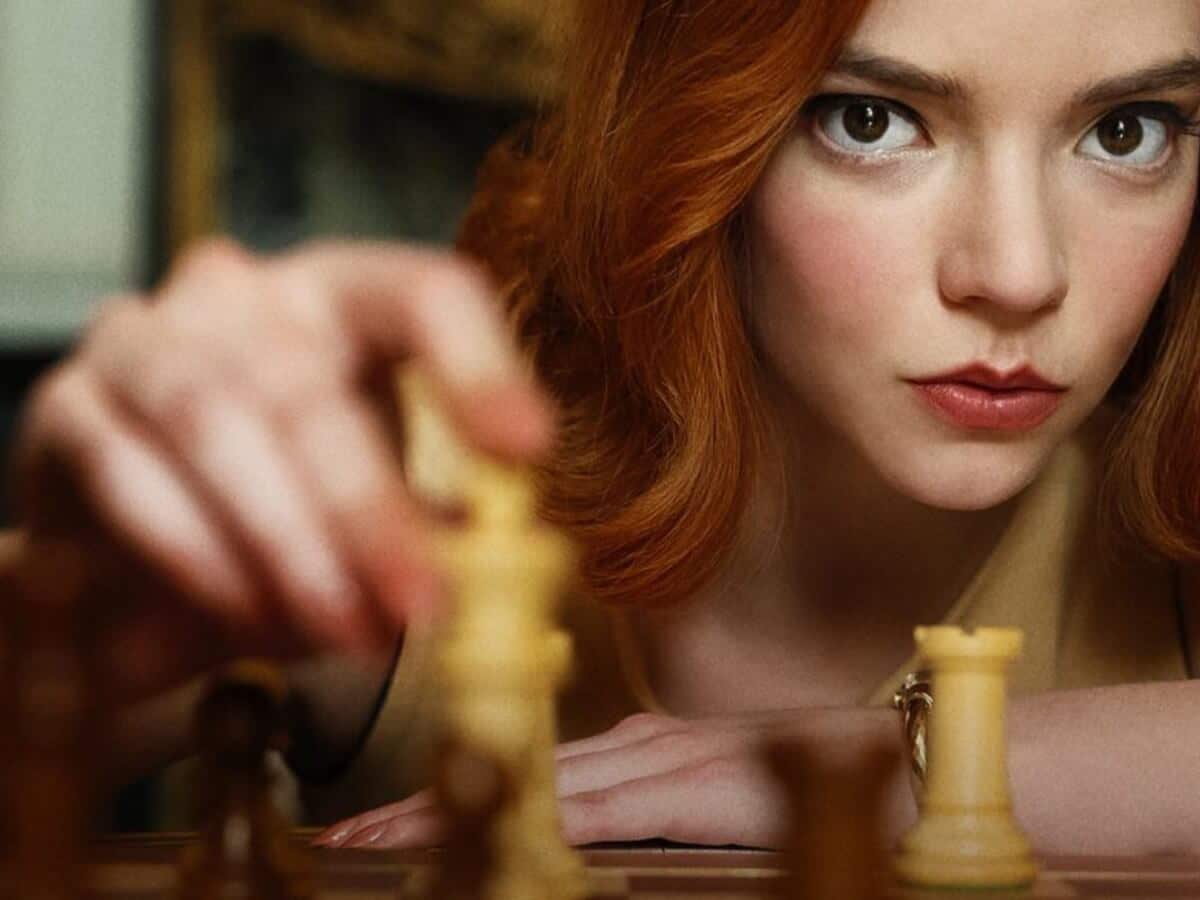
But if there is one thing in which the series has contributed very positively, it is in the dissemination of chess among women. The Chess and Women department of the Catalan Chess Federation has been working intensely for years to attract women who want to participate in this sport. Having female and highly media-savvy role models, beyond the Polgar sisters ---Judit Polgar is considered the best female player in history and is the only woman who managed to be among the top ten players in the world--- in a sport mostly practiced by men not only breaks down many prejudices but also opens doors to all those girls who want to play.
Add The New Barcelona Post as your preferred Google source for free
Stay informed with the latest news.
