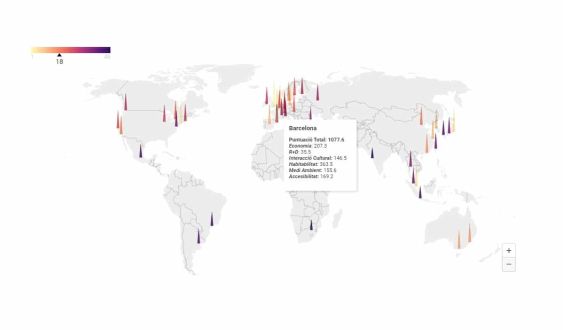
Barcelona has once again positioned itself among the twenty most competitive cities in the world, according to the Global Power City Index report, prepared annually by the Japanese Mori Memorial Foundation. Since 2016, the Catalan capital had not managed to get into the Top 20 of this ranking, where it registered its best score in 2012 (13th position). This 2021, it has managed to occupy the 18th position globally, rising three positions compared to 2020 and placing itself ahead of European cities such as Brussels, Vienna, Frankfurt or Dublin, and North American cities such as Toronto, San Francisco, Chicago or Boston. At a European level, it has placed itself in seventh position, two positions ahead of last year.
This classification, made with the participation of prestigious universities and think tanks, evaluates and scores "the magnetism of the world's main cities or their power to attract people, capital, and businesses." It does so by comparing a total of 48 large cities based on about seventy indicators, ordered into six categories of urban competitiveness (economy, research, cultural interaction, livability, and environment).
Since 2016, the Catalan capital had not managed to get into the Top 20 of this ranking, where it registered its best score in 2012 (13th position)For the Deputy Mayor for Economy, Labor, Competitiveness and Finance, Jaume Collboni, Barcelona's return to the Top 20 of this ranking shows that the city continues to be a leader internationally for the economic and business world.It is demonstrated that in Barcelona we are working in the right direction to generate more opportunities and more jobs, and that we have to continue investing efforts in making the city even more competitive and attractive for the landing of new investments and for the capture and attraction of global talent," he remarks.
While the Catalan capital has placed 18th, the first position of the Global Power City Index has been taken by London, followed by New York, Tokyo, Paris, and Singapore. Barcelona is not the only Spanish city that appears among the most competitive cities in this ranking and has been surpassed by Madrid, which occupies ninth place, entering the Top 10 for the first time.
Both Madrid and Barcelona stand out in the liveability category, occupying the first and third positions, respectively. This category assesses aspects such as the unemployment rate, labour flexibility, the price of rent and basic products, safety, and life expectancy.
Other categories where the Catalan capital obtains a good score are cultural interaction and accessibility, placing 14th and 16th, respectively. The first values the cultural and tourist dynamism of cities, with indicators such as the number of tourists and international conferences they host or the hotels and museums they have, while the second evaluates their connection, both within the city itself through its infrastructures and with the rest of the world according to the international flights they receive. In the other categories, Barcelona registers a more modest position: 26th in environment; 29th in economy, and 34th in research.
Add The New Barcelona Post as your preferred Google source for free
Stay informed with the latest news.
