
Climate change also affects schools, with classrooms ill-prepared to face an unprecedented rise in temperatures and increasingly longer summers. Until now, schools were prepared for a climate that did not exceed 30 degrees in summer, with tools such as the installation of cross-ventilation systems and portable or ceiling fans, and the air conditioning of common spaces or the creation of climate shelters in courtyards. Unfortunately, this threshold has been widely exceeded in recent years and the measures applied so far have lost effectiveness.
Given this emergency, the Barcelona City Council has launched the Pla Clima Escola Barcelona to increase air conditioning in schools and guarantee optimal climatic conditions in the classroom, as well as reduce the energy impact of the centers. "Given climate change and rising temperatures, we must be able to mitigate the effects in schools and restore comfort. But we also have to apply the energy transition in the centers to be more sustainable," explains the manager of the Culture, Education, Sports and Life Cycles Area of the Barcelona City Council, Sara Jaurrieta. A municipal commitment for the centers that is part of a global vision, not only reinforcing environmental education in the classroom to raise awareness among students, but also with a battery of measures to combat climate change in the city.
"Given climate change and rising temperatures, we must be able to mitigate the effects in schools and restore comfort. But we also have to apply the energy transition"With a budget of 100 million euros, fully financed by the tourist tax, the Pla Clima Escola Barcelona will act comprehensively in a total of 170 public centers in the city, with an estimated average cost of 590,000 euros per center. The actions will extend from this 2024 until 2029, benefiting classroom comfort formore than 55,500 students. Specifically, the plan will be carried out in 149 schools, two special education schools, and three high schools managed by the Barcelona Education Consortium. In addition, 16 school-high schools have been included in the project.
Firstly, the Pla Clima Escola Barcelona will involve the installation of mechanical air renewal systems, which will operate overnight and remove part of the heat, with the aim of ensuring quality air for students and other users. On the other hand, domotized thermal systems will be incorporated. These electric aerothermal systems will only be activated from the threshold of 26 degrees indoors in summer, while the threshold will be 21 degrees indoors in winter. By providing them with gradual and automatic activation, energy saving will also be favored.
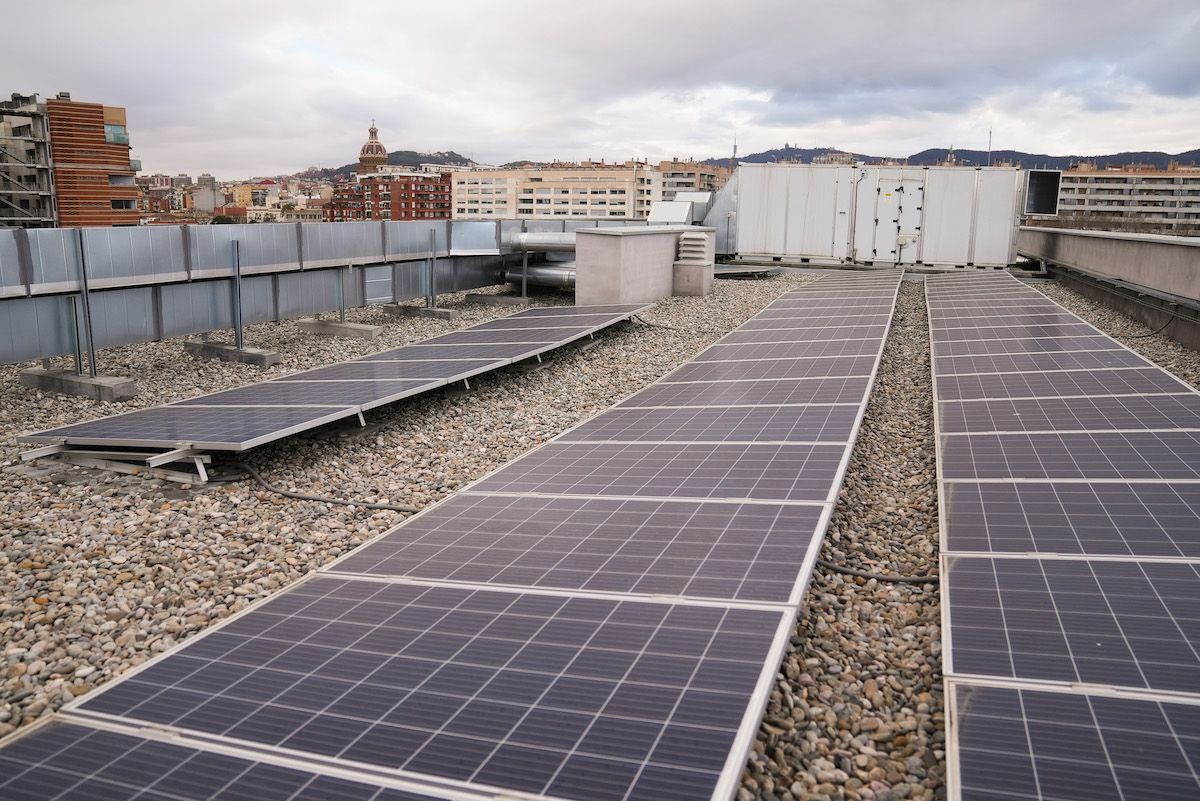
The actions of the Pla Clima Escola Barcelona will improve classroom comfort for more than 55,500 studentsLikewise, schools will be equipped withphotovoltaic panelsto favor decarbonization. It is estimated that the suitable area for installing solar panels on the roofs of the centers is a total of 181,000 square meters, with a projected annual production potential of 31.27 GWh/year, a figure that exceeds the energy needs to cool spaces during the warmer months and heat the facilities in winter. The installation of solar panels will not only allow schools to generate enough energy for self-consumption and improve the climatic comfort of the facilities, but will also allow them to produce energy surplus for the community, allocating it to other municipal facilities.
The electricity produced by solar energy will power the new aerothermal air conditioning systems, which will replace gas installations and improve the energy efficiency of the buildings. According to the city council's forecasts, by 2029 the 170 schools where action will be taken will go from using 73% gas and 27% electricity consumption to almost reversing the figures, with 62% electricity consumption and 38% gas. This gas will be consumed mainly in kitchens and boilers to heat water in changing rooms. In the future, it is also contemplated to study how to save this type of consumption.
Different phases of action
This 2024, action will be taken in a total of 24 schools where only minimal interventions will be necessary. Specifically, these will be Escola Drassanes, Escola Mediterrània (Ciutat Vella); Escola Fructuós Gelabert, Escola dels Encants, Escola Els Llorers, Escola Fort Pienc, Escola Mallorca (Eixample); Escola Anglesola (Les Corts); CEE Municipal Vil·la Joana (Sarrià- Sant Gervasi); Escola Josep Maria de Segarra, Escola L'Univers (Gràcia); CEE La Ginesta (Horta-Guinardó); Equipament antiga Escola Ramon i Cajal, Escola Can Fabra, Escola Eulàlia Bota, Escola Ignasi Iglésias, Escola La Maquinista (Sant Andreu); Escola Fluvià, Escola La Mar Bella, Escola L'Arc de Sant Martí, Escola Pere IV, Escola Provençals, Escola Sant Martí and La Llacuna del Poblenou (Sant Martí).
This summer, taking advantage of the holiday break, action will be taken in a total of 24 schoolsAfterwards, until 2029, works will be carried out in the remaining 146 centers according to their urgency. The criteria for classifying schools will be the location(closer to the mountain or the sea),the orientation(if they receive a lot of sun),the urban environment(if they are surrounded by a lot of traffic) andthe state of the building. Between 2025 and 2026, works will be carried out in 60 more centers and, between 2027 and 2029, in the remaining 86.
To minimize as much as possible the interference of the works with classes during the school year, the Pla Clima Escola Barcelona has distributed the tasks so that winters and summers concentrate, during holidays, the part of the process that could cause more inconvenience. The rest, approximately between both holidays, will be used to carry out simpler tasks with students indoors, such as, for example, deploying interior installations, assembling electronics, and finalizing details.
Add The New Barcelona Post as your preferred Google source for free
Stay informed with the latest news.
