
Barcelona has launched a pioneering energy network that harnesses residual cold from regasification. This solution, located at Enagás facilities in the Port of Barcelona, will power public buildings, in addition to the future Marina del Prat Vermell neighborhood, and the possibility of extending it to Mercabarna will also be studied.
In the traditional regasification process, liquefied natural gas (LNG) arrives at the terminal in liquid state, and seawater is used to transform it into natural gas at ambient temperature. With the new network, the residual cold generated by this process, which was previously wasted, is recovered and used at a temperature of 20 degrees below zero.
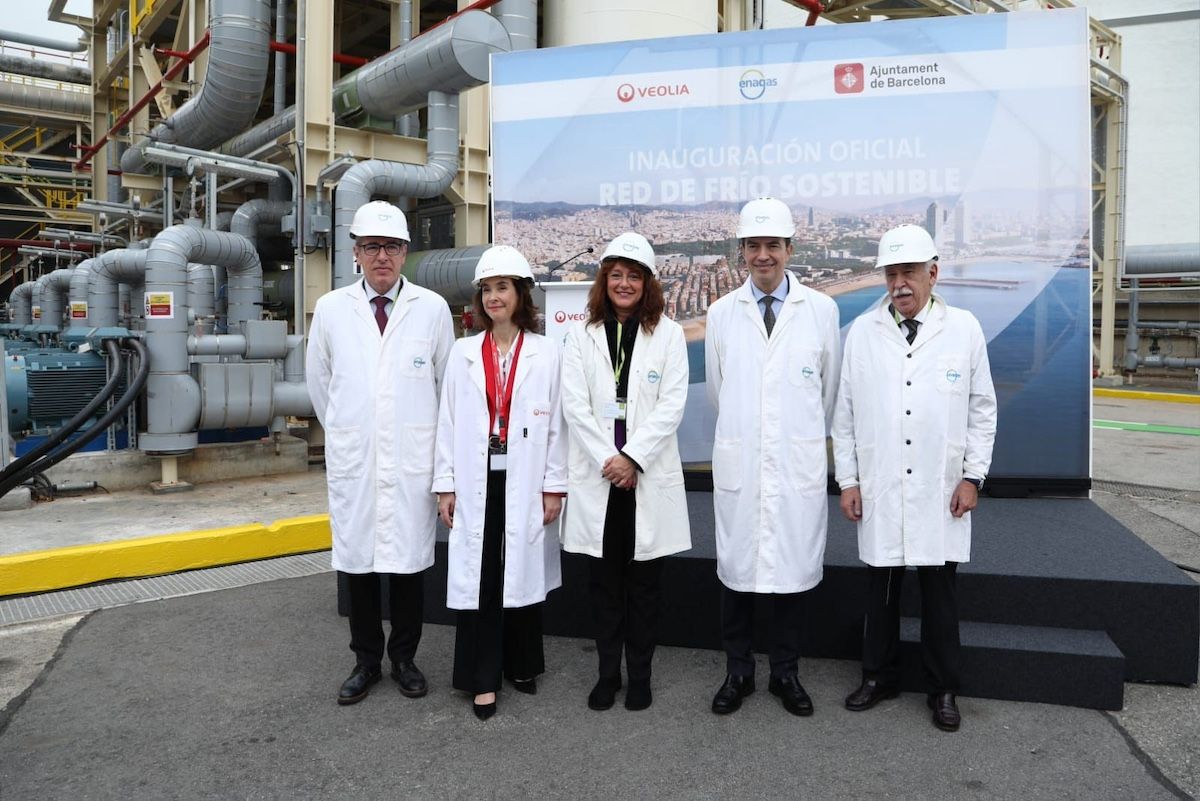
The project promoters have assured that it will allow the recovery of approximately 131 GWh of energy per year, equivalent to the annual consumption of a city like Reus. At the same time, it will save 32,000 tons of Co2 emissions, comparable to what 110 round-trip flights between Barcelona and New York emit. The network, developed with Enagás and Veolia, was inaugurated in the Zona Franca with representatives from the companies, Barcelona's Deputy Mayor, Laia Bonet, and the President of the Port of Barcelona, José Alberto Carbonell.
Through a 4.5-kilometer pipeline, the energy is transported from the Enagás plant to the south of the Catalan capital and L'Hospitalet de Llobregat, reaching infrastructures such as Fira de Barcelona, Generalitat offices, industrial areas, hotels, and shopping centers, in addition to homes. This was explained by Enagás CEO, Arturo Gonzalo, who noted that this project could be replicated in other cities.
Agreement with Mercabarna
In addition, Veolia has signed an agreement with Mercabarna to study the possibility of supplying sustainable cold to the fruit and vegetable markets and the fish market. It will also be analyzed for use by other companies and complementary activities, such as cold storage chambers for fresh and frozen food preservation, as explained by the company's CEO, Estelle Brachlianoff.
This cold reuse network allows for "advancing towards energy sovereignty" in a context where "we must be more prepared than ever and commit to projects that combat climate change," according to Bonet, who emphasized that the project began to be developed more than a decade ago, under the Mayoralty of now minister Jordi Hereu.
Add The New Barcelona Post as your preferred Google source for free
Stay informed with the latest news.
