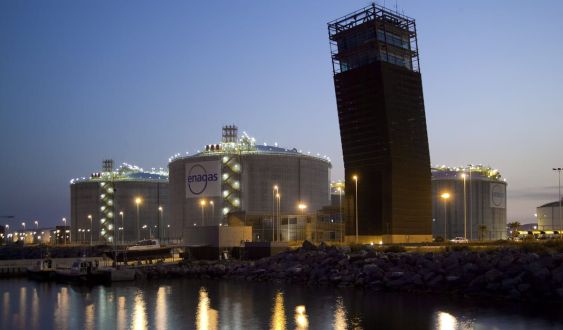
Barcelona will be a key piece in the reconfiguration of the European energy map. Catalonia's strategic logistical location and the Enagás regasification plant in the Port of Barcelona position the city as a clear reference point for building the necessary infrastructure to minimize dependence on Russian gas. This was made clear this Thursday, after France, Spain, and Portugal agreed to build an underwater pipeline that will link Barcelona with Marseille and will be able to transport both natural gas and green hydrogen.
This 360-kilometer gas pipeline, which will be called the green energy corridor between the Peninsula and France, could be named BarMar and represents an alternative to MidCat, a project that aimed to interconnect Catalonia with France through the Pyrenees and did not have the approval of President Emmanuel Macron. Precisely, this Thursday, before the European Council, Spanish President Pedro Sánchez and Portuguese Prime Minister Antonio Costa met with Macron to try to convince the French leader about the virtues of MidCat, but, surprisingly, this alternative proposal emerged from the meeting.
According to Sánchez, the new Barcelona-Marseille corridor is "very good news" resulting from "many months of intense work between the three governments" and will allow "to accelerate the interconnection process" between the Peninsula and Europe. The objective is to finalize the details of the project at a meeting to be held in Alicante on Friday the 9th, coinciding with the Euromed summit, where three fundamental issues will have to be defined: "the deadlines for investment, the cost sharing, and the volume of necessary economic resources," reports ACN.
In a joint statement, the three countries claimed that the interconnection between Barcelona and Marseille is "the most direct and efficient option" to connect the Iberian Peninsula and central Europe and considered its creation "a priority."
The president of the Generalitat, Pere Aragonès, has celebrated the announcement because "it marks Catalonia and Barcelona as a neuralgic point of the new European energy structure". According to the Govern, this initiative is viewed favorably because it will be a gas pipeline already adapted for green hydrogen and will avoid the construction of a new infrastructure of that magnitude through the Pyrenees. The MidCat generated controversy in the affected territory, that is, in the Girona regions. In fact, the European Commission stopped financing the viability plans of its promoters, Enagás and Terega, because it did not see it as profitable, and even less so taking into account the European Union's green transition strategy.
The president of Foment del Treball, Josep Sánchez Llibre, one of the leaders who has most defended the MidCat and the need to highlight the role that Catalonia can play as a strategic energy hub within the new European context, has also applauded the agreement. "We are facing a very important decision" to guarantee the energy supply to the European territory, Sánchez Llibre highlighted. "Catalonia ---he pointed out-- will be part of the lung of the European Union" and thanks to this agreement investments and jobs will be generated in the Catalan territory. "The investment effort in the country's regasification plants finally sees the great utility it represents," Sánchez Llibre stated, who believes that the new infrastructure "will provide security to the electricity supply" of the European Union "whatever the conditions".
Foment del Treball has added, however, that it "will not stop insisting" on the need to connect, also through a gas pipeline, Barcelona with the city of Livorno, in Italy, a project that gained strength given the French refusal to Midcat.
Add The New Barcelona Post as your preferred Google source for free
Stay informed with the latest news.
