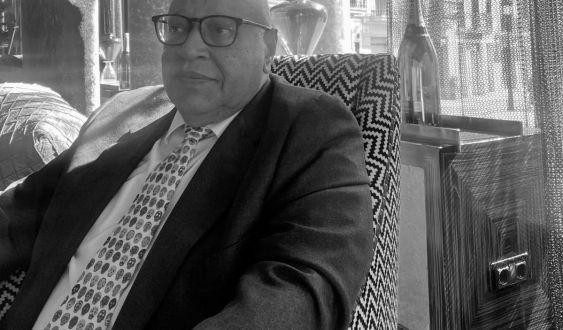
Virgil Simons (Chicago, 1946) arrived in Barcelona ten years ago after having lived in New York (and worked in the textile, hotel, and healthcare sectors) and in Paris. He is the president and founder of The Prostate Net, a foundation based in New Jersey dedicated to the prevention and minimization of the ravages of prostate cancer. Its scope of action is global and focuses on both educating and early detection of the disease (which he himself suffered) and supporting the patient during treatment or in an advanced state.
The reason for moving his organization to Barcelona is, in part, due to the desire to expand its action to Europe and Africa, but also to the well-being that Simons has found in the city. He frequents all the jazz clubs in Barcelona and lives in an apartment right in front of the new María tower of the Sagrada Familia. A light turns on in the cave when Simons starts to speak. In jazz, one is allowed to applaud after a solo: Simons dedicates a few to us.
--What are you doing here?
--I have been lucky enough to travel a lot through various countries in Asia, Europe, and Africa. New York was for me an example of quality of life, and it is the city where I learned that with imagination you can do everything. Not all cities lend themselves to it: Chicago, for example, is the city where I was born, but it doesn't offer as many possibilities as New York by far. There, the atmosphere was (and still is) very discriminatory in racial terms. A non-formal racism, but de facto, a blockage of various personal exits: there, for example, Italians formed their groups and even mafias could operate, but it was because they behaved, they became "useful." There was no incentive for disruption. As a child, for being black, I had to run and obey certain unwritten rules: if you are black, some parts of the city are not open to you. In New York, the famous "gangs" have become businessmen, free trade makes you more democratic and peaceful. In New York you can progress well, in Chicago you can have a lot of money and even imagination, but you will still have barriers.
--And in Barcelona?
--Here I was going: Barcelona is even more open than New York. In Barcelona you don't wake up thinking you're black, in this sense it resembles cities like Amsterdam, Genoa or Milan: here you have the feeling that everything is possible and that you just have to have class consciousness.
--Class consciousness?
--Yes: here, just by seeming to be something or truly wanting to be something, you are. Barcelona is a city of connected closets, and here I feel I can be part of many different closets. It's very flexible, more so than New York, and I suppose that has to do with the Catalan character. I believe you are an open country, a place of passage, of commerce, where difference is not a problem but a virtue. It's a sophisticated community, with style. What you experienced in 2017 is associated with the fight for civil rights, and it's not that it ended badly: the importance of the mobilizations against the Vietnam War was not that they managed to stop any war, but that they existed. The only problem is that losing that atmosphere is easier than recovering it.
--And now we are in 2022. It's a non-stop string of misfortunes, isn't it?
--The pandemic has forced us to make sacrifices and we have learned to be deprived of things, to not have everything. We have hardened, we have strengthened ourselves at a private and individual level. The potential of this is that the time to come, also difficult and warlike, demands that capacity for resistance and resilience. Now we are capable of doing more things with less. I am not worried about the war, because we have shown ourselves to be strong enough.
--What does The Prostate Net do?
--In '95 I suffered from prostate cancer and that caught me in New York, where I underwent treatment. I must say that here the quality of care would have been the same or better (and I was in the hands of the best American surgeons), but here, in addition, it would have been much cheaper. It was in '98 when I saw that, in any case, many improvements were needed in care and treatment: at first, the doctors didn't want to do tests on me, like the PSA (prostate-specific antigen) measurement, and had it not been for an excess of cholesterol, I would never have known I had cancer. I started to feel bad, and we discovered that the cholesterol medication was masking the blood indices that indicated cancer. I decided to take action and, once recovered, I wrote a book about managing the disease. Then, an informative website and a free phone number for frequently asked questions. From there we moved on to barber shops.
--Excuse me... barber shops?
--We had to deal directly with people, and we devised The Barbershop Initiative. Black people make barbershops their club, their community, their confessional: we used barbers as antennas to talk to their clients, raise awareness, and direct them to get scans and tests. We got 75,000 people to get tested. We only needed to identify and train barbers, putting them in communication with doctors and promoting their collaboration. We spread it across many American cities, and from there we moved on to I'll go if you go: involving museums, cultural centers, to hold information events. Then we just had to identify women who would make it possible for their husbands to go to the museum for free if they also went, and we would then take the opportunity to immerse them in prostate cancer awareness. Then we expanded the initiative to breast cancer, reversing the roles.
--It's a hassle to get it checked out.
---And age doesn't forgive! Gentlemen, check your engines was a collaboration with Harley Davidson where we invited them to reflect that their customers took better care of their motorcycle than their body. The midlife crisis, etcetera.
--I don't know what you're talking about.
--Well, Harley Davidson understood it right away: "you're interested in your customer, from 40 or 50 years old, staying alive." It's a crushing logic, isn't it?
--Yes, it is.
--Therefore, we brought doctors to sales establishments, with appetizers and entertainment, and then we took the opportunity to invite them to a medical check-up program. We did it all over the world.
--And then you settle in Barcelona?
--I knew Barcelona from when I worked a few years in El Masnou, in a textile company [the former Dogi]. It seems to me an open society, that doesn't look at your money or where you come from. Here the opportunity to live well is quite proportional to the time and effort you invest. It's New York, but without the stress. In New York you have to invest a lot of energy just to survive, people walk faster on the streets, they eat in 30 minutes at their desk, they work 60 hours a week. In Barcelona you are less than two hours from everything, from everywhere, and you can dedicate a part of your time to enjoying life.
--I'm missing the bad part.
--It's not such an easy city to do business in. It's very noticeable that there are few historical families in Catalonia that have led the country, and the inbreeding created over the years is noticeable. I detect about 50 people who pretty much share the pie, but the advantage is that if you really manage to get into one closet, it won't be hard to move to the next closet.
--So we are not that open.
--You are in spirit, but you don't enjoy it. The challenge is this: since you are, enjoy it to the fullest! Take advantage to change the focus, open your mind, live the exchange. I cannot understand, for example, why administrative procedures are so slow and complicated here. Bureaucracy suffocates you. I started the process to renew my foreign resident card in October and I haven't managed to get it until February, after being sent from Barcelona to Manresa and back to Barcelona. The mobile capital should show more confidence and bet more on technology: procedures should be immediate, as should renting or buying a house, or opening a business, or having a driver's license: I had an American driver's license and they forced me to take a whole driving course!
--It's just that here they don't want us to drive in the city.
--A new course! As if I had to learn from scratch or as if the signs weren't universal. It wasn't worth it.
--They also say that we should be the city of research and development.
--Our foundation is very focused on this area, and Barcelona seems like a good place for us to do it. We managed to finance four researchers, paid entirely by the American government... but by the Department of Defense (where there is always funding). Here it should be possible to promote business initiatives without falling into a defect that you should not forgive yourselves for either: stealing ideas. Please don't steal. Share! What are you afraid of?
--Finally: jazz.
--Life is more like an improvisation than a creation on a score.
Add The New Barcelona Post as your preferred Google source for free
Stay informed with the latest news.
