Volunteer lists, mobility devices, giant screens, fan zones… A year and a half after the announcement that Barcelona would be the setting for the Grand Départ of the Tour de France 2026, the city is finalizing preparations to host it, and not only that: it wants to extend it to all districts, making it transcend beyond sport. In this endeavor, many areas of the city have joined in: shops, hotels, and even a major festival, a bread, a cake, an official song, and a commemorative jersey inspired by the Eixample.
All of this, to turn the start of the Tour from the Catalan capital into a "citizen's celebration," and a historic edition. And the city will be celebrating: it will be the first time it hosts the Grand Départ. Although the Tour has already passed through Barcelona three times, it has never started from its streets. Hosting the Grand Départ implies a dimension that goes beyond being a stage in the route, and expands its impact. So much so that the city will become the nerve center of the Tour for several days: it will host the official presentation of the teams, the initial time trial, the first stages, and all the logistics and deployment that this implies, from sponsors to technical teams and journalists. "The arrival of the Tour de France in the city represents the consolidation of Barcelona as a global sports epicenter and a great opportunity to bring cycling closer to the citizens," defends the Sports Councilor of the Barcelona City Council, David Escudé.
Converted into a global showcase for cycling, the city will take advantage of this projection to maximize it on an international scale and, at the same time, bring it to its neighborhoods. With this objective, the Tour will not be limited to the race route or to the great stages of Montjuic or the coast, but will extend to the entire city. In what format? With a citizen festival with about sixty activities between the end of June and the beginning of July. This major Tour festival will have music as one of its main axes, with performances by Sexenio, 31Fam or Doctor Prats —also responsible for the official Grand Départ song, Energia—. "We want it to be a great citizen festival for the people of Barcelona, to be experienced in the streets and squares. That is why we have organized the Tour's Major Festival, and that is why the team presentation will unite architecture and sport," in two emblematic spaces of the city, such as the Hospital de Sant Pau and the Sagrada Familia, as Escudé highlights.

The city will also deploy itinerant shows and participatory activities to bring the Tour to the neighborhoods. Among the most unique proposals is Le Tour on Tour, a mobile show that will travel through various points of Barcelona bringing music, entertainment and cycling atmosphere to the streets. This will be joined by popular bicicletadas, children's activities, sports exhibitions and spaces to follow the competition from giant screens and fan zones. And even more: more than 50 buildings and fountains will be illuminated in yellow, and large maillots will be installed in all districts.
La gastronomy is not left out, with proposals that include products created especially for the occasion: the Pan del Tour, from the Gremi de Flequers de Barcelona, and the cakes created by the Gremi de Pastisseria de Barcelona, inspired by the Tour's maillots. The recipes have been opened to pastry shops and bakeries in the city so that they reach all neighborhoods. And not only that: commercial hubs, such as El Clot, will organize routes to taste the bread and cakes with the Tour brand.

There are many commercial hubs that are preparing activities to dye Barcelona yellow for the Grand Départ. "Activities are being organized in practically all districts," highlights Jordi Arias from Barcelona Comercio. A tapas tour in the Sagrada Familia district, trade, gastronomy and sports days in hubs such as Creu Coberta and Coreixample, or cycling workshops for children and adults are just some examples of what the city's commercial universe is preparing to join the Tour. And one more recipe: a Tour Omelette, still with secret ingredients, can be tasted in several markets.
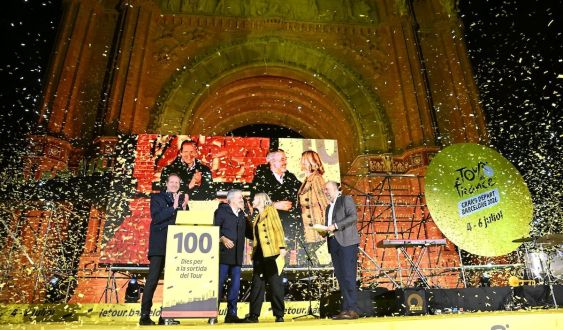
"We are not content with just hosting the Grand Départ; we want to make history in the Tour de France," says Escudé.Thus, commerce is making the most of the event from multiple angles: "It is very positive that a global event like the Grand Départ comes to Barcelona, and that it reaches all neighborhoods of the city, also through commerce," highlights Arias. In addition, it coincides with the European Capital of Proximity Trade, which Barcelona premieres this year."Being able to unite the Tour and the Capital City is very powerful", and even more so on dates when commercial activity usually decreases on weekends, with the arrival of summer: "It's one more reason to encourage consumption." The city already had a taste of this festive cycling atmosphere, with a party for the 100 days to Grand Départ, on March 26.
In this way, Barcelona seeks for the competition to be experienced not only on the road, but also in shops and squares. There will be 14 commercial areas, 40 municipal markets and six shopping centers that will organize activities, workshops, concerts, exhibitions and gastronomic proposals revolving around the Tour, to which facilities such as the Port Olímpic, Tibidabo and the Zoo will also join. The city's hotel ecosystem is also preparing for the event, in coordination with the Barcelona City Council, both for the agenda of events and, above all, for the logistics and mobility alterations that will affect their guests, as explained by the Barcelona Hotel Guild.

"We want the team presentation and the start to be historic; we are not content with just doing the Grand Départ, but we want to go down in the history of the Tour de France, just as Barcelona went down in history with the 1992 Olympic Games," says the Sports Councilor. In this sense, the City Council seeks that "all areas of the city, cultural, educational and sports, feel like protagonists of the arrival of the Tour in Barcelona."
When the city has already been warming up its engines (or pedals) for days with the Tour's Main Festival, the start will arrive on July 4. The first stage, a team time trial of about twenty kilometers, will start from the Fòrum and cross some of the city's major urban and maritime axes, before climbing towards Montjuïc. This final scenario will once again be the protagonist of the second stage, the following day, which will depart from Tarragona to return to the Olympic mountain, in a route that will combine sea, architecture, Olympic spaces and urban landscape.
After the first two stages with Barcelona as the protagonist, the Tour will continue its route through Catalonia, before heading towards France. The third stage will depart from Granollers on July 6 towards the Pyrenees and the French border. In total, 63 Catalan municipalities will participate in one way or another in the Grand Départ, either as part of the route, hosting activities linked to the race or forming part of the logistical operation.
To articulate this entire operation, the Tour relies on an essential figure for the event: the volunteers. Distributed throughout the 63 municipalities of the route, they will mainly perform information and citizen support functions, collaborating to organize public flows and accompanying the deployment of the device in coordination with the city councils. Beyond logistics, the Government wants to turn this volunteering into an expression of "collective pride" and the vocation of collaboration with major international events, as highlighted by the Minister of Sports, Berni Álvarez, when the Generalitat opened registrations in March. Since then, more than 4,200 citizens have registered to participate as volunteers, as detailed by the Department of Sports of the Generalitat.

Volunteers also have a role in bringing the Tour to all layers of citizenship, and in the legacy that is intended to be left in its wake through Barcelona and the rest of the Catalan municipalities, beyond the three days of competition. This legacy will remain both in the form of international projection and positioning in hosting sporting events, as well as in promoting cycling culture, bicycles and sustainable transport, and strengthening a network of local agents ranging from sports clubs to citizen entities that will be involved in the device.
"The main legacy will be that Barcelona is, once again, the main ambassador of sport, and that the bicycle becomes part of the daily life of citizens. Not only as a sporting practice, but as a means of transport," Escudé emphasizes. In this way, when cyclists leave Catalonia behind for France, they will also have left an imprint on the world of cycling and on a collective welcome that will have involved institutions, neighborhoods, businesses, citizens and much more, in Barcelona's eagerness to host events not only for the impact of the moment, but so that they endure.
Add The New Barcelona Post as your preferred Google source for free
Stay informed with the latest news.