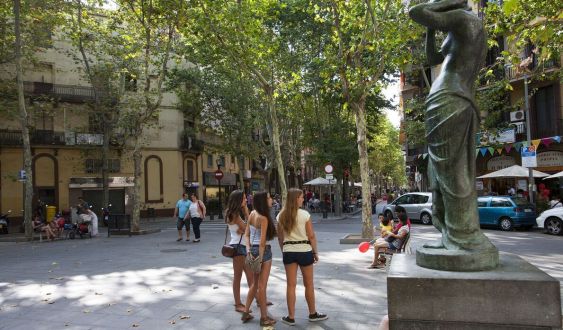
Configure your GPS because very soon Barcelona will change the name of some of its locations. The City Council's Nomenclator committee has given the green light to the introduction of four women's names to four more squares in the city, a movement that seeks to give greater visibility to the female gender in public spaces, given that only 12% of Spanish streets bear women's names, according to a study by the Pablo de Olavide University of Seville.
Likewise, the council has approved the nomenclature of Trabajadoras de la Numax (Numax Workers) for the interior of a block patio near the Plaza de la Sagrada Familia ---where the Niza cinemas used to be located--- in homage to the employees of this appliance factory who led a long struggle to improve their working conditions.
A space located between Selva de Mar, Treball and Concili de Trento streets and Angeleta Ferrer square, in the Sant Martí district, will bear the name of Carmen Balcells (Les Olegues, 1930-Barcelona, 2015), the renowned editor who represented six Nobel Prize winners and who is considered a key figure in the boom of Latin American literature of the second half of the 20th century.
Recently, the writer Carme Riera published a work as a tribute to her former literary agent: Carmen Balcells, traficante de palabras (Carmen Balcells, trafficker of words) (Rosa dels Vents, 2022). Riera, who is a member of the Royal Spanish Academy, states that Balcells put the city of Barcelona on the map for the population of Hispanic America, at a time when the Catalan capital was known only for Barça. Vargas Llosa, García Márquez, Carlos Fuentes, Nélida Piñón or José Donoso are some of the names that the editor brought to our country.
The landscaped intersection between Freser, Trinxant and Indústria streets, also in Sant Martí, will honor the first registered female architect in Catalonia, Margarita Brender i Rubira (Romania, 1919-Castellón, 2000). Brender was for a long time the only woman practicing the profession alone in the province of Barcelona. Her style was very avant-garde, with Mediterranean influences and a strong interest in the integration of architecture with nature. Among her most notable works are the block of 346 homes, Can Mercader (Badalona), and a luxury residential complex in El Prat de Llobregat.
The garden adjacent to the Les Corts Women's Prison monument, at the intersection of Joan Güell and Europa, will be named after Carme Claramunt i Barot (Roda de Berà, 1898-Barcelona, 1939), the first woman executed by the Franco regime in Campo de la Bota, at the age of 41. Claramunt was a political activist, a member of Esquerra Republicana and the communist party Estat Català. She was denounced by her neighbor and her own aunt, and arrested without any conclusive evidence by the Falangists, who accused her of military rebellion and against the legitimate power of the State.
The road located between Carretera del Carmel and Avenida de Pompeu Fabra, in Gràcia, will be named after Josefina Torrens Illa (Barcelona, 1902-Barcelona, 2006), a swimming pioneer and winner of five Catalan Championships in different modalities, as well as the Travessia del Port de Barcelona in 1932. She was a prominent figure of Club Natació Barcelona and founder of the first exclusively female Catalan sports institution, Club Femení i d'Esports.
In addition, Dolors Canals i Farriols (Barcelona, 1913-Barcelona, 2010), a pedagogue recognized by the Ministry of Labor of the Republic, will also have her name in the city, although in her case, it will be for the passage located between Plaza de Albert Badia i Mur and Bonaventura Gispert street in Sant Andreu. Canals dedicated part of her life to scientific research on early childhood. Coinciding with the outbreak of the Spanish Civil War, she prepared all Catalan nurseries for the war conflict and trained interdisciplinary teams, in order to ensure the education, health, hygiene, and nutrition of children between 0 and 6 years old.
Add The New Barcelona Post as your preferred Google source for free
Stay informed with the latest news.