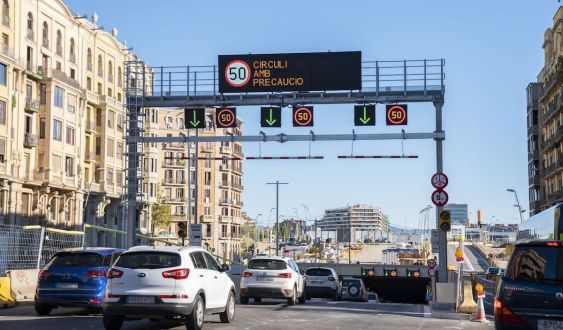
Mobility as a tool for the city, sustainability and progress is the title of the latest report promoted by the Barcelona Global association, which includes a series of proposals to address mobility in the Catalan capital and its surroundings from a metropolitan perspective. Beyond a review of the current context, the Barcelona civil society lobby has gathered the voices of experts in the sector ---RACC, Telefónica, Seat, Abertis, Saba, FGC, Renfe or TMB--- and from different areas to propose solutions to the challenges Barcelona will face.
Among the conclusions, the need for public and private administrations and operators to lead a grand pact is highlighted so that metropolitan mobility is safe, sustainable, and intermodal and places citizens at the center of all its actions. For this reason, there is a main proposal: the creation of an "agency for metropolitan mobility" to replace the current Barcelona Mobility Pact, which they describe as "obsolete."
This objective should be achieved, according to the report, through the development of a real metropolitan mobility governance model, with the capacity to "plan, design, execute and evaluate mobility policies with a broad vision of the territory", which requires "governance that involves all implicated administrations (Government, Generalitat, Metropolitan Area and Barcelona City Council) and public and private mobility operators."
Critical of the current metropolitan mobility model, considering it "unsustainable," they point out a series of actions that have been implemented with a short-term vision and without rigorous execution, and others that have not been addressed and would facilitate a change of model: the implementation of Park&Ride dissuasive parking lots, the management of car access to the capital, or the decarbonization of the taxi fleet.
They also advocate for a Bicing network that connects Barcelona city with the rest of the municipalities in the metropolitan area. In this regard, the association criticized that the metropolitan Bicing system will not connect with that of the Catalan capital, something that will generate daily "problems" for citizens moving between both areas. Along the same lines, Barcelona Global calls for revising some sections of bike lanes, regulating the use of electric scooters, decarbonizing the entire public transport fleet, and facilitating the deployment of electric chargers.
The study, which was presented in Barcelona at an event closed by the Minister of Transport, Mobility and Urban Agenda, Raquel Sánchez, throws "a dart against everyone" involved and not just against the local government of Barcelona, according to the president of this association, Maite Barrera, who insisted that "mobility is an important critical element" and that the challenges it poses must be faced from "consensus and dialogue, and acting with rigor," she pointed out.
Finally, the authors of the report consider it "urgent" to address the financing model for public transport and infrastructure, and call for improvements in the fare scheme, which they say should be "more equitable and accessible."

Add The New Barcelona Post as your preferred Google source for free
Stay informed with the latest news.
