
Stained glass windows always star in the most coveted photos when visiting a cathedral like Barcelona's, even if it's hard to capture them in their full splendor, but little is known about the centuries of history behind them. Even less so among locals, who don't even remember the last time they entered one of their most touristy buildings, which received almost 750,000 visitors last year. With the aim of dusting them off and making them shine again, Barcelona Cathedral has carried out a deep restoration of the stained glass windows in its ambulatory, surrounding the altar. They are the oldest in the entire temple, built in different stages, some dating back to the 14th century, and were in very poor condition.
For several years, starting shortly before the pandemic, architects and glaziers have been dedicated to dismantling, cleaning, repairing, remaking, and reinforcing the 12 windows around the ambulatory, compositions characterized by being made with colored glass and assembled with lead rods, with the saints in the lower chapels as protagonists. According to architect Manel Julià, it was decided to act on these pieces when it was detected that the grilles protecting them had rusted and some supporting stones were loose, with the imminent risk of them falling into the temple and harming someone. Pigeons had not helped either, staining the exterior of the stained glass windows with their doings, as well as air pollution that also dirtied them.
Visitors, surely, had not noticed, but, in a restoration of these stained glass windows that was done after the Civil War, some plates had moved and had been misplaced, such as the one dedicated to Saint Sylvester, with bishops and cardinals looking outwards when they should have been looking inwards. These are details that art historian Sílvia Canyelles has been able to rectify, who, precisely, dedicated her doctoral thesis to the stained glass windows of Barcelona Cathedral. As the researcher points out, the haste for the cathedral to shine in the early years of the Franco dictatorship was responsible for these blunders and subsequent interventions had not corrected them until now. Of course, not everything could be returned to its original state, with Saint Peter and Saint Paul still feeling a little out of place in each other's spot.
The workshops of glaziers Bonet, in L'Hospitalet de Llobregat, and Grau, in Montcada i Reixac, have been responsible for the piece-by-piece restoration of the stained-glass windows, now returned and well-placed in a cathedral that has almost 200 windows. In addition, their exteriors have been protected with glass to avoid the trace of pigeons and mitigate light pollution.
After the touch-ups they have undergone, they look brighter and, even from a great distance, their details are much better appreciated. A lifting that looks much better when compared to the rose windows directly above them, dark and disheartened, still pending their own surgery. Other stained-glass windows that have been updated on other occasions are those on the main facade and the rose windows of the central nave. The stained-glass windows of the side naves still have room, considering they date from the 20th century.
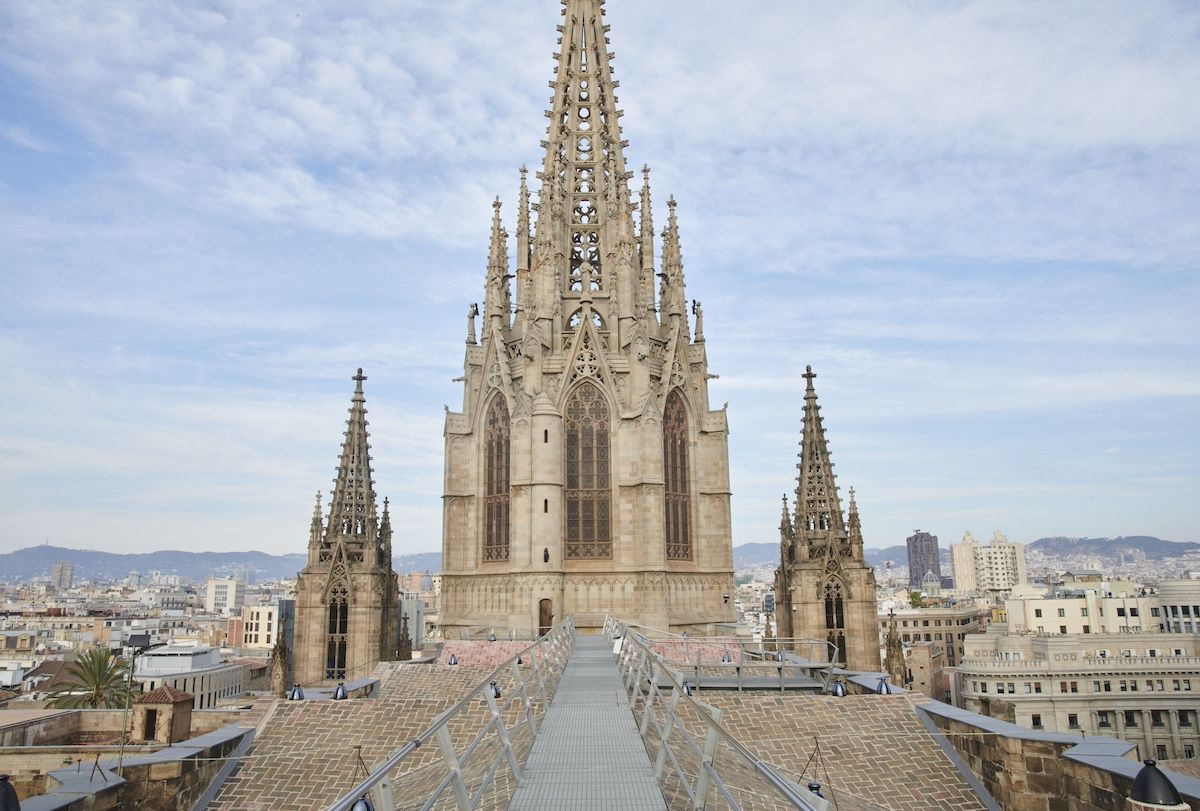
After the touch-ups the stained-glass windows around the ambulatory have undergone, they look brighter and, even from a great distance, their details are much better appreciatedIn case all this seems like too little an excuse for anyone to be encouraged to drop by the cathedral, despite it usually being overpopulated, the restoration of the apse's stained-glass windows has been accompanied by an improvement of the route that can be taken on its terrace, another viewpoint from which to see Barcelona, especially its historic center. Access and security have been improved, so now it is possible to go almost completely around the entire temple, sides, facade and central part, pending being able to pass through the area where the ambulatory remains.Action has also been taken on the tiles covering the naves to prevent damage to the church roof and the cloister, where the 13 geese, probably the most popular tenants, are always heard.
All these actions have been mainly financed by the Government, which has contributed more than one million euros. The budget has also been covered by FEDER funds, with almost 640,000 euros, and the Generalitat, with more than 220,000 euros. In total, the execution cost has been around 2.56 million euros. The Minister of Transport and Sustainable Mobility, Óscar Puente, the acting Vice President of the Government, Laura Vilagrà, the Barcelona City Councilman Albert Batlle, the Archbishop of Barcelona, Cardinal Joan Josep Omella, and the Dean of Barcelona Cathedral, Father Santiago Bueno, attended the inauguration.
Add The New Barcelona Post as your preferred Google source for free
Stay informed with the latest news.
