
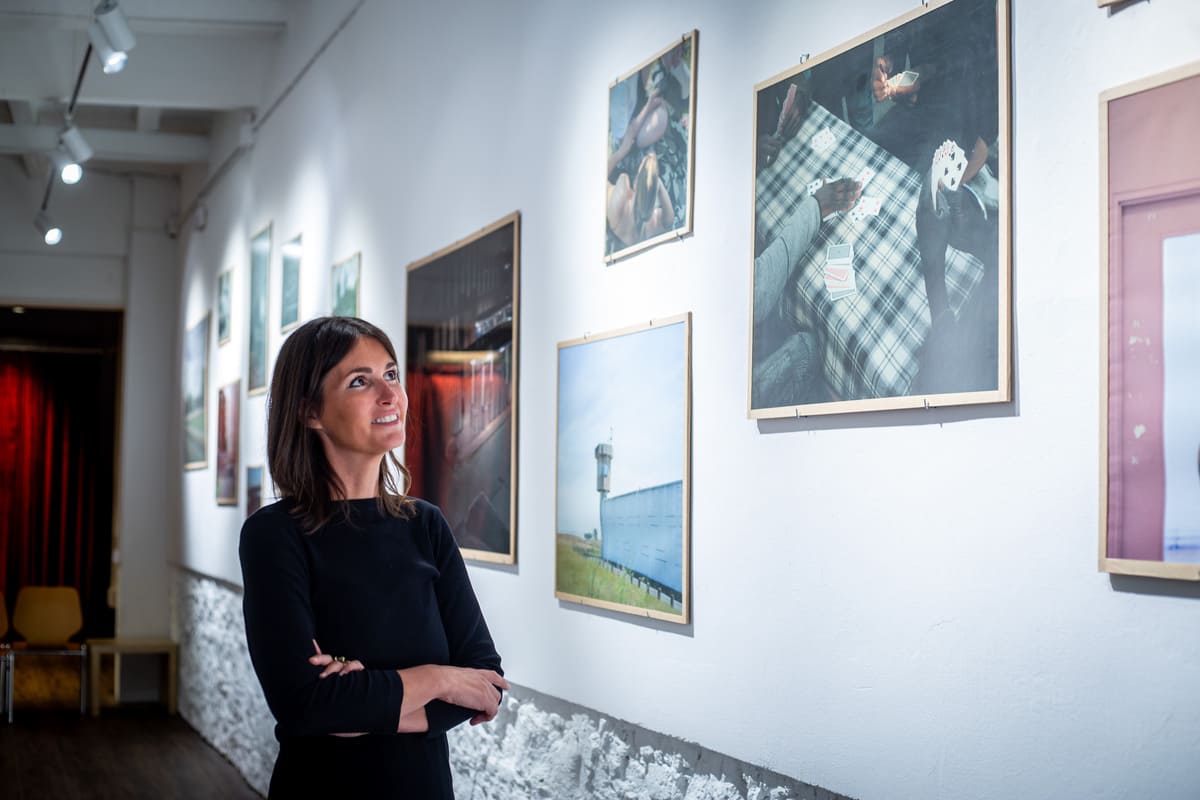
Interview with Sara Catalán, promoter of the artistic platform The Over and of the Barcelona Art Biennial 2025-2026 project, an initiative that will bring the city closer to international contemporary art through a social and participatory perspective.
The curator defends a unique Biennial model for the city that responds to Barcelona's character: open, sensitive, global and local, and above all focused on cooperation between creators and citizens.
---So, a contemporary art Biennial in Barcelona?
---The idea emerged in 2019, when we met some artists at the Venice Biennial. I was already involved with The Over platform, which still focuses on offering opportunities to artists outside the commercial circuit, and from that sensibility, we thought about rethinking the concept of a Biennial. Talking with Kemang Wa Lehulere, from South Africa, or with Admire Kamudzengerere, from Zimbabwe, we started discussing what they needed as artists in a Biennial. And why there isn't a Biennial in Barcelona. We started working horizontally, asking ourselves these questions: what would be needed, what prototypes do we use as reference, what questions should we ask about it, and from there we started from scratch with a new and specific concept for Barcelona.
---And the references, therefore, what were they?
---All biennials, in some way, are helping us to know what works and what doesn't. But we focused a lot on Lagos, Sao Paulo, or Dakar. We want a concept that makes artists interact a lot with the community, with the city, with the neighbors, with local artists…
---Less institutional?
---We want artists to spend a few weeks in the city, in residencies, and for them to create their work here. So, residency, creation, and interaction are all part of the Biennial. The creation of the work is part of the event, and of the experience, giving rise to previously unreleased works. This, in Venice, for example, does not happen.
---And where is this residency?
---At the Pol & Grace hotel, on Guillem Tell street, but we also have other hotels throughout the metropolitan area. We have an agreement with the Gremi d'Hotelers in this regard. In fact, it's not that it's not institutional, it's that institutions are also part of the entire journey: we want to involve prominent museums in the city, theaters, the City Council…
---And are we talking about international artists in any case?
---International and local (for example, here we have Agnès Essonti or Lolo & Sosaku), but as long as they have interacted with each other. We are talking about hosting ten artists and two local and international art collectives in residence for two years, because it is a continuous Biennial. In addition, it will operate without pavilions. We can understand that the city itself will be the pavilion.
---That's not like Venice, no.
---And then, once the work has been created, we make it travel around the world to tell the story of the artist with the city of Barcelona.
---Okay. So, who pays for it?
---We expect to secure public funding, but we are also looking for sponsors especially for the first edition, which will require a higher level of participation.
---Tell me about The Over platform, which you referred to earlier. Where does it start and why?
---The idea originated in New York, with the mission of facilitating experiences and opportunities for artists outside the commercial sphere. It is not against commercial circuits, but rather we act in parallel to them, seeking for artists to find time and space to create, without pressure, not always counting on selling, and with something very important: with the ability to make mistakes.
Catalán foresees that the Biennial will include open actions in the neighborhoods: "It's about people walking around and noticing that there is an art Biennial in Barcelona"---Very important.
---If you don't allow yourself to make mistakes or don't have time and space, as an artist you live in suffocation. That's why in 2018 we started the residencies at the Pol & Grace hotel, and we have an exhibition branch which is the gallery on Sant Pere Màrtir street, in Gràcia, which allows artists to also exhibit in the city center during their residencies. Furthermore, since the cost of the residency is not high, artists often donate works to the space and this balances the costs. All of this adds to the activities that arise during their stay: talks, workshops…
---Does Barcelona have a problem with contemporary art?
---If something is missed today in Barcelona, it is the lack of interest in international artists, and especially African or Asian ones. We lack perspective, we are too Eurocentric. I believe this has improved in recent years; in fact, in Dakar, they tell me that Barcelona now has a quite vibrant and interesting independent artist scene.
---Are we too conservative, in terms of art tastes?
---I think so. But also the city's communication channels, for example, universities, something is not sufficiently articulated between knowledge, creation, and dissemination. I remember, for example, that in Cairo they explained to me that the Iranian revolutionary movement is very marked, very permeable to creativity and communication, but that in Egypt, on the other hand, where the situation of women is similar, that movement lacked cohesion. And it's hard to understand why. Simply, some systems are alive and others are not.
---What complicities have you found so far?
---We have spoken with the City Council, with Turisme Barcelona, with the Hotel Guild, as well as with several museums that we hope will end up collaborating, such as the Picasso or the Macba, or some theaters. We want the growth of complicities not to be forced or artificial, but artisanal, natural, organic.
---And will it be from 2025 to 2026?
---Exactly. During these two years, artists will carry out open actions in the neighborhoods, as we have already done in collaboration with the Pakistani community of Raval and with the Institute of Marine Sciences. The idea is for people to walk through the streets and notice that there is an art Biennial in Barcelona, and for there to be meeting places and joint celebrations. An invited artist can be commercial, there's no problem with that, it's just that what we are going to do is not.
The promoter defends that "it's not that the project isn't institutional, but rather that institutions are part of the entire journey"---So, no interest in selling?
---It's not the mission, nor my specialty, we are not a fair. I do have people nearby who know how to sell works, advisors and gallerists, but we are not looking for big sales. And, honestly, in Barcelona, not that much art is bought either.
---And all this for a stay in New York.
---After spending so many years studying Design and a postgraduate degree in business at Columbia (in addition to working at UN Women of the UN), I saw the value and impact of openness. Living with other cultures, doing things in common, not closing oneself off. I have also been able to see the experiences of Miami (the Winwood district, Art Basel…) and from 2014 to 2019 I have organized exhibitions in New York and Miami.
---And the contrast with Barcelona?
---Perhaps we lack a self-critical gaze, the self-critical gaze of the colonizer. Dynamics of privileges, of resulting violence, still persist among us. Artists can show all this and make us see it.
---Make us see what, exactly?
---That we still don't see.
Add The New Barcelona Post as your preferred Google source for free
Stay informed with the latest news.
