
The West as we knew it no longer exists. With these words and a certain bewilderment, the current president of the European Commission, Ursula von der Leyen, described an uncomfortable truth. The arrival of Donald Trump to the presidency of the U.S. with his avalanche of reactionary and protectionist measures, and his declared animosity towards Europe caught European institutions unprepared once again. A new scenario that forces the EU to reconfigure its foreign policy, its security and defense policy, and to reconstruct its purpose and narrative before its almost 500 million citizens.
In recent years, relevant voices like Josep Borrell, in his capacity as High Representative of the EU for Foreign Affairs and Security Policy, proclaimed to whoever would listen the need to forcefully address the challenges of European strategic autonomy. The European Union cannot be "a herbivore in a world of carnivores," Borrell proclaimed, but there is none so deaf as he who will not hear. The war in Ukraine came to shake off much of the traditional European naivety, but Trump's new arrival to the U.S. government and his tariff diplomacy has brought us down to earth in one fell swoop and forces us to adapt to a disruptive and complex reality that ends the world order after World War II.
It is likely that we have abruptly and without transition re-entered what has come to be called the realism of international relations. That is, a school of thought that considers world politics to be based on a permanent competition between states with their own interests that compete for power and positioning within an anarchic global system devoid of a centralized authority. And to a large extent, it seems that the world to come may be like this. The new Trump era resembles the old law of the jungle in which the strongest ---or those who want to be the strongest--- want to impose their rules. However, we cannot fall into the trap of self-fulfilling prophecies, no matter how gray the horizon may seem. We have an obligation to reconstruct the idea of progress by advocating for a new, more just and peaceful global order.
In contrast to that realism of this new international disorder, we have to reclaim again another of the thought disciplines of international relations of recent decades, idealism. An optimistic doctrine that seeks to transcend anarchy and international confrontation to create a more cosmopolitan world order that advocates peaceful coexistence and multilateralism as possible and necessary. Idealism has strong roots in European thought and in the West in the last century, with intellectuals of the stature of George Steiner and his essential The Idea of Europe, or the work and thought of the Jewish-Austrian author Stefan Zweig, as well as other contemporaries such as the small political writings of Jürgen Habermas.
From a historical, political, or sociological point of view, idealism is based both on the rejection of war and on the aspiration to create an institutional architecture that allows preventing similar situations that were the germ of the world wars that devastated Europe. A transversal idealism that has made it possible to build in the last 80 years what is today the European Union with its imperfections and shortcomings.
But utopian thought goes back much further. In the already distant 1516, in the city of Leuven, the humanist Thomas More wrote one of the great masterpieces, Utopia. The book was a fierce critique of English society of his time, and influenced by the Platonic ideas of The Republic, he tried to recount what a perfect State would be like even knowing that this was simply impossible. That perfect State can only exist... "nowhere," which is what Utopia means in Greek. Today, as then, we know that the perfect Republic, like the idea of a perfect Europe, does not inhabit anywhere, but utopia should continue to be, despite the difficulties, the horizon that guides us and gives meaning on the path to advance ethically and socially in the European project.
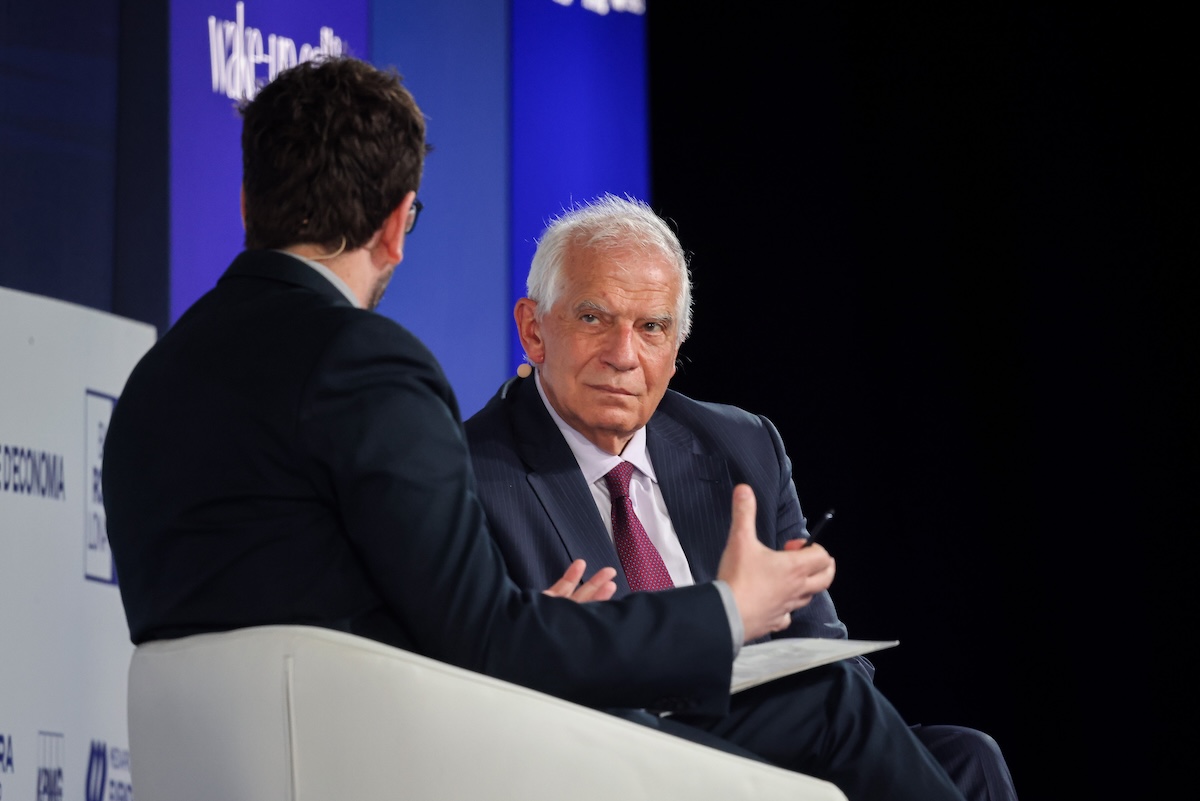
And that is precisely what we must demand from Barcelona and throughout the EU next May 9 in the protest concentrations on the occasion of Europe Day. Today, as the founding fathers of the European Community did after World War II, we live in a reconfigured world that needs to be reinterpreted. Europe needs to rebuild its narrative with the same old values, but with new ideas and leaders to help us build new consensuses that allow us to navigate this new global reconstituent process. These leaders probably are not and will not be at the head of national governments, and even in the European institutions themselves, as they will be very busy with the complex global geopolitical agenda in the coming years. Nor does it seem likely that they will emerge from large European corporations, focused on quarterly or semi-annual results that guarantee their bonuses in the case of executives of large companies.
We need a new model of open, ethical, moral, political, and territorial leadership from cities with the great European mayors at the helm. New local leaders who work in a coordinated network to reconcile community and destiny, economic development and prosperity with social cohesion and sustainability, and take charge of the emotional and mental state of European citizens and those beyond.
Barcelona as an open, progressive, cosmopolitan, and international city cannot afford Europe to fall back into conflict.If today we partially carried out Thomas More's intellectual exercise, and the citizens of Europe set about the task of constituting a new and utopian European Republic, we should probably do so, not so much on the utopia of building a United States of Europe, but with the commitment to build it on the foundations allowed by the strength of the weak ties of city diplomacy. That is, a European project that bets for a Europe based on dialogue, competitiveness, sustainability, equity, security, and democracy. And in that task, Barcelona has to take the lead along with other European cities, as Pasqual Maragall did at the time, to influence the European and international agenda.
Barcelona, as an open, progressive, cosmopolitan, and international city, cannot afford Europe to fall back into conflict, militarism, or identity withdrawal, as we would lose part of the essence of what we are also as a city and as a country. Barcelona, like the idea of Europe, is an essential utopia. We have the legitimacy, reputation, and recognition to lead a narrative complementary to that of the complexity, limitations, and contradictions emanating from European institutions. While Brussels is the political and administrative capital of Europe, it will hardly be able to be the capital of European values if the rest of the free cities do not take the lead in reconstructing this new broad, rich, plural, and complex narrative. Europe is an imperfect but essential project, and its cities are the foundations of the great European house that we have to rebuild, because inaction is not an option.
Add The New Barcelona Post as your preferred Google source for free
Stay informed with the latest news.