
Barcelona has architecture among its great assets. The history of the city can be narrated through its buildings. From the remains of Roman constructions, passing through Romanesque, Gothic and Renaissance, Neoclassical legacies and, of course, Modernist with its great names: Domènech i Montaner, Puig i Cadafalch and Gaudí as maximum exponents. Also great contemporary architects have their work in the streets of Barcelona: Norman Foster, Jean Nouvel, Herzog & DeMeuron, David Chipperfield, Frank Gehry, Enric Miralles, Ricard Bofill and Toyo Ito, among many others.
However, there is an important and ancient architectural style that Barcelona lacks: dry stone. It is a construction method that is profusely scattered throughout the rural areas of the Mediterranean since the Neolithic. It consists of small constructions erected with stones arranged in an adequate way so that the use of mortar or cement is not necessary and that proliferate in some regions of Catalonia. With this technique, small huts, walls and deposits have been built for millennia, many of which have lasted to this day.
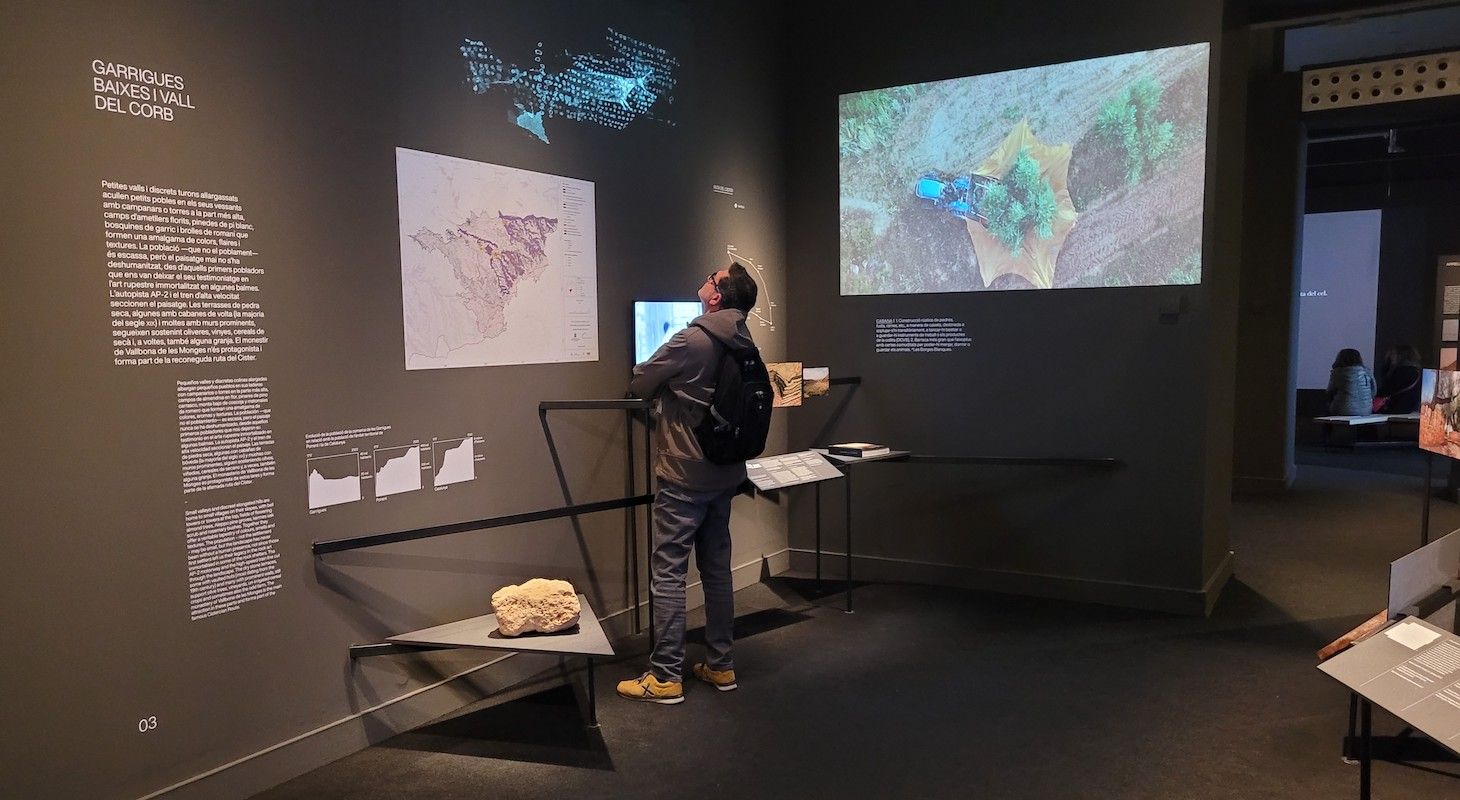
To alleviate this absence and disseminate this important heritage, the exhibition Dues pedres. Paisatges persistents can be visited until next June 2 at the Palau Robert. The exhibition is a journey through the most important vestiges of this ancient technique in Catalonia, where we can find thousands of kilometers of dry stone walls. This type of construction was included in 2018 in the representative list of intangible cultural heritage by Unesco.
El Pont de Vilomara i Rocafort is the Catalan municipality with the most registered dry stone constructions, a total of 1,808, according to the latest census. Thus, in this municipality of the Bages region, 1,172 huts, 351 water storage facilities, 18 ovens, 111 walls and 156 various elements, such as vats and even bridges, can be admired.
The most common construction are the huts. They were erected next to the vineyards and were used as shelter for farmers or to store tools. The high presence of dry stone architecture in Bages is explained by the fact that between 1860 and 1890 it was the region with the most vineyards in Catalonia. They extended over 27,700 hectares. The phylloxera plague, detected from 1889, caused the progressive abandonment of the vineyards. In 1989, only 500 hectares remained.
Enric Campàs, mayor of El Pont de Vilomara i Rocafort, is very proud to possess the most important dry stone complex in his municipality. Campàs is promoting a project to convert this artistic heritage into a tourist attraction. Thus, a spectacular construction known as the Tines de la Vall del Flequer has recently been recovered, destined since Roman times for wine production, with a double function: crushing grapes to obtain must and its subsequent fermentation.
In addition to vats and huts, the dry stone technique was also used for the construction of ponds and cisterns for water and for various types of retaining walls and fences. Through these, the land could be leveled to obtain land for cultivation. Walls were also erected to delimit properties and channel rainwater.
The exhibition at Palau Robert explains how this construction method, which does not require any type of mortar, worked. At most, gaps were covered with dry earth. It required a refined technique that basically consists of playing with the shapes of the stones to fit them together until a consistent structure is achieved. The law of gravity does the rest. On some occasions, some stones were carved to ensure the proper fit.
In Barcelona, there are no dry stone vestiges today, although there undoubtedly were in areas that were rural in the past. In any case, we will have the Palau Robert exhibition, at least until June 2.
Add The New Barcelona Post as your preferred Google source for free
Stay informed with the latest news.
