
When you've lived your whole life in the same city, you feel like you know every corner and that on every street corner you can build at least two memories. You even know which traffic lights go faster and which slower, or if that terrace has installed more tables, or if a chicken shop has disappeared in that stretch. Therefore, it's hard for the city to surprise you, because what is no longer surprising is that the City Council tries to show off with works on the maritime facade or with various entertainment shows. What is surprising is to see how, in the heart of Barcelona and very close to the Vila Casas Foundation, under a facade of modernist stone trees, the Barcelona Academy of Art, directed by Jordi Díaz Alamà, has been operating for eleven years. Alamà, as an artistic name.
This graduate in Fine Arts from the UB and trained at the Florence Academy of Art has turned the concept of a classical art academy on its head and has established a nucleus for the international dissemination of talent in a large space on Ausiàs Marc street, where it is already clear that classicism, realism, is not content with reality but with life (which is not the same).
A painting by Jordi, showing a man painted with academic technique but with a surprising McDonald's bag (and a soda cup from the same brand) on the floor, already warns us where we are: we come to learn technique, but art is not just technique. This work by Jordi, in fact, was looked down upon in Florence (the academy where he presented it). But they finally accepted it and he got his degree. They also didn't accept, for example, the use of synthetic brushes. When he returned to Barcelona to found an academy, he decided he would do something different.
The Barcelona Academy of Art is today the first in the world in terms of the number of students and, above all, the most innovative of the four most important ones.It is immense, that's for starters. Workshops and easels and models and ongoing projects, backlights and figures and sculptures and above all drawings,based on an ancient technique that is the foundation for doing anything else.A very high level, this is what is seen in every ongoing work. Much human torso, much musculature and many curves, some objects grouped in still life, Beethoven's death masks, self-portraits (if a work is not always a self-portrait), and above all many young people. From everywhere.
Slaps to get in. The Barcelona Academy of Art is today the first in the world in terms of number of students and above all the most innovative of the four most important. The ideas are different, the materials are variable, the program is unique, 2.0 technology is fully present. Alamà embodies the generational change that was pending in this sector, internationally, which has also earned him the appointment as new director of the European Museum of Modern Art (near the Picasso museum). He also intends to update it, of course.
Alamà believes that the key to his success has been the use of different procedures (technology, materials, ideas), as well as the presence in Barcelona, the light and color of the Mediterranean, but above all the fact of updating academicism: not regenerating it, learning and respecting it, but updating it so that it is a base and not an end in itself. Alamà represents, so to speak, the renewed version of the Reial Acadèmia Catalana de Belles Arts de Sant Jordi or the Cerce Artístic de Sant Lluc, where so many of our historical artists learned to be themselves. It is now about learning the usual skills but being able to apply them also to current themes. The technique can be old, classical, but the ideas and themes can be contemporary. Academicism was abandoned at the time because it was repeated too much, but realism, says Alamà, will never pass. That realism never goes out of style does not mean that reality does not go out of style. And that is the key: that reality does change.
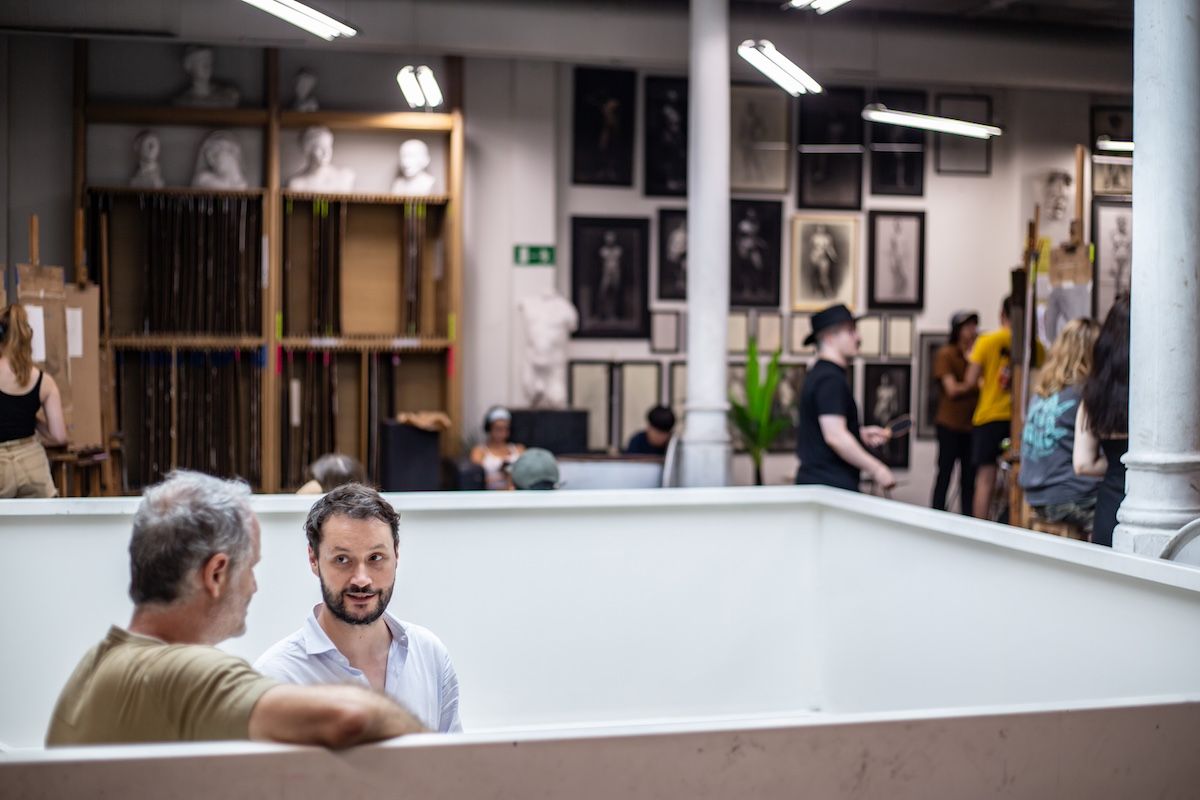
In the academy, the aim is to train critical, reflective artists who know how to transmit their ideas. Realism would be the common language that the receiver knows how to identify (which is already a lot), but returning to the student's concept with a foundation does not mean that the goal is to create works that move people and that the artist himself evolves. Abstract art or performances, says Alamà, come and go: realism, on the other hand, stays. Always. The problem Jordi saw in Florence is not that the academy lived too much in the past, but that the entire city of Florence lives there. This is not the case in Barcelona. And I couldn't have received better news, as much as I complain about getting stuck in narcissism towards Miró, Dalí, or Picasso. Things happen in Barcelona. Big things happen.
Barcelona, he tells me, has a very important pictorial tradition but also (he insists) the light, history, and a great cultural offer. It is a niche to attract very young people, besides the fact that the academy tries to offer affordable prices and present a general training offer (it currently has 300 operational students, but throughout the year a thousand students pass through here, 80% coming from abroad, and dividing the three-year courses into trimesters).
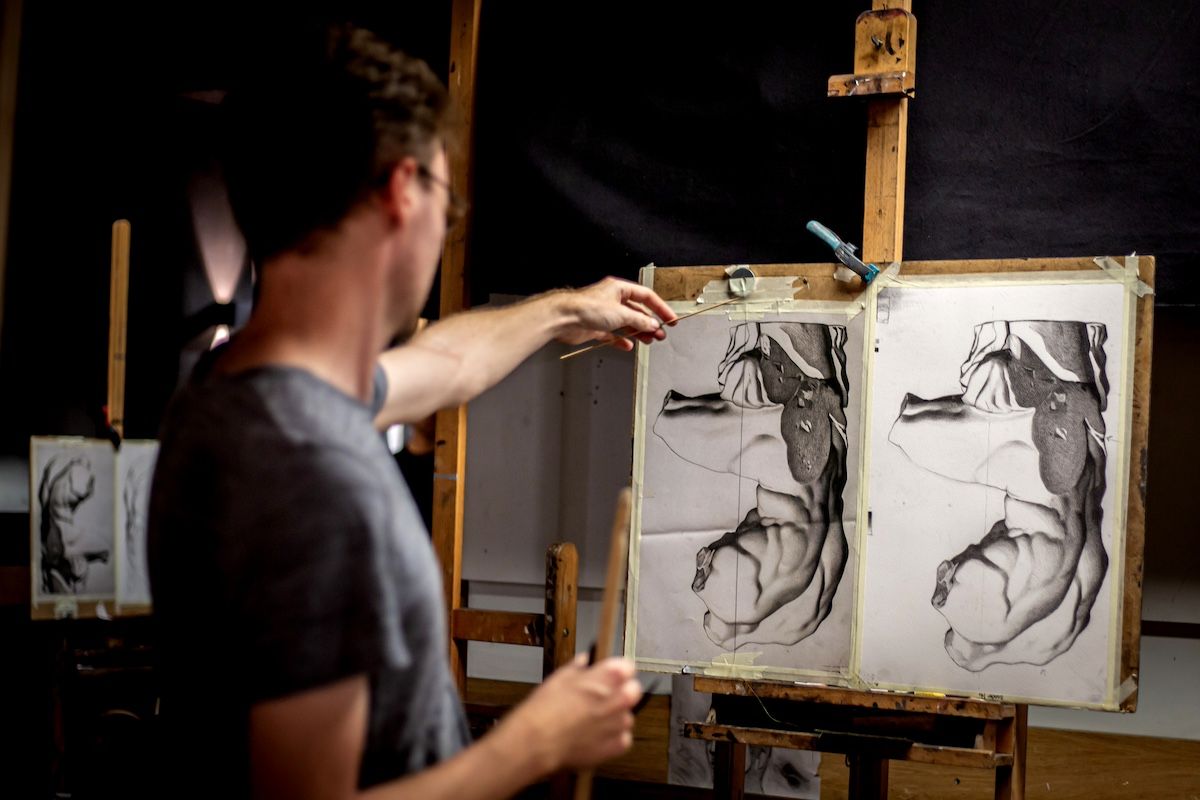
They have stopped conducting an entrance exam because they have decided to reach the student from the ground up. They do, however, pay attention to the motivation letter presented: the attitude, and the desire for discipline and perseverance. Qualities that, in times of laziness and the desire for immediate results, are missed. In art, apart from technique, what is needed is the patience of a saint. This is not at odds with, for example, exploring (as Alamà does) the possibilities of AI: even though art will be the last space to be invaded by this technology, he is sure that it is convenient to approach it to see what can be leveraged.
English is the vehicular language in an academy with high participation from North Americans and Europeans from all over, but also Spanish, due to the large influx of Latin Americans (it is the only academy in the world that also uses Spanish in classes). The career opportunities are multiple, apart from the creative pleasure itself: gallery work, teaching, video games, audiovisuals, photography, cinema... And another notable thing: unlike the classic idea of artists being wary of their tricks, here knowledge is shared and no one keeps anything to themselves. Knowledge is not stolen, but transmitted.
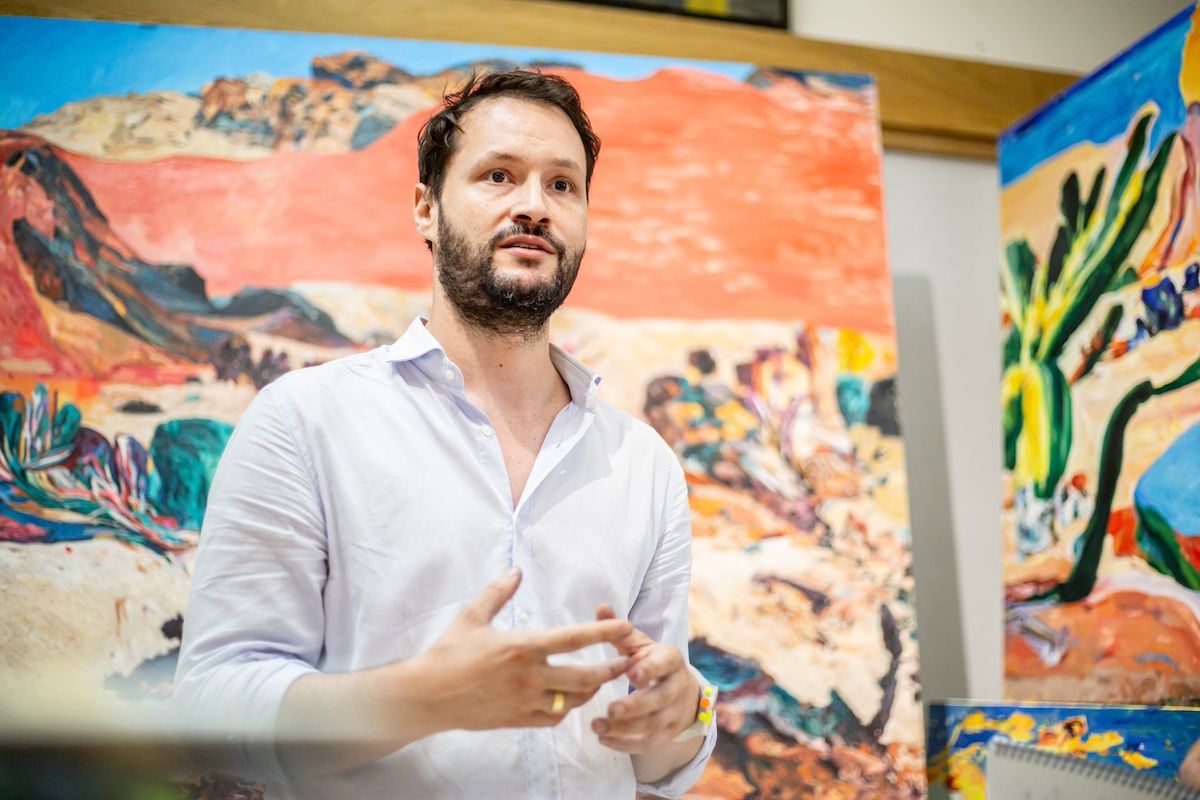
Finally, we arrive at Jordi's workshop, located at the back of the space, where he begins to explore the terrain of realistic expressionism through somewhat Martian landscapes (after having descended into Dante's realistic hells). He exhibits in Madrid, London, Italy, or Figueres, and says that realism, if it has ever tired him, is not to never return, but because the feeling of mastering it already drives him to explore new territories. Painting should consist of having a good time, but also, a painter's cycles close, and when they close, they also increase in value instead of transforming into industrial mechanism. Unlearn, to find different expressive languages. Sorolla, Rembrandt, and Velázquez. But also Barceló, Gauguin, Kiefer, Miró. To have the tools and, then (only then), be an artist. Another thing is that, musically, he prefers to stick with symphonic music and doesn't dare with jazz (he has a saxophone hanging in the workshop). As he says himself in reference to painting: until the solfège is finished, the game cannot begin.
Add The New Barcelona Post as your preferred Google source for free
Stay informed with the latest news.
