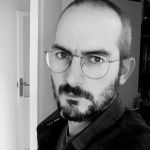
Miquel Barceló (Felanitx, Mallorca, 1957) is one of the most important and highly valued contemporary artists in the world, known primarily for his paintings and murals in cathedrals and in what is considered the Sistine Chapel of the 21st century: the dome of Room XX of Human Rights at the UN. A painter, sculptor, and draftsman with a Neo-Expressionist style, his painting is characterized by viscosity, textures, and a color that seeks a mimesis with the organic. His recurring themes are nature, zoology, and bullfighting.
Coming from a rural and fishing background, he is a lover of the sea and the underwater world. In his own words, his daily life is summarized in painting, diving, and reading. The sea is his theme; the artist dives and collects precious treasures in the form of objects and debris from the seabed. In the depths of the ocean, the artist discovers colors that amaze him, the colors of nature, debris, shells, fish, beings, and forms that he tries to reproduce like an astronaut who discovers in the sediments of the seabed a strange universe, different and yet so close to dry land. A better and more interesting universe than the one presented to us in the sky.
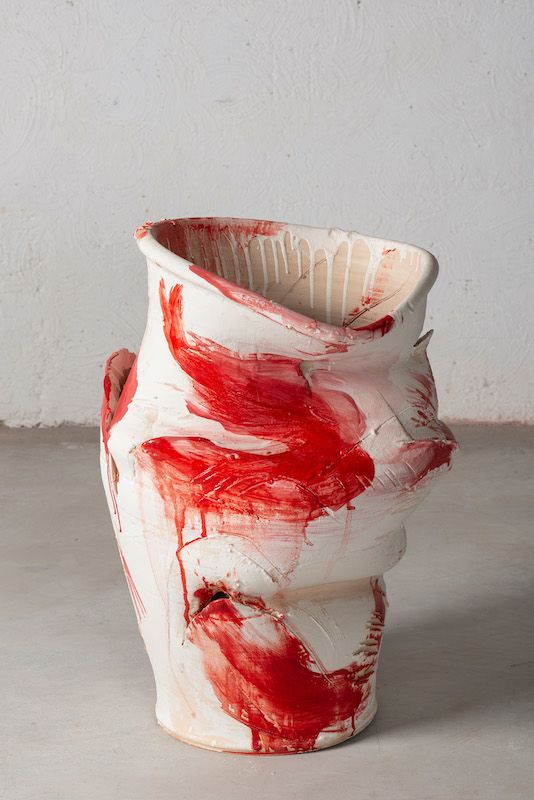
His works are of remarkable visceral intensity, and at the same time, deeply reflective. In his desire to recreate matter, Barceló is obsessed with organic life and time. The artist considers his ceramics an extension of his painting. He works ceramics from the inside, in reverse, using reliefs from the negative. He establishes a physical relationship with the work. He changes it, transforms it, literally fights with it and against it. He paints and sculpts with his whole body: he uses his fingers, head, elbow, shoulder, strength, and chance. The force of chance and fortune become the driving forces in the search for the final result.
There is no other way to work than by taking the risk of accepting the accident and embracing it. This is how its textures, reliefs, and forms are conferred through mixed and innovative techniques.His is the phrase that "an artist doesn't know what he's doing most of the time."He states, proudly, that "most of his work is a mistake." He comes to art out of necessity; creating is: "A gratuitous act done just because, but it stems from the artist's necessity." An admirer of Miró's work, he cannot understand life without a physical relationship with a plane: book, canvas, and floor.
Todos somos griegos (We Are All Greeks), the most complete retrospective of Miquel Barceló's ceramics held to date in Barcelona, exhibits more than 100 works with 80 pieces and 15 paintings. Barceló's ceramic work consists of about 4,000 pieces, and most of the exhibition features unreleased works, anonymous private donations, and recent works directly from his studio. Chronologically, the exhibition traces three decades of work, from his early African works to the present. The exhibition is complemented by paintings and notebooks related to his creations, as well as a bronze sculpture in the courtyard of La Pedrera.
His relationship with ceramics also stems from an accident. In 1988, Barceló traveled to Africa with his friend Javier Mariscal, who, with the intention of painting, rented a house in Gao (Mali). In 1994, due to the constant sandstorms in the area, painting became almost impossible for him. The canvases filled with dust, sand, and sediments, and he decided to imitate the women of the Dogon ethnic group, and local artisans and potters. He built figurines with clay, tile, brick, and animal excrement. Over time, he acquired a workshop in Vietri Sul Mare and another in Vilafranca de Bonany. Barceló, therefore, has lived most of his career between Africa, Paris, and Mallorca.
The exhibition establishes a relationship with Gaudí due to the exceptional nature of the exhibition venue, and the artist recalls that this relationship already existed when he painted the chapel of Palma Cathedral.
The artist from Felanitx is enthusiastic about the process of firing clay and solidification; for him, it is very similar to the drying of oil paint and other pictorial materials. He recognizes that clay is "the material that best captures defects and imperfections" and that the transformation of the material and color in the kiln fascinates him. Barceló molds with unusual parts of his body, sits on them, hits them to achieve shapes...
Barceló understands his ceramics as an extension of his painting, he speaks of Dogon cosmogony as his true initiation and as an impossible leap between Neolithic art and modern workshopsThe name of the exhibition, We are all Greeks, refers to a poem by Percy Bysshe, a fan of ancient culture and especially classical Greek art, who wrote in 1819 as a response to Ode on a Grecian Urnof John Keats.
Many painters profess a deep admiration for sculpture and ceramics. Relief is a natural progression of drawing and painting. The act of creating obeys the irrepressible urge many artists have for pictorial work to come to life. Thus, it exists in three dimensions and on a physical plane. This animistic effect is described by Barceló along with the historical discredit of ceramics compared to other disciplines. According to him, ceramics have no value and are not destroyed throughout history because no value is conferred upon them in invasions, nor transformative or symbolic power, as painting or sculpture do.
The exhibition begins with Apología del vidre (1987), a painting in which the reliefs of amphorae and fish are already hinted at. Peix Blau (1988) is a fish head that Barceló molds like a mask. There are African busts: Amassagou, Amo, and Domo; amphorae, and what the artist calls self-portraits: clay masks molded on his head that refer to the performance spectacle Paso Doble, which he created in 2007, and which we can see in recordings alongside French dancer Josef Nadj. The clay is molded wet and soft on his head using his fists and transforming his features into animals, monsters, and other beings.
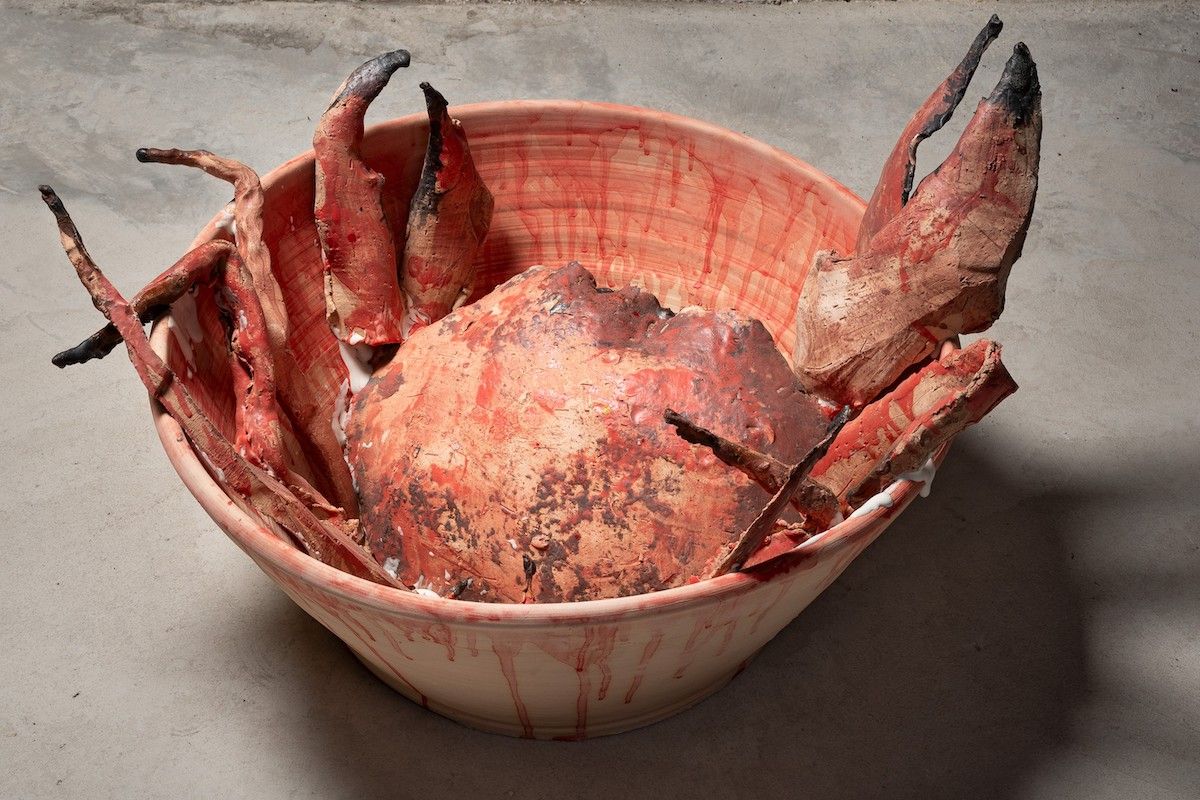
The painting Grissalle avec deux espandons is a black and white still life with two swordfish and a skull in relief. Familia stands out for its detail and color, and the small figures representing bullfighting scenes establish a clear relationship between life and death. The marine and rural world appears represented in Peixos, a clay mural that served as preparation for the large pieces of the Cathedral of Mallorca.
Cráneo de Pinocchio (Mali, 1995), Tótem Dórico-Azteca (2019) or Cap de morena (1999) are works that stand out for perfectly defining Barceló's work and intentionality.
We can also observe, in video, the process of the conception of his recent monumental work Grotte Chaumont, installed in the forest of the Loria Valley (Chaumont-sur-Loire, France), which is a kind of giant monster head with teeth, halfway between an open and threatening maw, and what could be considered an entrance to a cave.
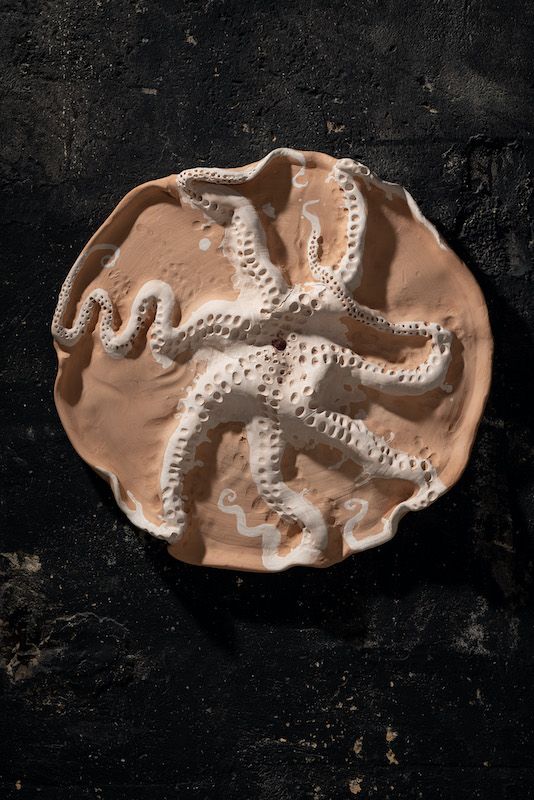
Quatre pommes et un couteau (2022) consists of amphorae and colorful fruits, Pulpe a l'envers (2001) is a relief of the back of an octopus on a plate, and Egomacro (2006) is one of the indeterminate self-portraits with eye sockets and hair. At the end of the exhibition, we find the totems, which symbolize the homage to Greece and the great Aztec and Chinese empires.
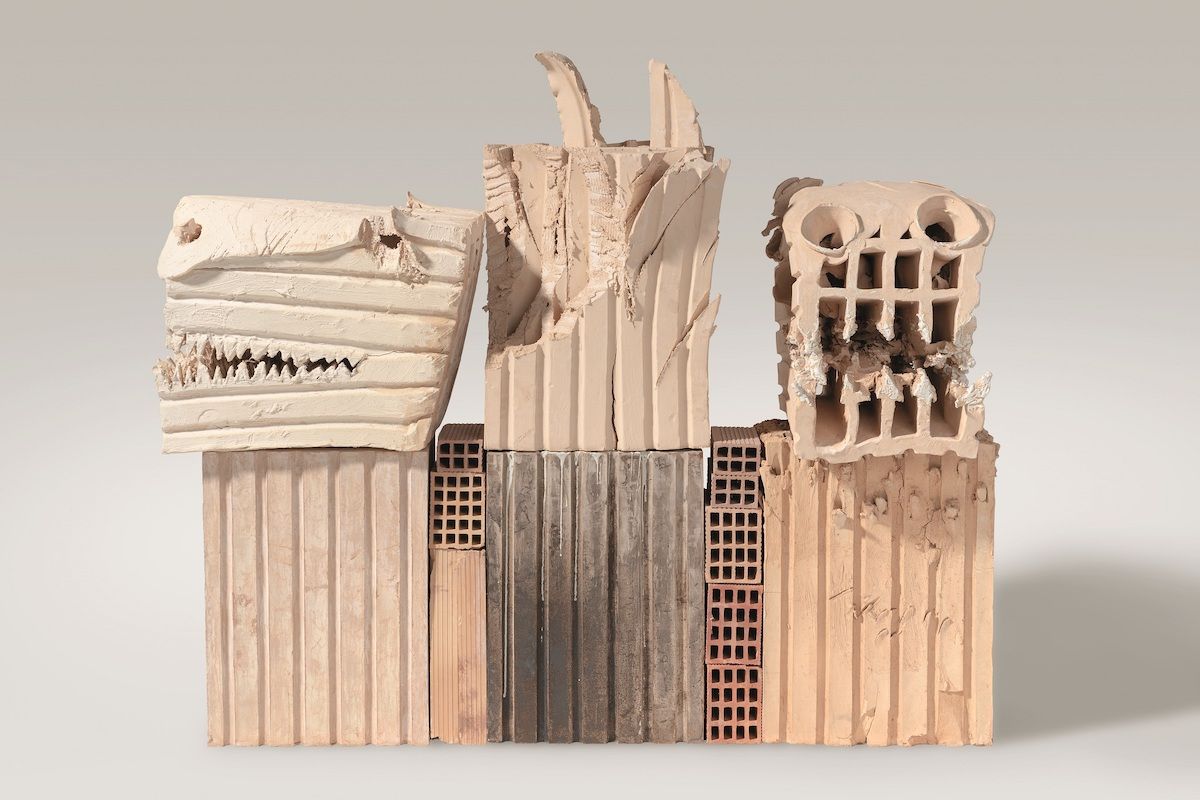
Todos somos griegos, commissioned by the writer Enrique Junquera, has already been visited by numerous personalities such as Francina Armengol, Marga Prohens, and Joan Laporta, and will be in effect until June 30, 2024.
The exhibition will be complemented by several activities such as the premiere, on April 24, at the Auditori de La Pedrera, of the documentary Barceló, traços de fang, by Josep Maria Civit. The rest of the activities that will form the expanded exhibition will be the concert at the Gran Teatre del Liceu with pianist Alain Planès, who will premiere Francisco Coll's piece composed expressly for the occasion; the conversation between Miquel Barceló and director Albert Serra, Pascal Comelade's concert at the Palau de la Música, Miquel Barceló's bibliographic exhibition Per amor a la literaARTura, at the Biblioteca Nacional de Catalunya on Sant Jordi's day; a guided and dialogued visit with the Fundació Joan Miró and Miquel Barceló's day with the Escola Superior de Música de Catalunya (ESMUC).
Add The New Barcelona Post as your preferred Google source for free
Stay informed with the latest news.