
The implementation of remote identification and authentication systems has become a central element for the success of digital banking services offered by financial institutions. In a pandemic context, it is vital to be able to address processes such as the onboarding of new customers completely online, without the need to interact with other communication channels, such as the branch network or the telephone customer service. To ensure that this process, in addition to being 100% digital, is fast, agile, and secure, Banco Sabadell has signed a strategic alliance with Onfido, a London-based startup specializing in facial biometrics and identity verification.
[subscribe_newsletter_esp]
Thanks to the agreement, Banco Sabadell has been able to integrate Onfido's artificial intelligence technology into its IT system for customer identification and digital onboarding processes. Thus, since September, Onfido's service is already being used for remote onboarding to Sabadell's online banking. The startup's tools allow for the completion of document verification and confirmation that the identification sent by users matches their face thanks to facial biometrics. The solution ensures that the person presenting the identity is the legitimate owner and is physically present at the time of identification, which avoids the need to send additional documentation, making the process much more agile for both the customer and the bank.
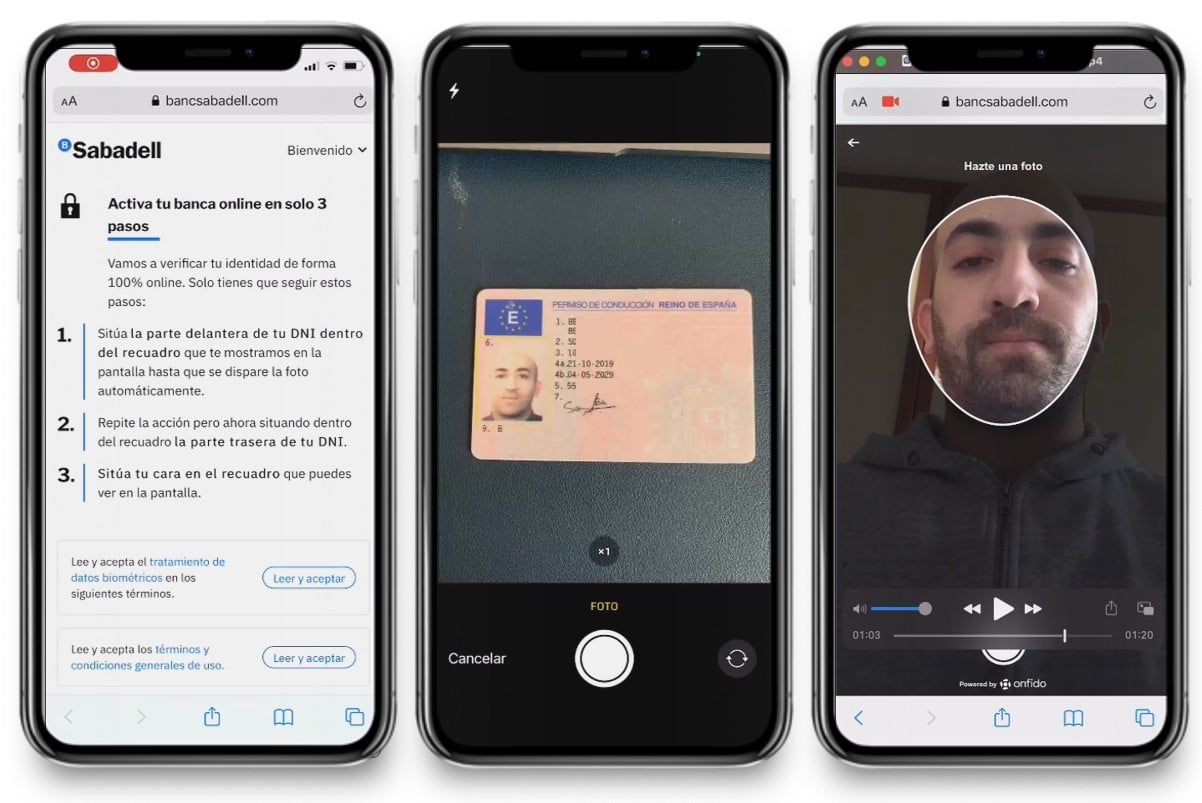
"The partnership with Onfido allows Banco Sabadell to accelerate the deployment of a key capability in the remote customer relationship model through a simple and efficient experience for their identification and contracting of new products," explains Pol Navarro, general director of InnoCells, Banco Sabadell's digital innovation hub.
For his part, Onfido co-founder, Husayn Kassai, highlights that their technology "brings trust to digital interactions worldwide, as it securely verifies a user's identity from the moment they sign up with the company."
Thanks to the implementation of this service, The Digital Banker, in its 2020 edition, has awarded Banco Sabadell the Best eKYC award at the Global Retail Banking Innovation Awards, international awards that recognize the best financial institutions that stand out for their leadership in innovation and customer experience.
According to Banco Sabadell, of all the technological solutions available on the market, Onfido's was chosen "for its excellent fraud detection engine and for the ease of technological integration into the bank's various digital channels." Through identity verification techniques such as photo-selfie and video-selfie, Onfido's system allows covering all normative and regulatory requirements demanded by the digitalization processes of official documents and identity verification.
Digital identity and security, the role of banking
A person's digital identity is configured by many data, which include not only name, date of birth, and age, but also email, passwords, and behavioral and preference records generated, for example, when browsing the Internet. The unstoppable digitalization process makes it very difficult to control the use made of this data, and one gets lost when managing the consents granted to companies, applications, or websites with which one has interacted.
Although the Data Protection Regulation (GDPR) exists, the truth is that it is extremely complicated to properly manage digital identity. In this context, banking stands as an ideal partner for citizens to help them preserve their data, since the relationship of entities with their clients is based on trust. Thus, if a citizen entrusts something as important as money to their financial institution, they can also entrust it with the custody of another increasingly precious asset: their digital identity.
Banks have before them the opportunity to also become digital identity providers for different sectors, taking advantage of the trust that the financial sector traditionally has for consumers. If they are the managers of their assets, how can they not be of their digital identity!
The blockchain is envisioned as the ideal technology to make this process of custody and access to personal data secure and to guarantee its preservation and total reliability. Thanks to blockchain, it will be possible at all times to know who has or has had access to our data. In addition, this technology can be combined with high-security biometric solutions so that sharing online identity or private information is only possible using biometric parameters such as fingerprints or iris scans.
To promote financial services in blockchain technology, Banco Sabadell has become a partner of Alastria, a non-profit association made up of more than 500 partners. The idea is for Alastria to serve as a platform for financial entities to develop better digital identity access and modification services than those developed by groups like Facebook or Google. Banking has an advantage over these large technology companies: it is capable of guaranteeing the veracity of its users' profiles.
As a member of Alastria, Sabadell works to be a benchmark in the development of services linked to digital identity and to become the guarantor of its clients' data, offering a service that allows them to manage their information and profile in any transaction carried out with third parties.
Add The New Barcelona Post as your preferred Google source for free
Stay informed with the latest news.
