
Modernism did not only seek modernity, or to be modern, or to act modern, but to be militants of modernity: hence the suffix -ism, which evokes militancy, faith, adherence. Barcelona subscribed to modernity at the beginning of the 20th century and wanted to be its leading sword, simultaneously sending a forceful message about roots and tradition, and how to update them through the most innovative techniques. This is the work of geniuses like Gaudí and masters like Domènech i Montaner, whose commemorative year we celebrate, and who, despite all difficulties, managed to build a Palau as functional (as the headquarters of the Orfeó and a concert hall) as it was daring, beautiful, and innovative.
I don't know if Domènech i Montaner was aware of building a future World Heritage site, but he must have been aware of building Catalan heritage, and doing so following the latest techniques and fashions of the time. A Palau of European stature, an avant-garde building, of the future, of color, placed amidst the eternal and solemn stones of the Gothic Quarter. Militant modernity. Movement. Always going one step further.
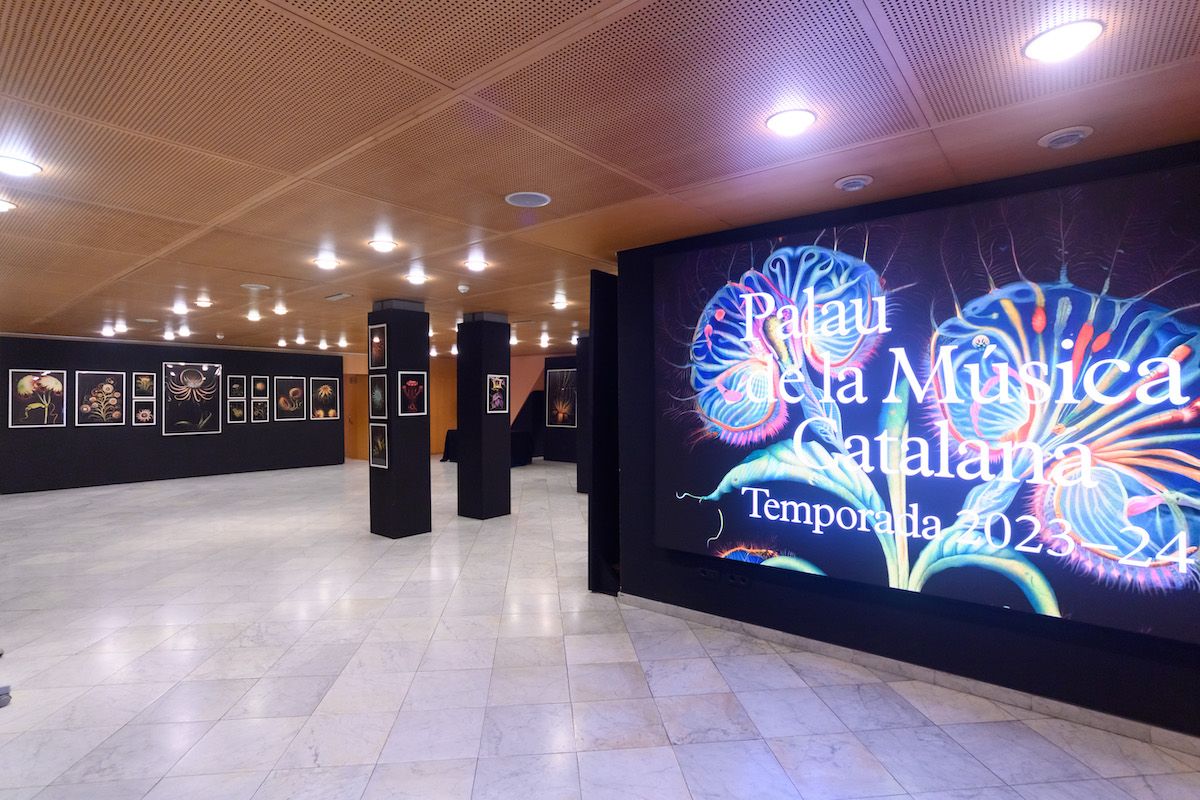
In the foyer of the Petit Palau, an exhibition has been inaugurated on works created with artificial intelligence by the artistic team Entangled Others, invited by the Palau de la Música Catalana as artists during the 2023-24 season. A display of digital works, yes, but inspired by the building's architecture and the natural elements chosen by its architect.
These two artists, the Argentine Sofía Crespo and the Norwegian Feileacan McCormick, based in Lisbon, use AI software to create unreal realities, virtual presences, non-existent beings, artificial natures, and all the other oxymorons that could occur to us today. Like architects, like painters, like writers, they first observe reality and extract its essential elements, to then play at being gods and build an alternative universe.
The result cannot be said to be exactly supernatural, because it is part of nature (especially plants and insects), but it does evoke a dreamlike world of "what could have been" or, to put it simply, a sophisticated version of Genesis or Eden. Sometimes, we have seen nature so much that it seems vulgar, predictable, with its rules and balances. The plants and living organisms of Entangled seem like a Darwinian evolution of our nature, but as if natural evolution did not have to go in search of the survival of species, but in search of beauty. Beauty as a higher stage that allows us, precisely, to survive.
The Palau de la Música has opted for sensitivity, for being a work of art and acting as a work of art, not just a concert hall.This relationship between humans and nature is precisely the theme of the 2023-24 season of the Palau de la Música, which is, moreover, increasingly insurmountable in musical terms, so the studio's work has served to illustrate all the graphic image of the programs and all the communicative materials of the auditorium. As has been done for two or three years now: starting from a work of art (at first it was art) and deriving from this work all the application in corporate image of the season. It is a brave and sensitive commitment, which puts artists above programmers or graphic designers (without these concepts being incompatible), and making art always go ahead of useful application. Domènech i Montaner also followed this process: from natural reality, to extract an illusory versionand, then, once this figure fit into the general project, place it in reality with the dual objective of materializing and beautifying it.
The exhibition, in fact, inaugurates the foyer space as a small exhibition area, and is a good omen for possible new communication projects for the Palau: while others simply place works by renowned artists at the entrance or open the umpteenth immersive space with three hundred and sixty glasses and multifunctional screens, the Palau de la Música has opted for sensitivity and for being a work of art, acting as a work of art, not just a concert hall. Therefore, its connections with the visual arts do not try to impress but to move, and not to develop through impacts, but through organic growths that intertwine like plants and microorganisms within the institution. Intelligence can be artificial, they say, although I have my doubts. But sensitivity, when it reveals itself to be artificial, becomes unmistakably ugly.
Add The New Barcelona Post as your preferred Google source for free
Stay informed with the latest news.
