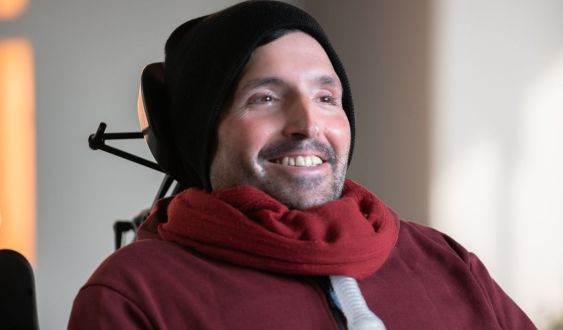
Armando worked as a panel beater and painter in the automotive sector. At the age of 33, he already had his own business set up, and two young children, Anna and Àlex. At the end of February, after a medical visit, he returned home with a diagnosis of severe flu. But three days later, he lost strength in his legs and, on March 6, his birthday, he was admitted to the Vall de Hebrón Hospital with cardiorespiratory arrest. When he woke up, he was in the ICU connected to a tube that allows him, to this day, to breathe.
Too harsh and fast, unexpected, unfair. The feeling of perplexity in the face of that adversity of life swept everything away. That virus undid the life he knew, in which he had formed a family, had learned a trade, and enjoyed hobbies, such as sports, the motor world, and Scalextrix. Until he had to start over.
The diagnosis was clear: transverse myelitis, of autoimmune origin, which directly affected the nervous system. This caused the loss of sensitivity and mobility in almost the entire body and, as a consequence, dependence on mechanical ventilation. Transverse myelitis is a rare disease, affecting approximately 1 to 8 people per million each year, and can appear at any age, although it is more common in young and middle-aged adults. It is a rare and unpredictable pathology, as unpredictable as his new beginning was.
How and why he contracted it, no doctor has been able to explain to him to this day. Armando admits that "that is one of the most difficult parts to accept: having to live with the fact that there are not always answers for everything."
Over the years —he says— "I have understood that, in my case, obsessively searching for a cause led me nowhere. And what did help me was to focus on how to live with the consequences and how to move forward with my new reality. To understand how far medicine can go, and also to accept its limits."
In fact, one of the best strategies he now masters is to put his energy where he wants it. And he has put a lot into writing the book in which he recounts the onset of the disease in his life and how he has been able to overcome the limits it imposes. Lost in so much confusion and pain, a friend —Nuria— told him: "writing is a way to find yourself again."
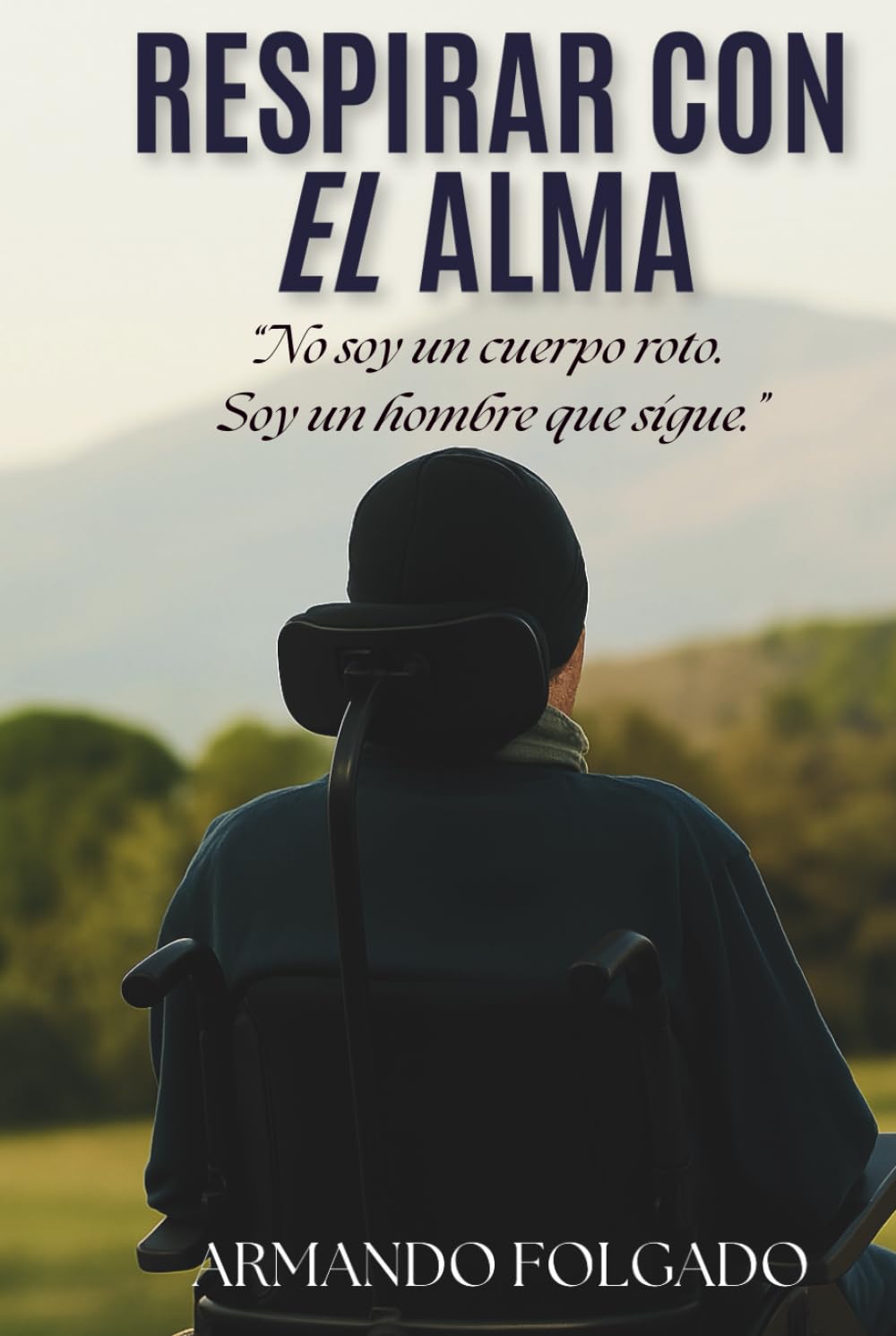
Armando Folgado: "True freedom is not in the body, but in the attitude with which you face life"And, with that idea, she changed the discomfort of her very frequent sleepless nights. In them, she created her writing space. Nights and nights of free expression, unrestrained, and almost a thousand pages full of content, full of life. The time of confinement during the covid pandemic gave refuge to that desire to shape what has ended up being the book Breathing with the soul, for which he is already preparing the Catalan version and a second part. Self-published and accessible on Amazon, as he himself says, this book does not intend to give anyone any life lessons, nor a motivational speech, only to recount the way he has faced everything and what he has learned along the way. But if there is one thing he would like readers to take away, it is the idea that "true freedom is not in the body, but in the attitude with which you face life."
From the feedback he has received from those who have already read it, he feels that the change in perspective they make is very gratifying. "They no longer see me as "the poor little thing," a view that has always made me uncomfortable. Now they see me as someone capable." In fact, he thinks that his testimony can help to consider the collective of people with functional diversity from another perspective. Not from the limit, but from the capacity. "Although the body does not move, life continues, the desire continues, and we continue fighting, creating and being much more capable than many imagine."
Valuable advice
One of the turning points in Armando's journey came when Andorran driver Albert Llovera, the first rally driver with reduced mobility to obtain a license to compete with able-bodied drivers, told him: "set yourself goals." As simple as it was powerful, that message set course for a new way of living, it was the bridge to new capabilities. And it was the beginning of everything that would come after. That same night, in a way as rudimentary as using a clothes peg, he managed to activate the remote control that moves the cars on the Scalextric track."Technology was one of the things that gave me my life back"The ability to move an object unassisted was just the starting point. Afterwards, Armando met Mauricio Ferrari, who designed a control for him with Formula 1 technology, and by gradually expanding coverage of needs, the MouthX device was born. It is a piece similar to a dental splint that, with movements of the tongue, jaw, and head, allows electronic devices to be operated without the need to use hands. The device, created by the company Aurax which, as Armando presents it, as Armando says, "is not just a technology company, it is an innovation project with a social soul. In it, 18 people work developing solutions that allow people with functional diversity to gain autonomy, access technology, and actively participate in society. At the same time, they demonstrate that living with a disability is another way of living and interacting with the world."
The MouthX device was presented last year in Barcelona, at the latest edition of the Mobile Congress. Welcome technology! "I can use the computer with the device, to communicate, write, create. I don't know if it's right to say it like this, but technology was one of the things that gave me my life back. It reconnected me with the world and continues to keep me in touch with my surroundings, people, and many of my goals."
"To live is not to be in this world, but to belong to this world"His children, his desire to move forward, the goals and projects he continues to have fill each day of Armando's life with meaning. And his attitude is the main engine. Another thing he has learned —he comments— "is that living is not being in this world, but belonging to this world. That, despite everything, you are part of the game."
Of the entire path traversed since that day she entered the hospital, when life took that turn, she confesses that accepting has been, without a doubt, the hardest part. "Not because you decide it, but because, sometimes, there is no other option. You accept because you have no choice but to accept. Life teaches us to run, to walk, to live in a way considered "normal", but at no time are we taught to live with a functional diversity. And this is where the true learning begins. Because within this acceptance, there is a second equally important part, which is to learn to live in the best possible way with what you have."
Learning from every place and at every moment
Before entering the Guttmann Institute neurorehabilitation hospital, Armando spent about three months at Vall d'Hebrón University Hospital. He was at Guttmann for 11 months, with a month and a half break for hospitalization at Germans Trias i Pujol Hospital (Can Ruti), due to a cardiac arrest caused by sepsis. He especially appreciates his stay at the Guttmann Institute because "they not only taught me how to live again with the situation I had, they also taught my environment how to take care of me, how to help me and how to do it well. And that was key."Anyway —he adds— "being at Guttmann is, in a way, a bubble. Everything is adapted, there are great professionals, everything is designed so that life is possible and more pleasant. The real blow comes when you leave there and encounter reality. The street is full of barriers and in your own home, there are also some."
Strength and surprises
Another important thing he recognizes having discovered is his own strength. "I would never have thought—if someone had told me—that I would be able to endure a situation like the one I'm living. And, at the same time, I have also understood that, if all this hadn't happened to me, many of the things I have done and am doing since then I probably would never have done." Above all—he adds—"I have learned to live in the moment. I don't think much long-term. I think about the day-to-day, about the projects I have at hand, about what I can do tomorrow. I try not to generate expectations too far off, because my life changed in a week. I had many plans, and they all broke in the blink of an eye." Now, "to continue living, to continue enjoying my children, the journey, everything that still remains to live and to continue, simply to continue, enjoying the smallest things, the simplest things, moments of the day-to-day, waking up in the morning, writing, having a good conversation with someone, meeting an interesting person... Today, what fills me most is the everyday, the small moments and gestures of life," he states."Yes, I lost a lot of mobility, but I don't feel less whole, because I also gained many things. I gained awareness, patience, and a different way of contemplating life," he says. "I don't deny what I've lost, but I don't dwell on it either. I prefer to focus on everything that loss has made me grow as a person. Because, in the end, not everything that counts can be measured in movement."
"Hold on tight, life only ends when you give up"Now, Armando lives at a slower pace and that helps him see things more clearly. "When you go slower, you look differently. You listen more. You notice details that you previously missed because you were always in a hurry, thinking about the next step, about what would come next."
And the message he now seeks to convey, or to remind himself of, he summarizes with two words: "bravery and courage. Hold on tight, life only ends when you give up." He also likes to say that a transformed life is not explained from the wound, but from the light. Pain and losses are part of life, but if you get trapped in them, it is very difficult to move forward."
With the presentation of the book, Armando is being presented with many opportunities to talk about this transformation of life that makes it possible to overcome adversities as great as the one he experienced. They also call him to give talks in educational centers. "I am open to any initiative in which I can contribute. Everything that involves building, sharing, and generating reflection, I listen to with enthusiasm," he concludes.
Add The New Barcelona Post as your preferred Google source for free
Stay informed with the latest news.
