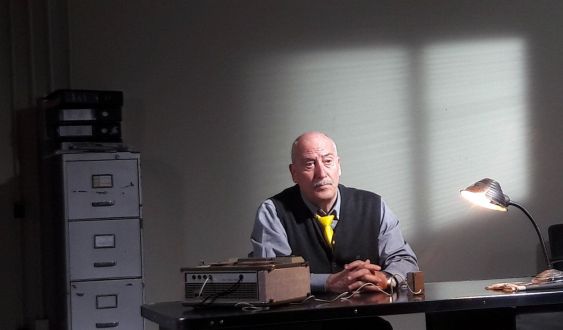
With all injustice, there are times when, in discussions of great Barcelona novels, Andreu Martín's Cabaret Pompeya is not mentioned. It is one of the most accurate narratives set in a city that functions as more than just a simple backdrop, becoming a protagonist itself, living and suffering a narrative arc of half a century of impeccably chiseled history.
And, despite the impressiveness of the aforementioned work, this is not the only reason why Martín is welcomed with fanfare when he arrives at the Bar in the afternoon to down a gin and tonic and submit, with kind resignation, to a conversation that takes on the tones of a third degree interrogation on the street.
"I studied psychology and, one day, I started earning money as a writer. That's how I've lived until today, forty-something years later. Now I should be retired, but the addiction to writing is stronger than me," explains the highly awarded author of hundreds of works ranging from comics to young adult novels, including screenplays for television and film, or seminal crime novels like Prótesis, Piel de Policía, or El Harén del Tibidabo.
--- And how and when did you decide you were going to dedicate yourself to this profession?
--- I became a writer in the military service, because I preferred writing comic scripts to doing drills.
That was the beginning of a fruitful collaboration with Editorial Bruguera and the development of characters so solidly anchored in our popular cultural heritage as Sir Tim O'Theo, created by Raf but often scripted by Martín.
The result is the mastery of a craft of which he is very proud: "I have been able to be a writer all my life. Not a journalist who writes novels, or a lawyer who writes novels, or a professor who writes novels, nor a rich person who writes novels; but a writer with specific time, dedication, and vocation. I have the feeling of having done what I wanted all my life," he argues, his gaze lost in the gin and tonic in his glass. After a moment of reflective silence, he clarifies: "Although that's impossible, of course."
Placing Barcelona crime fiction on the map
Manuel Vázquez Montalbán, possibly the name that has most contributed to cementing the presence of black and criminal narrative manufactured in the Catalan capital in bookstores around the world, assured that, with Andreu Martín's Barcelona Connection, "the city penetrates the empire of international crime." A recognition of the work of an all-rounder writer who remains in the spotlight with new works of the genre, developed with speed, effectiveness, and a total mastery of the tools and resources of a great narrator. The latest, take note, is the legitimately acclaimed Vais a decir que estoy loco (AlRevés).
--- And, lately, what are you up to?
--- I am writing a novel that will be titled Una chica disfrazada de clarinete. And I keep living.

Personally, Andreu highlights having become "a husband twice: once thoughtlessly and madly and I ended up falling into the bottom of a ravine; and a second time, during a costume ball where I stole a star from the Night. I became a father on a journey full of adventures, like getting lost in the Orinoco jungle, in a small canoe, in the company of my dear RM." Having said that, what brings out his most categorical smile is the proximity of his next encounter with his grandson, with whom they share worlds, games, and adventures that are reflected in a complicity that moistens the writer's gaze with joy.
Married to a city he left
When Andreu Martín is asked what he loves about his native Barcelona, where he was born in 1949, the answer leaves no room for doubt: "Everything, its virtues and its defects, its dirty history and its brilliant achievements. It's like asking me what I like about my wife. There's only one answer: everything. Even what I shouldn't like."
Even so, he no longer lives in the city. "I liked it when it was the gloomy Francoist capital of my childhood; I fell in love with it when Maragall helped it to get pretty; and I have gone to another place when Colau has decided to destroy everything I liked about it," he laments about "my detested superblocks, the bike lanes, the elimination of the usefulness of the chamfers, the badly thought out and ill-conceived works. But ---he reflects--- I am no longer talking about my Barcelona. I am talking about a place that is as alien to me as if I had been turned into a tourist."
On the radio plays the furious rhythm of Cayo Diablo, by Los Mambo Jambo, captained by his good friend and godson, saxophonist and composer Dani Nel·lo.
Andreu smiles affectionately and glances at the menu.
--- Are you going to want to eat something?
--- If my doctor doesn't hear me, something sweet please.
Add The New Barcelona Post as your preferred Google source for free
Stay informed with the latest news.
