
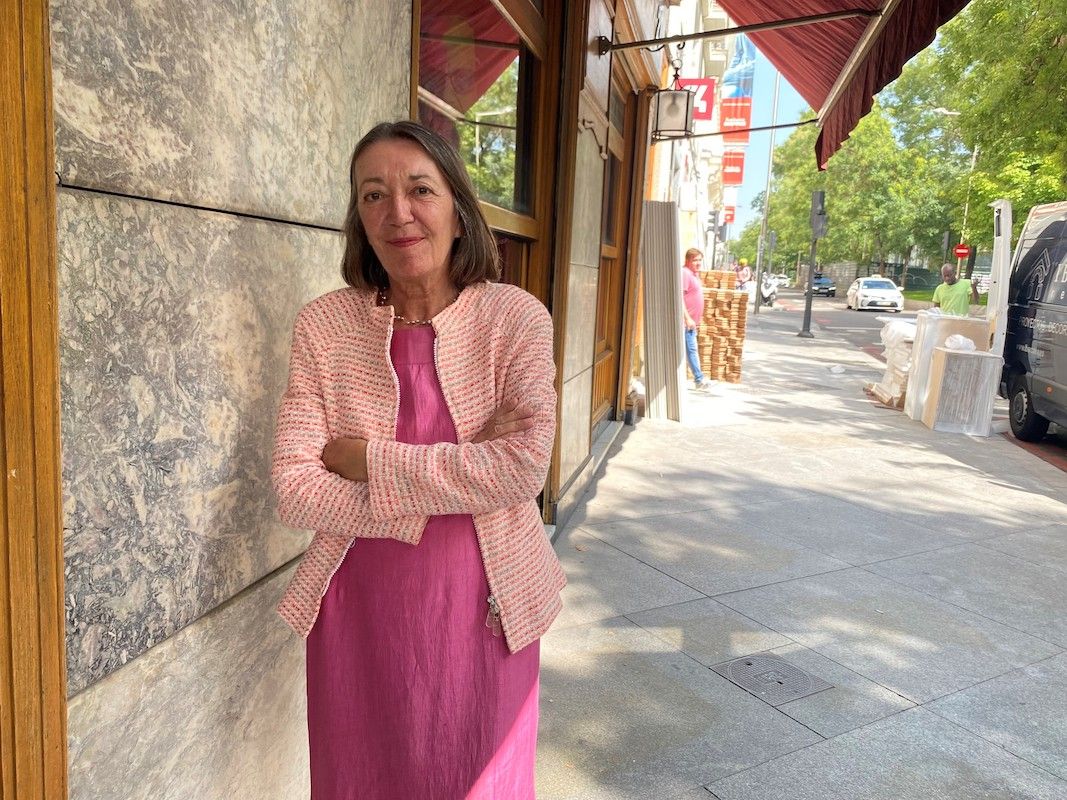
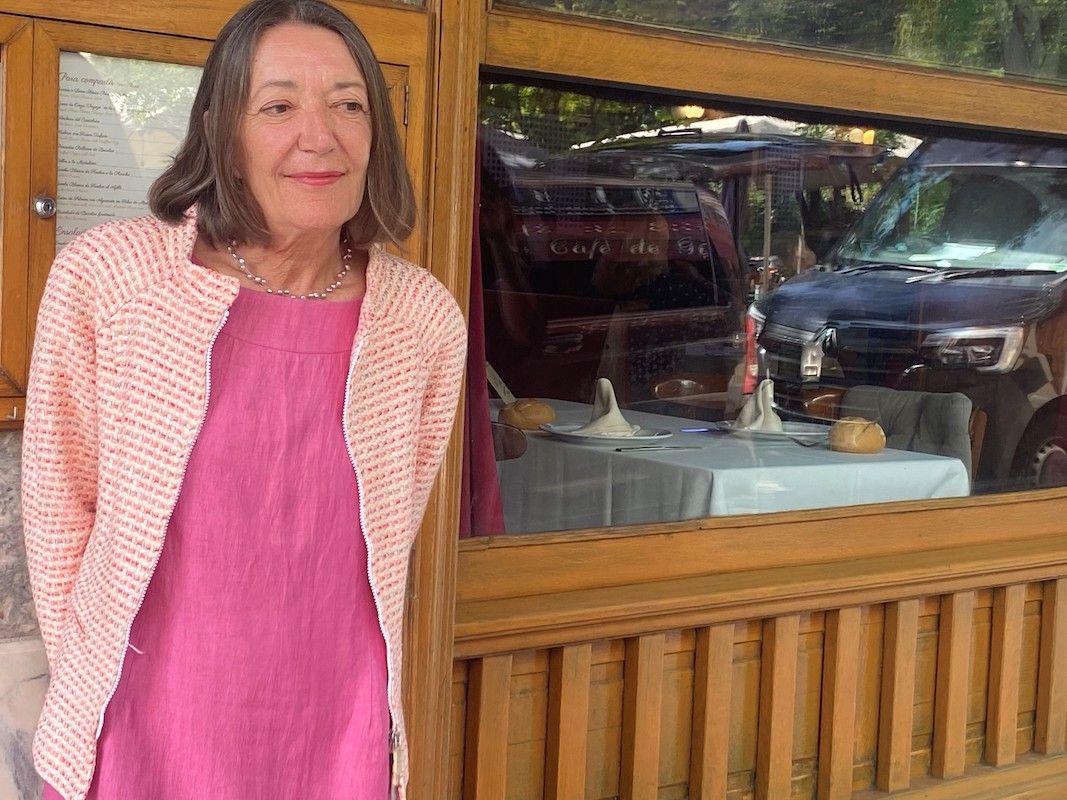
"After my adolescence, back in 1974, I spent a year in California. Later, after finishing university studies, I went to Boston. These situations brought me solitude and, consequently, being more in myself and at the same time the need to communicate with those I left behind, sending them frequent and extensive letters. I believe that is where I discovered writing." The writer, essayist, literary critic, and Literature professor Ana Rodríguez Fischer recalls those transoceanic experiences at the bar, while enjoying a quick snack that anticipates the menu to come. "If there were more people, I would order portions, but never, ever, a combined dish." The radio is off —"to converse, I prefer to eliminate ambient noises or sounds"— and midday appears in the form of sunbeams filtering through the Bar's windows.
A professor at the University of Barcelona and a deep connoisseur of the work, life, and legacy of the writer Rosa Chacel, the regular is responsible for a notable quantity of critical editions of names such as Marsé, Mendoza, Rosalía de Castro, or Moratín; of a corpus of articles and literary criticisms for media such as ABC Cultural, Babelia, or Revista de Libros from which the essay Por qué leemos novelas (Why We Read Novels) was derived, or of other texts such as Trajinantes de caminos (Road Travelers) or Prosa española de vanguardia (Spanish Avant-garde Prose).
Since 1995, she has combined her teaching and research activity and literary criticism with a third facet as a novelist, with which she has signed works such as her acclaimed debut Objetos extraviados (Lost Objects), and Batir de alas (Flapping Wings), Ciudadanos (Citizens), Pasiones tatuadas (Tattooed Passions), El pulso del azar (The Pulse of Chance) or El poeta y el pintor (The Poet and the Painter). Among the awards received are the Premio Femenino Lumen and the Café de Gijón. Quite something.
Now she returns to bookstore shelves with Antes de que llegue el olvido (Before Oblivion Arrives) (Siruela), a novel that delves into pain and oblivion in the USSR between World War II and the leaden rigors of Khrushchev, passing through the brutal Stalinist purges. Through the words of the poet Anna Akhmatova, and through her bond with the writer Marina Tsvetaeva, the narrative challenges two decades of silences full of damages, dreams, illusions, falls, exile, and an invincible love for literature that interweaves worlds with scraps of memories and dreams.
The taste for conjugating
"I have spent my life reading, that's why I write. There has also been a lot of cinema, exhibitions, theater, music and sports, in addition to life in nature, especially by that sea that I keep looking for in Barcelona," explains the parishioner with a smile of someone who has dealt with several fronts always "with that independence that my condition as a university professor provides me in the exercise of literary criticism and in the writing of my novels."
At the same time, she feels satisfied "with the memory I have left in my numerous former students. And of which there are testimonies," she points out. "Also, and that is something very important to me, I am proud to have been able to reconcile and dedicate a lot of time to my children and my friends."
---And hasn't it been difficult, sometimes, having to do all those jobs simultaneously?
Ana lets out a loud laugh. "Not at all! I like the fact of combining these three activities that, inexplicably, some consider incompatible." She feels comfortable harboring those three souls of hers, independent and, at the same time, interconnected.
She still has a lot of energy left, as she announces, she is in the process of writing "a very tough book about mothers". And she reveals no more.
The city they turned into a brand
Born in the Asturian council of Vegadeo and based in Barcelona, the writer asserts that she has always adored this city. In her memory, the celebration of "those unforgettable International Libertarian Conferences" organized by the CNT/FAI in July 1977 in Parc Güell holds a special and favorite place. That gigantic coven brought together more than six hundred thousand people who debated anarchism, free love, drugs and dogmas, with the participation of prominent intellectuals of the time, and performances by artists such as Jaume Sisa, Pau Riba or Ocaña and Camilo, among others. An episode that, in her opinion, "deserves a book" that curiously no one seems to have written yet.
Ana Rodríguez Fischer announces that she is in the process of writing "a very tough book about mothers""This city was fundamental in my formative stage, when I was a night owl, because I had to scratch out time and lengthen the days. The 70s and 80s were years of exceptional superabundance in all aspects of life," reasons the parishioner, before losing some of the smile that shines in her eyes and finishing, with a hint of certain bitterness: "That's not how it is anymore."
---What exactly do you mean?
"To the fact that they have reduced it to a brand; not only for the mercantile and Phoenician aspect, but for the impoverishment. Barcelona has been reduced to a few clichés and flashes, as worn out as they are insipid." And she pulls a pack of Benson & Hedges from her purse to go out for a cigarette and let the fresh, sunny air envelop her.
---Don't be long, your first course will be out of the kitchen any minute.
Ana Rodríguez Ficher suddenly recovers her smile. "I'll be right back," she promises with a wink.
Add The New Barcelona Post as your preferred Google source for free
Stay informed with the latest news.
