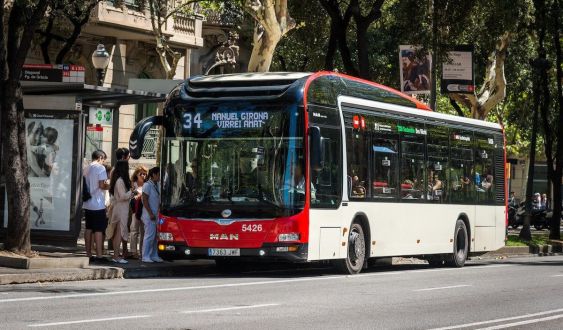
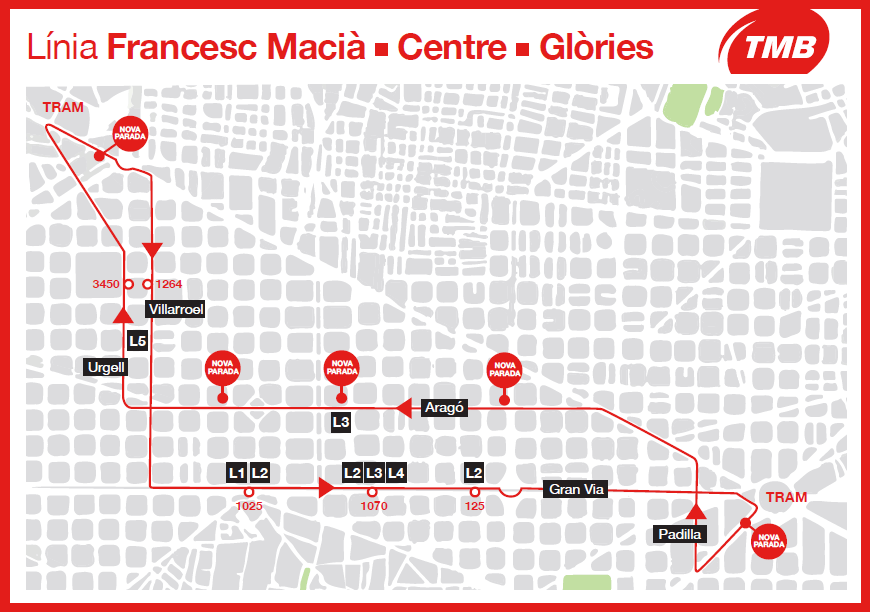
Fast bus lines will arrive for the first time in the city with a pilot test that Transports Metropolitans de Barcelona (TMB) will carry out to connect Glòries and Francesc Macià with the city center. The new express bus will link these two nodes with Hospital Clínic, Plaça Universitat or Passeig de Gràcia in a period of between 10 and 13 minutes, reducing the time it currently takes to make similar journeys with lines 6 and 7. To go from end to end, the journey will take 20 minutes.
The outbound journey will be via Villarroel and Gran Via, while the return will be via Aragó and Urgell. It will run entirely on bus lanes, finally debuting the one on Aragó. There will only be four stops in each direction ---Hospital Clínic, Universitat/Aribau, Passeig de Gràcia and Passeig de Sant Joan---. The new TMB service will start operating in September and will do so on weekdays, from 7:00 a.m. to 10:00 p.m., with a frequency of eight minutes.
The objective of this fast bus will not be to replace any current line but to facilitate access to the center of Barcelona for users coming from other municipalities in the metropolitan area, improving connections with the tram, metro and other existing buses. It also aims to attract new travelers who make this journey by private vehicle, with the aspiration of attracting 30% of new users. TMB expects that one million people will use this line per year.
A total of six 12-meter buses will cover this new line. Initially, they will be gas hybrids, but hydrogen buses are expected to be incorporated, which will begin to arrive on the Barcelona bus network at the end of this year. TMB is collaborating with Iberdrola to build the first public-use hydrogen plant in Spain in the Zona Franca, which is expected to become operational this November.
Pilot test that can be extended
This new line between Francesc Macià and Glòries will be a pilot test, but the operator assures that it will not hesitate to extend it to new lines if it works well. "The will is to grow," assures the president of TMB, Rosa Alarcón. In this sense, a pilot test that TMB will now generalize after its good results will be the on-demand bus in Torre Baró, with more than 860 registered users and very positive evaluations. This model serves to manage areas with few users. There are no defined routes, only stops. To use it, users request the bus when they need it and indicate what route they want to take, and optimal routes are created for all travelers who want to use it through artificial intelligence. "It's like a shared taxi," summarizes Alarcón.
Now, this model will be applied to more areas, specifically, in those where there are Bus de Barri lines, which are currently 24. For the last quarter of 2021, three on-demand bus service areas will be created in Horta-Guinardó (135), Sarrià-Sant Gervasi (118 and 128) and Ciutat Vella (120 and 121). The definition and commissioning of the rest of the areas will continue in 2022.
Add The New Barcelona Post as your preferred Google source for free
Stay informed with the latest news.
