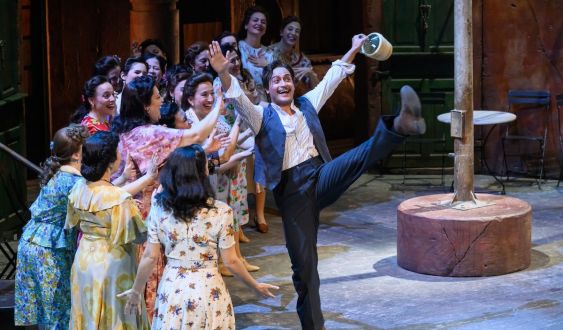
Barcelona had been for weeks a small secular sanctuary dedicated to Javier Camarena: banners and posters where the tenor held his flask of elixir like someone proudly preserving a domestic relic. And yet, opera—always fond of plot twists—decided otherwise. The icon could not perform in the first session, and the spotlight fell on the third tenor of the cast, Filipe Manu. His interpretation, more inclined to comic gesture than vocal solidity, showed skill and ease; he resolved the situation with dignity, in an opera that humorously presents the dual aspect of destiny—capricious and arbitrary, yet implacable and necessary—with the backdrop of Tristan and Isolde's love story. Not by chance, Serena Sáenz's luminous Adina enters the scene reading a gossip magazine that recounts the wonders of "la regina Isotta," with whom we are invited to link her at various moments.
L'elisir d'amore, an opera conceived in a few weeks by Gaetano Donizetti—barely fifteen days, according to some sources—to fulfill a commission that another composer never delivered, is a masterpiece born of hurried work and inspiration, by those coincidences of fate. The score demonstrates the composer's best ingenuity: a mix of immediate lyricism, well-calibrated humor, and unashamed Mozartian debts. Perhaps that is why a captivating spontaneity breathes from the very beginning, despite the clichés it unashamedly exhibits.
A direct heir to Scribe's text, the libretto already brings packaged archetypes: the shy lover, the clever girl, the overconfident soldier, and the irresistible charlatan. And yet, Donizetti manages to musically weave a story generous in games of appearances: identities fold like mirrors and sentimental trompe l'oeils abound, which never become entirely cruel… Although at times tragedy is palpable, as in the imprudent games of Così fan tutte.
L'elisir is a masterpiece born of haste, by those coincidences of fate: a mix of immediate lyricism, well-calibrated humor, and unashamed Mozartian debtsIt is not uncommon to see the dottoressaDespina in the outlandish Dulcamara, who will have to cede his privileged position to Adina, as she ---the servant and educator of Fiordiligi and Dorabella--- would have wanted. Similar logic runs through the staging ofMario Gas, traditional and festive, with an airFelliniesquethat makes it almost a popular ritual: from the lamppost ---already iconic and, for many, associated with other musical comedies, like the previous oneSinging in the Rainor the obviously subsequentLa La Land---even the lights that dot the stage as in a perpetual or at least recurrent fair, in accordance with the circular temporality of archaic civilizations.
With the spirit of that emotional topos that Serrat consecrated in his song Fiesta, spaghetti, local wine, and black market superstitions will be shared. And the doctor will mingle with everyone in the celebration of the wedding that inaugurates the second act, with the house lights still on, as if there had never been a barrier between charlatanism and salvation, nor a strict separation between those on one side and the other of the stage.
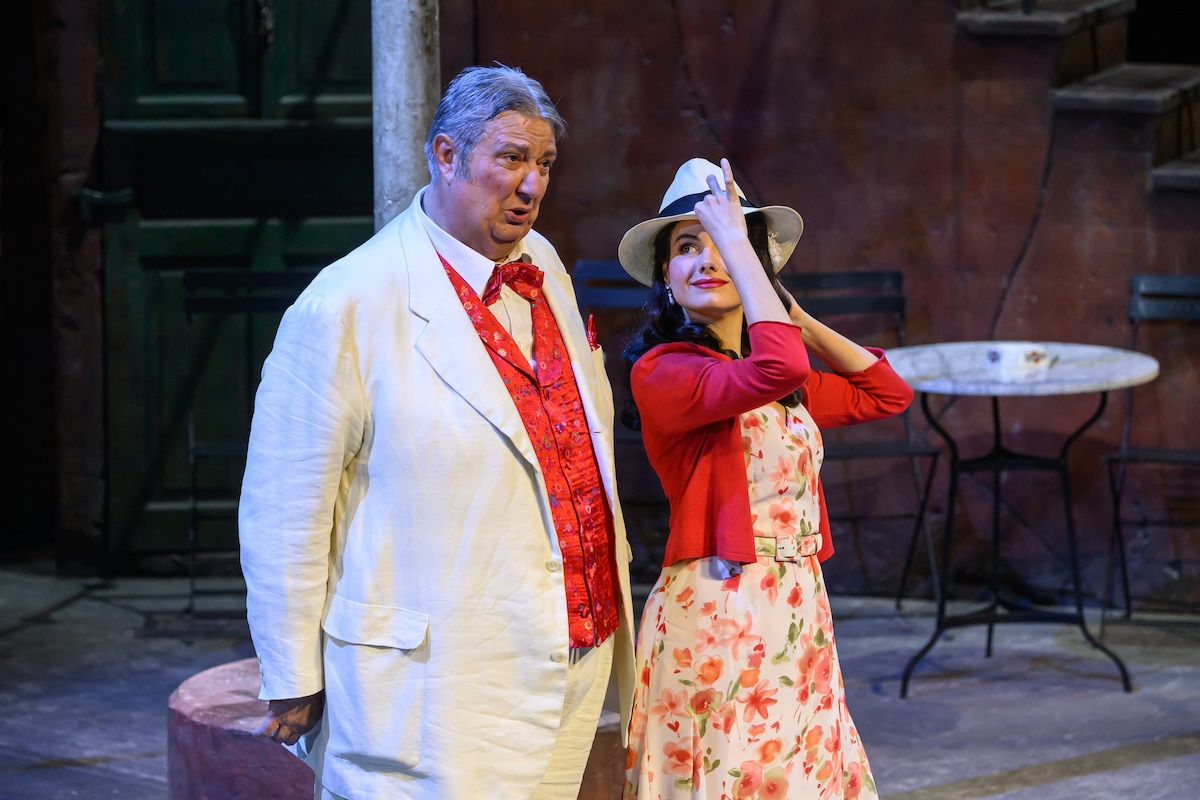
Proof of the porosity is that this pagan, vibrant atmosphere once again convinced at the Liceu: the staging from a very remote 1983 does not age, perhaps because it evokes a collective memory older than theatrical representations. The elixir that Nemorino ingests believing in its powers ---wine, in reality--- becomes an anthropological artifact rather than a dramatic one. It works because ---like a placebo, only with very noticeable effects in this case--- we believe it works; because it allows the affected person to align themselves all the more with what is desired, granting it the status of truth… with which reality corresponds.
It sounds like magical thinking and it undoubtedly is. But not in opposition to reality, but by shaping the essential credulity in our very personal representations: fantasy, inevitably connected with the affective sphere, operates as a lens through which we understand ourselves and believe we are seen. Scientists explain it with neurotransmitters; dottore Dulcamara, with a flask and a smile.
The elixir works like a placebo, because we believe it works and thus allows the affected person to align themselves all the more intensely with what is desiredAmidst so much alchemy, it is inevitable to remember that the buffa version of the Tristanian filter officiates an effect similar to that of the medieval tragedy of origin, whichWagnerwould reformulate in his well-known opera in 1865, thirty-three years later. It is ironic and deeply symptomatic that the Liceu proposes a journey, in the same season, from that light, Mediterranean elixir, to the Wagnerian reformulation of that Celtic or Breton tale; as if the story of maximally conditioned love unfolded before us at two extremes of the same mythical arc.
The emotional release from the perception of fatality, and consequent ---still Aristotelian--- catharsis, anticipates in Donizetti's comedy an effect of inverse sign, though no less curative, through the laughter awakened by the costumbrista scenes. The visualization of erotic impulses, more credible from the deformation inherent in dramaturgy, provokes the discharge of psychic energy that Freud had explained in Jokes and Their Relation to the Unconscious.
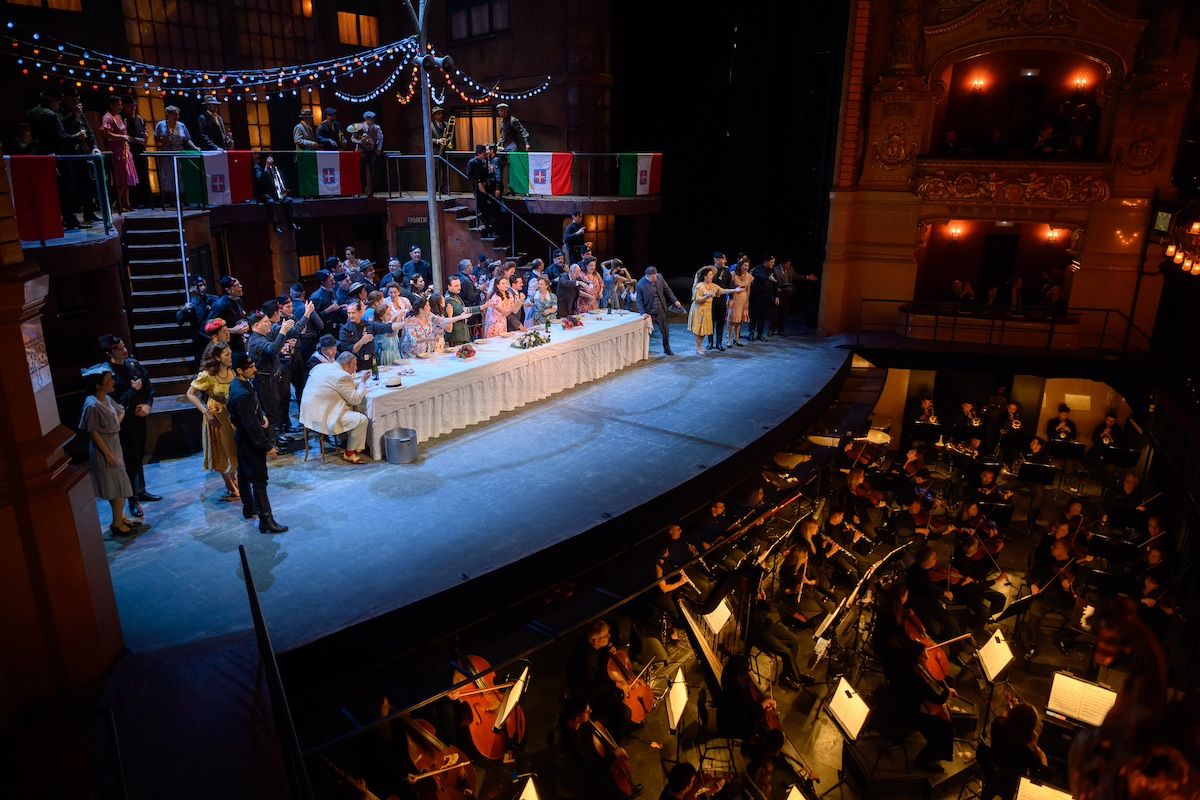
Musically, the performance at the Liceu was solid, at times very inspired. The orchestra shone in the wind solos and the chorus ---collective consciousness, a small sociological experiment on environmental pressure--- showed cohesion, color, and an energy that knew how to accompany every emotional fluctuation on stage. In this opera with hardly any supporting characters, Ambrogio Maestri characterized an expansive and charismatic Dulcamara, aware of his histrionic function, as if preparing for Falstaff, this same season at the Liceu.
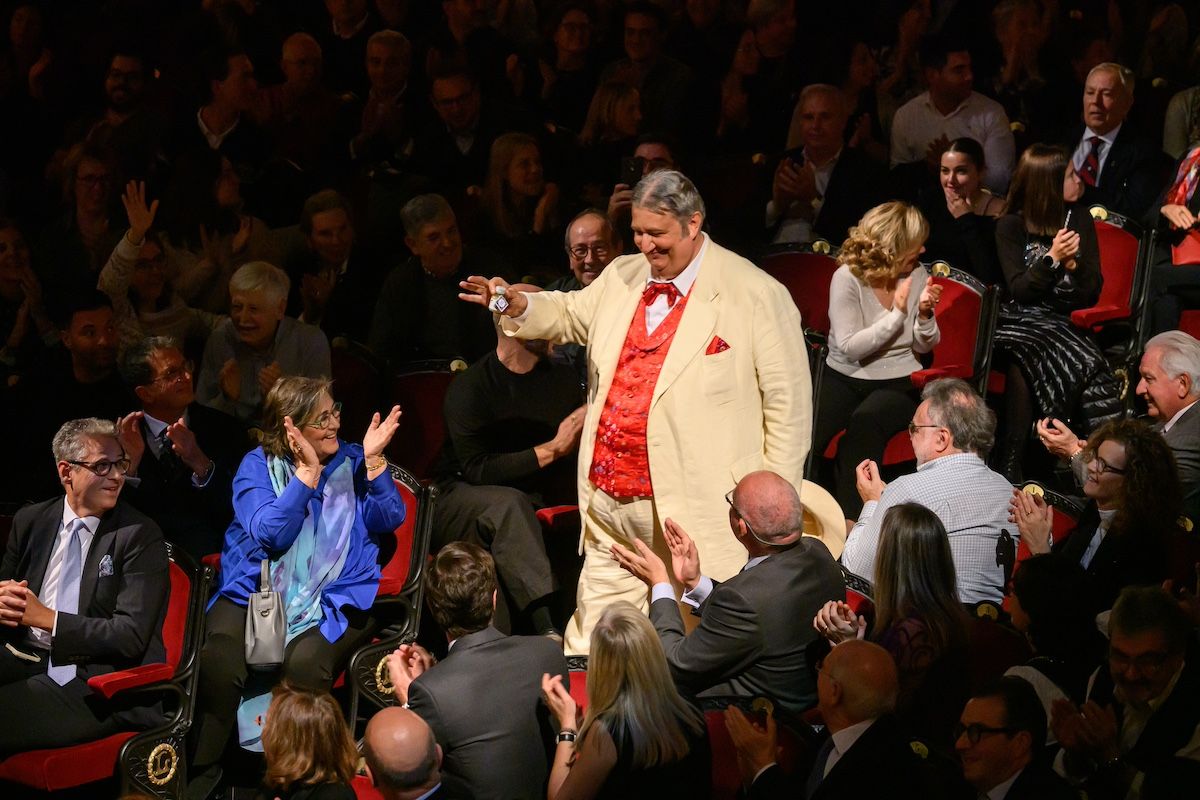
What's more, he would make a funny final appearance ---once the performance was over--- walking down the aisle of the stalls and addressing the audience, to whom he offered a bottiglia while singing his hit, in which he claims supernatural powers: "Questo è un balsamo celeste / questo è un filtro universale!" The kind of artist capable of selling a car without wheels, and still receiving thanks. We also cannot forget Huw Montague Rendall's Belcore, who, adding to the caricature, showed himself as a living manual of the boastful male ---here a soldier.
But, above all, Serena Sáenz reigned supreme. Her Adina—cunning and luminous, with a vocal line as fresh as it was precise, and a superb performance in the buffo register—achieved that rare blend of dramatic intelligence and natural charm. In her first interpretation of the character, she captivated with clarity and playfulness, managing the opera's pulse without hesitation. She led the audience by the hand to the desired outcome, unafraid to show from the beginning that game, that of maximally artificial spontaneity.
The applause might have been more timid than expected at some peak moments of the opera, perhaps still under the shadow of the poster announcing another name in the role of the male protagonist. In any case, the magic—a synthesis of theater, music, and shared faith—worked again. The formula of L'elisir d'amore remains infallible not for what it cures, but for the truth it places before our eyes, and in a pleasant way: that we continue to be creatures easily seduced, and that the state of emotional intoxication—that Platonic eros—is, in reality, the source of all true creation.
Add The New Barcelona Post as your preferred Google source for free
Stay informed with the latest news.
