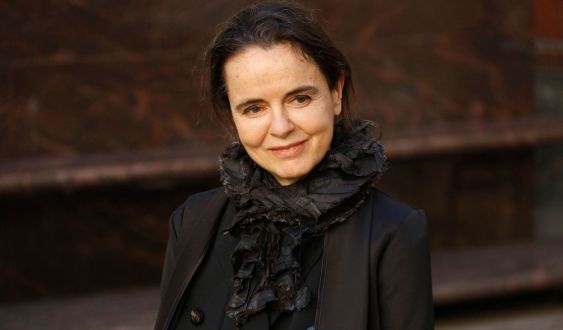
"It will depend on you." That was the phrase that allowed Amélie Nothomb to be born. Her father, Patrick, was one of the 1,500 hostages a revolt in the Congo had trapped in the city of Stanleyville in 1964. He was the consul and it fell to him to be the spokesperson for the kidnapped, using words to defend himself, like Scheherazade, his daughter remarks. Facing the firing squad, the leader in charge of everything asked him if he wanted to have children again and his answer saved him.
"I am the fruit of that phrase," Nothomb declares at the presentation of Primera sangre (Anagrama), with translation by Sergi Pàmies in Spanish and Ferran Ráfols Gesa in Catalan. It is the book about her father, or by her father, written after he died in the first days of confinement. "I was born close to death. It's no coincidence that I became a writer. But I've only realized it now," delves the Belgian writer born in 1967 in Kobe (Japan), where her father was ambassador after surviving the shootings. She also feels she knows more about Patrick Nothomb after writing this novel, starring and narrated by him: "It seems like a paradox. Death does not prevent knowing someone, but rather allows one to know them intimately."
The author had not considered writing about her father before because she never thought he could die. But, it wasn't until finishing Primera sangre that she was able to overcome her grief, after the pandemic prevented her from attending her father's funeral, who died in Belgium while she was confined in Paris. "My father spoke to me all the time," Nothomb recalls of the months after his passing, so she decided to tell his life story. "I held the pen but it's his voice that is heard," she maintains. And, when she wrote the last sentence, the voices fell silent: "We should all consider writing about our parents' lives when they die."
Nothomb resorts to the first person singular to give voice to her father, that which is most gone and cannot be found in photos when one is no longer there. "I was afraid his voice wouldn't be heard," she confesses, although she had extra help, all the times they had told her how much they resembled each other. As a child, she even introduced herself with the name Patrick, waiting for them to tell her no, but they always agreed with her. "It was easy for me to find his voice," she relates, "my father's life has not been mine, but he is in me."
First Blood speaks of the childhood and youth of Patrick Nothomb, starting from his early years marked by the death of his father when he was a few months old, which left his mother "so desperate that she was only a widow." Then came the hunger and Darwinism fostered by his grandfather, an aristocratic poet who did not believe children should be fed. "It really happened," she insists, rejecting the anger she has received from certain relatives, disappointed to see how she has portrayed those years.
"My father was a true miracle," the author prides herself, "I wonder how he managed." But all that suffering is hinted at, but not narrated in the novel, "my father would have forbidden me to speak of him as a victim," respecting the family taboo of not talking about the bad. If her father recounted complicated episodes laughing, she was not going to do less. "It's a novel full of Nothomb," defends Anagrama's editorial director, Silvia Sesé, "a hymn to life and survival."
Add The New Barcelona Post as your preferred Google source for free
Stay informed with the latest news.
