
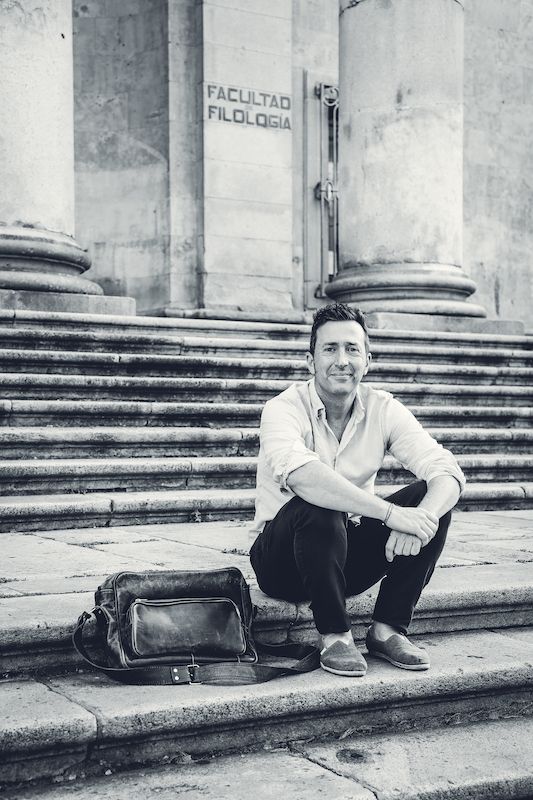
Cemetry Gates by The Smiths starts at the moment when, mid-morning, Àlex Martín Escribà arrives at the Bar with a thirst for beer, hunger for some tapas, a desire for a chat at the bar, and perhaps, if things later lead to a big meal, a good cigar to crown the play.
Professor of Catalan language and literature at the University of Salamanca, where he also co-directs the pioneering Congress of Noir Novel and Cinema, this Barcelona native born in '74 has developed a conspicuous activity as a researcher and popularizer of the noir and detective genre, "which is still reviled by academia." And he has done so from different facets: essayist, columnist, literary critic, or editor with the Clandestina label.
Precisely for this publishing house, he has just released his latest book, Interrogatoris: gènere negre i memòria, which, based on the binomial between literature and memory as a key to understanding and denouncing the present, offers a series of interviews —third-degree interrogations, rather— with scholars and experts of the genre. These share with the author a rich variety of perspectives and approaches on the interrelation between letters and memory as a key to developing narratives capable of challenging the present with knowledge. "For this book, I have interviewed numerous French specialists and writers, who are the cradle of knowledge, of genre production, and of reference studies. Furthermore, knowing French polar is understanding the reception of the noir and detective genre in Spain."
The essayist's best childhood memories are related to his native BarcelonaAuthor, alone or very well accompanied, of nine essays, assures he enjoys writing a lot, and highlights the volumes worked on four hands with Jordi Canal: "the two prodigious volumes" of At point-blank range —"our great project, achieved I hope, of trying to canonize, classify and order the crime and detective novel"--- and The Straw Tail: Portrait in Yellow and Black, "the history of the collection that was our little Série Noire Catalan". Other significant works are Rafael Tasis, detective novelist, about one of his great literary loves, "the introducer of the detective novel in Catalonia, our Edgar Allan Poe", or JJaume Fuster, black genre without limits, about the Barcelona author who prematurely passed away 25 years ago.
And crime fiction entered the university
"We could say that making the decision to go study in Salamanca changed my life. I trained there, I learned to value the study of humanities. I have been lucky enough to have great professors and then stay on as a lecturer at one of the most prestigious universities in the world", explains the regular with his beer half-drunk.
With time and constant work, he and his colleague Javier Sánchez Zapatero have managed to bring their common literary passion to the Salamanca university hall, organizing the Congress of Crime Novel and Film, "which will celebrate its twentieth edition in 2024." Furthermore, and always thanks to this activist work, "for more than ten years, Salamanca is the only Spanish university where students can take a course in crime and detective fiction that fills the capacity with more than a hundred students each year."
—Something to be proud of, right?
—I wouldn't know what I can feel most proud of, but, besides some essays, perhaps it's having introduced crime fiction into the university, yes.

Death by postmodernity
The essayist's best childhood memories are related to his native Barcelona. "I remember when my grandfather used to take me to the Club de Natació Barcelona to swim, and also the walks to Camp Nou to watch Barça with my father. For me, those details mark my life and I still remember them today with nostalgia and longing", he explains.
—Do you miss the city?
The regular takes his time to answer. "What happens to me with this city is a bit like what happens to Pepe Carvalho, that I have a love-hate relationship with it. Since I left, it has changed so much that I don't recognize it, sometimes I feel like an intruder, when I see that many of those places that made up my sentimental memory have disappeared. It's dirty and full of needy people. It has globalized and lost its identity. When I'm here, it makes me feel strange, a foreigner's syndrome. However, when I move away from it, I idealize it and feel the need to return, because I am a declared Barcelonian and I love my city."
A brief silence ensues, during which Àlex Martín Escribà reflects, looking nowhere in particular. The beer is running out, perhaps to make way for the next one, and The Smiths attack with You've got everything now. A few seconds pass like this, before the regular customer resumes speaking:
—I think it will be difficult to recover that Barcelona we all remember —he states, reflectively—. Postmodernity has killed it.
Add The New Barcelona Post as your preferred Google source for free
Stay informed with the latest news.
