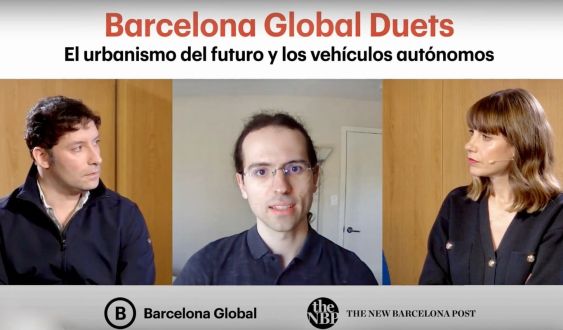
"Barcelona can be in the 21st century one of the reference cities to live and work globally", although, first, it must do its homework and equip itself with the appropriate tools to execute strategic urban interventions that contribute to boosting its economy, solving the housing challenge, and ensuring the success of the transition from the third to the fourth industrial revolution. These are some of the main reflections made by Ramon Gras, City Science Researcher at Harvard and co-founder of the consultancy Aretian Urban Analytics and Design, during his participation in the third session of the Barcelona Global Duets, a series of dialogues on current issues resulting from the perspective of two global Barcelona partners of Barcelona Global.
The video of the conversation that Gras had with another member of the International Council of Barcelona Global, Aleix Paris, a software engineer at the Californian autonomous vehicle company Waymo, owned by Alphabet, the holding company to which Google also belongs, is now available in this same article. According to Paris, the autonomous car will allow "saving millions of lives" and will make cities more efficient and have a much lower volume of congestion than at present.
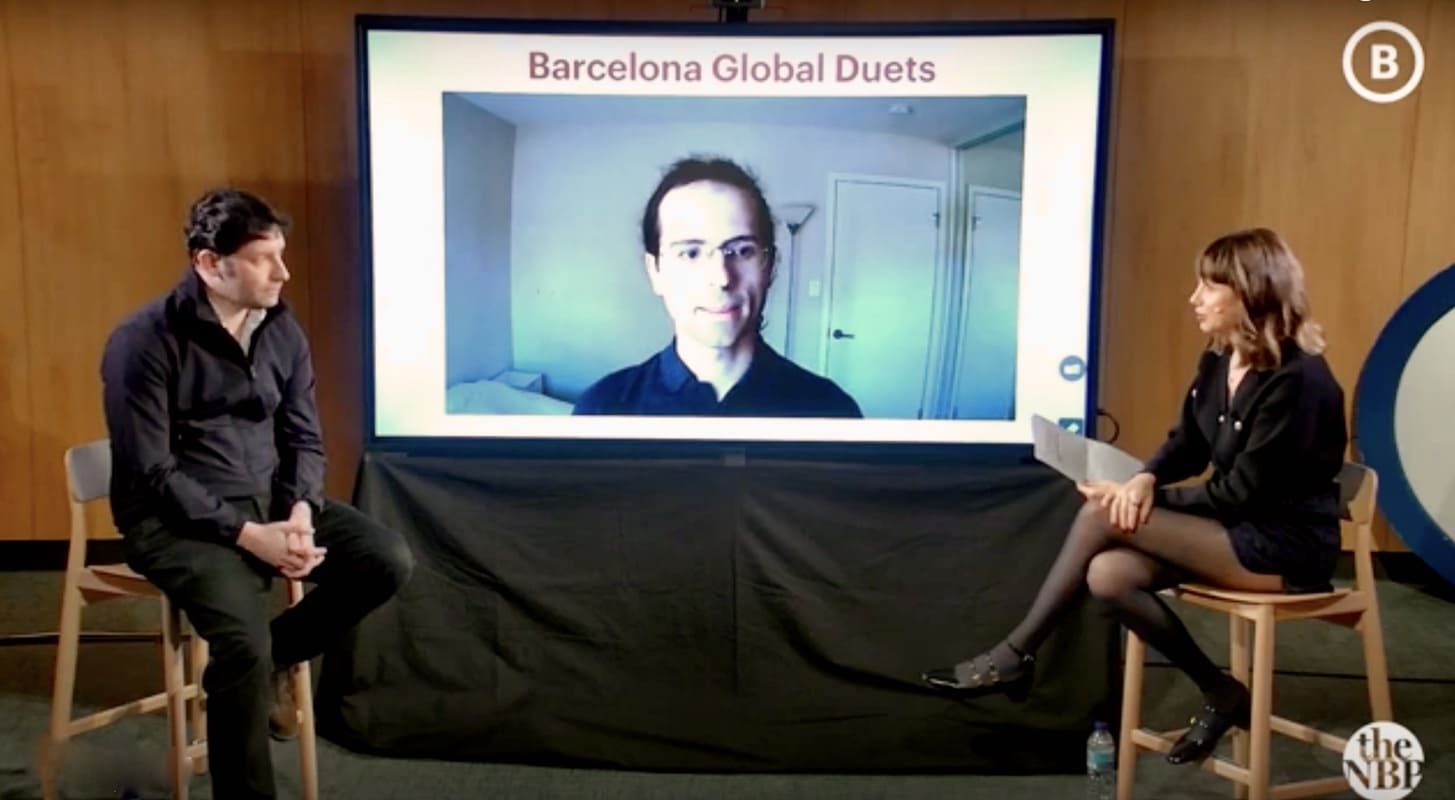
In collaboration with The New Barcelona Post and moderated by journalist and CEO of TheCreativeAgency, Bibiana Ballbè, Gras and Paris debated in this Duets about mobility and the future of large cities, and both agreed that the Catalan capital is very well positioned to occupy a prominent position in the global league of the world's most advanced cities. "I see Barcelona in good shape," admitted Gras as soon as the dialogue began and after having lived a few months in the city, since his usual residence is now in Boston. Along the same lines, Paris highlighted that on a recent visit he was "surprised by how well public transport works compared to many cities in the United States."
https://youtu.be/eJCqNvVVnGg
For this engineer specialized in robotics software, Barcelona fits the typology of a city where the autonomous vehicle "has a lot of potential," although he did not dare to predict when we will see the first self-driving cars circulating. This future possibility, however, is already a reality in the American cities of Phoenix and San Francisco, where Waymo has already launched the world's first autonomous ride service, which citizens can use like a taxi through the Waymo One app. "Indeed, autonomous cars already exist, I've tried them! It seems like science fiction and it still surprises me to see a car with no one at the wheel, but this technology is already a reality. Soon we will also start operating in Los Angeles," explained Paris, who works at the company's headquarters in Silicon Valley (California).
The engineer explained that the autonomous vehicles they are designing have the capacity to adapt to existing cities and that they will be able to coexist perfectly with traditional vehicles throughout the transition phase, which is expected to be long. "Our car fully adapts to cities as they exist today. It predicts on board and in real time what other road users will do, whether they are pedestrians, cyclists, or traditional drivers. We interact in a similar way to a human to be able to reach the destination safely."
Ethical and legal challenges
In Paris's opinion, the future of cities will be much better with autonomous cars, as there will be fewer accidents and "millions of lives" will be saved. "It is estimated that every year 1.3 million people die from traffic accidents and 94% are due to human error. With autonomous vehicles, we will have more efficient cities, with fewer accidents and less congestion, because there will be, for example, fewer empty kilometers of a taxi looking for passengers. This type of vehicle will be a good complement to public transport and will make it less necessary to own a personal car, that is, fewer parking lots will be needed and that implies more green spaces... they will be more sustainable cities and, in addition, all autonomous vehicles are 100% electric, so emissions will also be reduced," he anticipates.
Aleix Paris: "It is estimated that every year 1.3 million people die from traffic accidents and 94% are due to human error. With autonomous vehicles, we will have more efficient cities, with fewer accidents and less congestion"Both Paris andGrasthey explained that various initiatives are also underway to apply autonomous vehicles to the transport and logistics sector, with long-haul trucks that will not need to stop and will improve road safety, and delivery vehicles that will optimize distribution in city centers, a system that is already being tested in Chicago. "It is a reality that is making its way, but it presents some legal and psychological difficulties that will make the transition a bit slow," he notedGras. According to the urban planner, this sector still needs to resolve certain casuistries and face"moral dilemmas" of difficult resolution, such as, which lives should be prioritized in case of accidents. "If there are accidents, whose responsibilities will they be?", he askedGras.
Aleix Paris replied that the act of "having to choose between one life or another is a borderline case" and that this situation of asking who to save in case of an accident "simply does not apply, because we are going to save everyone!". "Waymo's car can perceive obstacles three football fields away," he emphasized.
While waiting for this technology to be perfected and advanced, both experts agreed that it is essential to promote electric cars, and for this, it is necessary to substantially increase charging points. "Both in the United States and here, only 1% of the total vehicle fleet is electric or hybrid. It is necessary to create a system of well-distributed charging points so that it is not a limiting factor. But there is another problem: the economic incentive. The US, for example, is a country that has abundant fossil fuels... that makes this transition to electric vehicles very difficult," reflected Ramon Gras.
The legacy of the Cerdà Plan
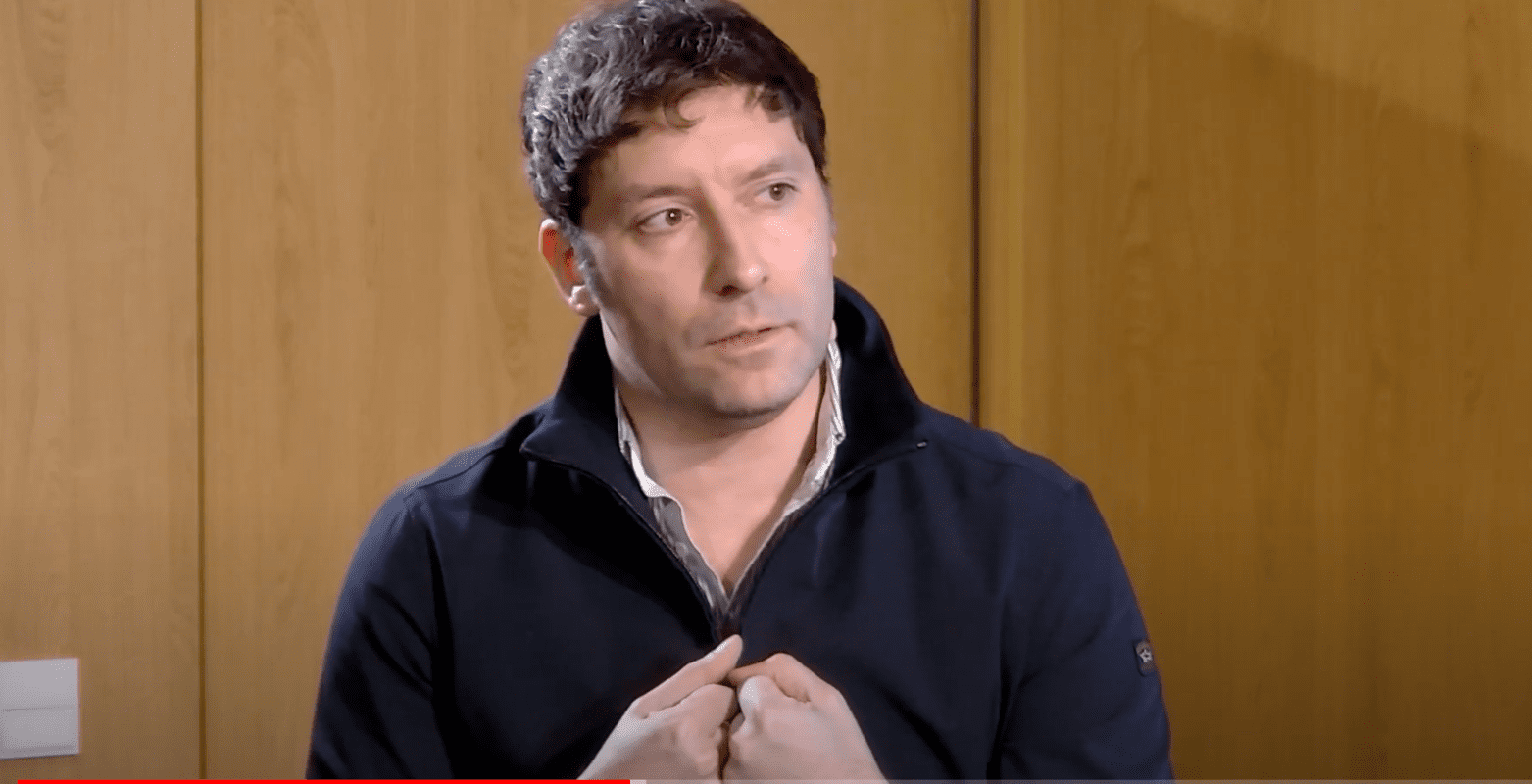
The urban planner indicated that Barcelona, despite what one might think, has an advantageous position in terms of mobility, since 74% of displacements are made by public transport or on foot, "a very high percentage" that is unthinkable in many American cities with a low-density urban model that hinders the efficiency of public transport. "Indeed, in Silicon Valley it is literally what happens: low population density and a lot of extension. Everything is far away, so the car is absolutely necessary," said Paris, who pointed out that in San Francisco, unlike other capitals, it is "easy to live with an electric car."
For Gras, Barcelona's model "is a good starting point" to achieve applying, for example, concepts such as that of the fifteen-minute city, which allows citizens to access all essential services on foot. This ideal, however, is still very far from most large cities in the world, since, according to Gras, "of the 500 million people living in metropolitan regions, less than 5%, 4.5%, meet these standards."
At this point, Gras vindicated the figure of Ildefons Cerdà, for whom he feels "great admiration" for his "human vision," for "putting people at the center" and applying criteria that today "are still totally valid." "He was brilliant, but unfortunately he did not always have the recognition he deserved. He was a visionary man who was 200 years ahead of his time. I admire him very much and he serves as an inspiration," Gras stressed.
Ramon Gras: "Ildefons Cerdà was brilliant, but unfortunately he did not always have the recognition he deserved. He was a visionary man who was 200 years ahead of his time. I admire him very much and he serves as an inspiration"According to the urban planner, the virtues of the Catalan capital are due, precisely, to Cerdà
El presidente de la República, Gabriel Boric, se refirió este lunes a la conmemoración de los 50 años del golpe de Estado, que se cumplirá el próximo 11 de septiembre, y a la polémica que se ha generado en torno a la fecha.
En ese contexto, el Mandatario hizo un llamado a “no empatar las responsabilidades” y a “no relativizar” lo ocurrido hace medio siglo.
“No es aceptable que se relativice o se justifique el golpe de Estado. No es aceptable que se relativice o se justifique la violación a los derechos humanos. No es aceptable que se relativice o se justifique la dictadura”, dijo Boric en un punto de prensa.
El jefe de Estado enfatizó que “no hay dos bandos” en esta materia, sino que “hay una verdad histórica que es innegable”.
“No hay dos bandos. Hay una verdad histórica que es innegable. Y esa verdad histórica es que el 11 de septiembre de 1973 se quebró la democracia en Chile, se violaron los derechos humanos y se instaló una dictadura que duró 17 años”, sostuvo.
Boric también se refirió a la propuesta de declaración conjunta que el Gobierno ha impulsado para que los partidos políticos firmen un compromiso con la democracia y los derechos humanos.
“Espero que todos los partidos políticos estén a la altura de la historia y firmen esta declaración. Es un gesto mínimo, pero necesario para la convivencia democrática”, afirmó.
El Mandatario recalcó que “no se trata de pasar la cuenta, sino de mirar hacia el futuro”.
“No se trata de pasar la cuenta, sino de mirar hacia el futuro. Se trata de que nunca más en Chile se quiebre la democracia, se violen los derechos humanos y se instale una dictadura”, sentenció.
Las declaraciones de Boric se dan en medio de la polémica por la conmemoración de los 50 años del golpe de Estado, que ha generado un intenso debate en el país.
Diversas voces han criticado la postura del Gobierno, acusándolo de “dividir” a la sociedad y de “instrumentalizar” la fecha.
Sin embargo, el Ejecutivo ha defendido su postura, argumentando que es necesario “hacer memoria” y “aprender de la historia” para evitar que se repitan los errores del pasado.
En este contexto, el presidente Boric ha reiterado su llamado a la unidad y al respeto, pero también ha sido enfático en la necesidad de “no relativizar” lo ocurrido hace medio siglo.
“No hay dos bandos. Hay una verdad histórica que es innegable. Y esa verdad histórica es que el 11 de septiembre de 1973 se quebró la democracia en Chile, se violaron los derechos humanos y se instaló una dictadura que duró 17 años”, concluyó.
"Barcelona has an important legacy, because 45% of its morphological design is inherited from the Pla Cerdà, which had well-thought-out levels of density and distribution of uses."In this regard,Grasexplained that Barcelona has a density of 16,500 inhabitants per square kilometer and its morphology favors, for example, that its water consumption is among the lowest in the world and that travel times in public transport or the volume of emissions are "notably lower than comparable cities like Atlanta or Seattle."The Boston model
After being asked about the city in the world that could be a good reference for Barcelona, Gras pointed to Boston. "It is a city that has many virtues: superior urban quality, very developed public transport, and a very well-thought-out fabric of uses," which has favored the city having some of the best hospitals, universities, and research centers in the world. "Boston has five mature innovation ecosystems, it is the most powerful innovation district in the world thanks to Harvard and MIT, with 45,000 professionals... two-thirds of whom work in knowledge-intensive activities and generate an enormous amount of patents and innovations," he noted.
According to Gras, Boston has managed to "take advantage of a very interesting strategy: generating a creative tension between the world of new ideas, that is, the academic world and cutting-edge research centers, with the industry verticals, both services and high value-added products." In Europe, interesting initiatives and "very powerful innovation ecosystems" have also emerged, he detailed, in cities such as Budapest, Manchester, Liverpool, Toulouse, Amsterdam, Rotterdam, and Tallinn.
Individual talent and collective talent
And Barcelona? "Barcelona has a problem ---Gras stated---: our individual talent is superior to our collective talent. We have very talented people, in all fields, however, decision-making and relationship systems certainly hinder the development of talent. We have a poor organizational culture and that causes us to have large companies that have stagnated in the third industrial revolution and not in the fourth; a fabric of SMEs with great difficulties to grow, and a quantitatively very notable startup ecosystem, but which, however, offers a lower quality in the products and services they develop than in other countries. This hinders the attraction of talent, hinders the path of young people to develop their professional careers and generates incentives for people to leave."
Given this forceful reality, Bibiana Ballbè asked him if we are aware that this is happening to us in Barcelona? And Gras was honest again: "I'm sorry to say it, but I don't think so. There is a somewhat distorted self-perception," he stated, and criticized that in many areas the city has remained "anchored in the past," which explains why it "constantly" looks back to the 92 Olympic Games. "Sometimes we are wanting to return to a past that will not return and missing out on the opportunities of the present," he warned.
And what needs to be done then? "It is necessary to give a new impulse both urbanistically and economically," he claimed, after recalling that urban planning has a direct impact on the economy and also influences the attraction and retention of talent. "Strategic, well-planned interventions must be promoted to help us successfully transition from the third revolution to the fourth so that in ten years we don't find ourselves having lost opportunities," he reiterated.
In Ramon Gras's opinion, "Barcelona has the ingredients, but not the tools" to be a European benchmark in a new urbanism that allows boosting the economy and the fourth industrial revolution. "There are urban design strategies that favor these knowledge economies to flourish," he highlighted. "Therefore, the tools must be put at the service of combining these ingredients in the best way so that the dynamics favor this transition," said Gras, who listed several challenges that Barcelona must face in the urban field, such as housing construction, economic revitalization, and the structural scarcity of water and energy resources suffered by the metropolitan region.
As he explained, these tools are the result of technological and scientific advances, such as artificial intelligence, which allow "a finer diagnosis" when making decisions and establishing projections with multiple future scenarios" that respond to needs. "These are tools that are in the academic world, but have not yet been integrated into the decision-making system in large cities," he lamented.

Thus, in a city where space is very limited, he urged to become aware of the importance of carefully considering morphological design, so that the layout of streets, the density of urban spaces, and the assigned uses truly respond to future needs and to the industrial and economic sectors that are to be favored. "There is not a sufficiently strong social awareness that a part of the economy's sectors are at risk of disappearing in the coming years if there is no impulse for innovation and sophistication of products and services. We have the ingredients, but we need a regenerating impulse, whether in strategic areas, such as Besòs or the Tres Xemeneies, or in Esplugues, in L'Hospitalet… A significant territorial, urbanistic, and economic impulse is required," reflected the expert.
Gras advocates for an urban model for the metropolitan region of five million inhabitants that bets on harmonious polycentrism, based on an egalitarian distribution of essential services, but with a concentration of uses in very strategic areas that favor knowledge-intensive activities and that produce the "necessary creative tension between university and business," as happens in Boston. "If we combine that vision of design and management with these localized high-quality interventions, Barcelona can be in the 21st century one of the reference cities to live and work globally," he concluded.
Aleix Paris also called for a greater effort of collaboration between the world of universities and companies. "In Barcelona there is talent and good universities, but collaboration between both should be further promoted, as happens in the US," he asserted, after showing himself "optimistic" about the future of the city. "Barcelona is a modern city, with good public transport and very powerful research centers; it has the potential, it has the talent, we just need to retain it," concluded Paris.
Add The New Barcelona Post as your preferred Google source for free
Stay informed with the latest news.
