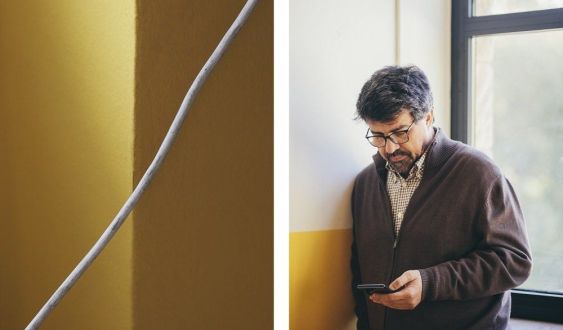
You studied archaeology. How did you get into the field of digital technology and big data? Not only did I do archaeology, but I specialized in the Lower Paleolithic. In that period, the fossil record is so tenuous that you need a lot of science, a lot of data, to understand what happened there. The other possible answer would be that archaeology is the study of human activity, and this is always associated with the use of technologies. I continue to apply the archaeological method to find out how people use technologies to advance in their daily lives.
After all, digital or not, are they tools? They are technology. Agriculture is a technology. Technology is any technical knowledge you apply to dominate nature for the sake of your better survival: not being cold, eating better, curing a disease…
And what do we want to dominate with digital technology? Do you have any doubt that any of the kids who are now in high school will be able to survive without using it? What jobs will they be able to aspire to? Today you can't be a shopkeeper or a taxi driver. If you are not willing to use technology, you are out of the market. And not only that: without computer technology, to be specific, I don't think you will have a good health system or enough information or employment prospects. Technology transforms society and you have to know it to survive.
So, does the internet break down social barriers or add another one? Because, after all, it costs money. That was a debate, the digital divide, from the nineties. Currently, the level of the population with internet access is around 98 or 99%. You can always connect from somewhere with free wifi. Now we are more concerned about whether citizens have access to participation mechanisms and about transparency.
Why should we be concerned about the privacy of our data? Every time humanity faces a disruptive technology of this magnitude, basic concepts are discussed again, such as who holds the power. When information depended on writing, that's what granted power. In ancient Egypt, scribes were very powerful. In the Middle Ages, monasteries. The printing press ended the dominance of written information, democratized its use, and caused a change of era. Now we are once again modifying our relationship with information, and that will lead to changes in the social model. Whoever controls this information will be close to what we call power. It had never happened before that a single organization, public or private, had so much personal information about so many people. Now Facebook knows how many people in Spain are considering changing their car and how many would prefer a red SUV over a green sedan. That information generates new economic models and does something more dangerous: since I know what you like, I'm only going to show you what you like. And this impoverishes you, because you end up living in environments where everyone thinks like you.
Is technology to blame? There is a tendency to use technology as a subject, as if it had intentionality or ideology... I sometimes say that technology is a superpower: it accentuates something you already had. It is an accelerator of your human quality. If you were a good person, with technology you can be a super good person, and vice versa. The solution is to educate people.
And how is that done? We have learned very quickly as a group not to trust a single source; questioning and doubting have become normalized. Before, people read a newspaper and took it as truth. Now we have matured. We know that there are many types of information and ways to access it. That is being aware and having judgment. But it is a slow process. The industrial revolution took us 150 years. The transition to the Neolithic, five thousand. Now everything goes faster: perhaps it will only take us 80 years. But it will be 80.
Why is it so important to educate young people in technology? If it is true that we will have to start being aware of where our data is, who is using it and for what (and whether we have authorized them to do so or not), it is crucial that we start raising awareness in schools. And EduCaixa is precisely a program that raises awareness about that: what data I am generating, what uses large organizations can make of that data, and what use we can give it to improve society or defend our causes. Not bad, right?
Photography: Laia Sabaté
You can read more stories like these in ALMA, the social social network, a digital space dedicated to the social sphere that provides a new perspective on the present and future of society, from an optimistic and diverse voice, and all the initiatives promoted by "la Caixa" Social Project.
Add The New Barcelona Post as your preferred Google source for free
Stay informed with the latest news.