
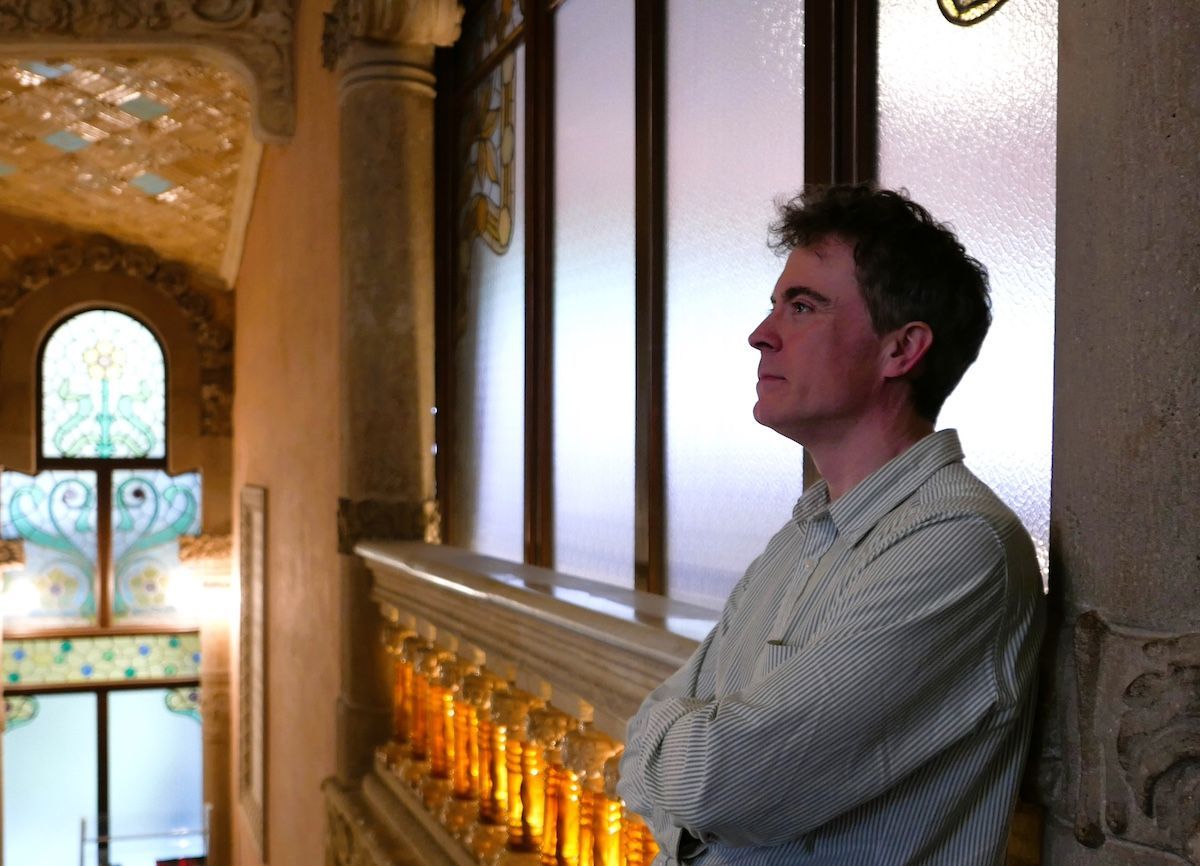
We conversed with the English pianist Paul Lewis, who has completed the integral of Franz Schubert's sonatas at the Palau de la Música Catalana. A project initiated in 2023, with two concerts last season and two in the current one, which traverses the emotional world of the Viennese composer with undeniable intensity. A beloved interpreter in the city of Barcelona, who has demonstrated continuous involvement with the modernist temple throughout his career, with some truly striking episodes in recent times.
--- During the pandemic, when travel difficulties between countries were immense ---due to the application of quarantines and other measures--- you were one of the few international artists to travel and play.
--- Well, in that situation, a lot of work was done online, and at some point, being in an empty concert hall, in front of a camera, I came to think: "if this continues, I'd almost rather do any other job." I couldn't get used to the idea of playing without an audience.
--- Everyone was in shock, in one way or another, and music felt more necessary than ever…
--- And also the inverse! Suddenly, I realized that music needs people. You need an audience occupying that space, experiencing what it is. Otherwise, it loses a good part of its meaning. Of course, musical performance is still something wonderful, but it's only alive if there's someone listening to it.
--- The presence of an audience affects the sound in a physical sense, acoustically, but there's another kind of difference ---difficult to express in words--- related to the impact of artistic activity.
--- What's more, one can say that one can rehearse in an empty concert hall, and the silence one experiences is not the same as when a thousand people practically hold their breath, because they are listening to you with full attention and vibrating themselves. That is another kind of silence; there is the energy we need.
--- Thinking specifically about Schubert, silences have a symptomatic and who knows if alarming presence; in my experience as a listener, not all audiences tolerate them easily.
--- Some people are afraid of silence, that's undeniable, but in Schubert, specifically, it seems as if all his music ---not just the sonatas--- ultimately leads to silence. In that silence there is so much music, so much concentrated meaning.
"Musical interpretation is in itself something wonderful, of course, but it is only alive if there is someone listening to it"--- The psychological explanation regarding his final triptych of sonatas, composed in the last year of life by a sick but lucid Schubert, perfectly aware of the situation, is very tempting.
--- There are theories regarding Schubert's consciousness at that moment and his purpose, which are supported by the fact that, in the manuscript of the score, he wrote "Sonata 1" for the sonata in C minor (D958), "Sonata 2" for the one composed in A major (D959), and "Sonata 3" for the final one, in B-flat major (D960). Of course, he had composed other piano sonatas before, but that numbering suggests that it is a whole, he thought of them jointly, as stages of a vital journey.
--- Could we therefore see, even a kind of narrativity not only within the sonatas, in each movement, but between them?
--- I get the feeling that the sonata in C minor reflects his experience with the problems of the world, anguish, a terror from which one cannot escape. In his case, of course, illness. Schubert knew his time was limited. That sonata is one of the most dramatic he composed; one constantly perceives the sensation of being pursued, of there being no escape.
--- Alfred Brendel, who also played these pieces in the Palau, referred to this sonata as the most "neurotic," while Schumann, master of irresolution, had highlighted the unending nature of its unfolding, "as if it could not reach an end."
--- In contrast, the next one ---in A major--- addresses the acceptance of destiny. The need to embrace the inevitable with open arms, to reach some kind of agreement with oneself. In the closing movement, with all those repetitions and the inclusion of a theme belonging to another previous sonata, he seems to be saying goodbye, bidding farewell to something that never quite arrives... And then, afterwards, comes the sonata in B-flat major, in which Schubert would be speaking from another place.
--- That dialectic in Schubert is strikingly noticeable, articulating repetitions ---insistent references to the theme, with hardly any development--- with sudden interruptions. A kind of obsession with remaining, confronted with the opposite tendency, consisting of rehearsing its disappearance and merging into silence.
--- Yes, unlike Beethoven ---in whose music there is also struggle, a very evident tension--- the questions in Schubert generally have no answer. After forty minutes of a sonata, not only do you not have answers, but the questions raised by the musical discourse in the listener's soul may even have multiplied. But for me, precisely because of that, it reflects what humanity consists of. Beethoven is superhuman, while Schubert shows the vulnerability, the fragility of the human being.
--- Perhaps that's why he was such a universally celebrated Lieder composer, don't you think?
--- The human element, specifically the voice, is present in his music, also in the sonatas. And one has to breathe as if singing; the pieces emanate a transcendent and deeply human truth through that vital rhythm that Schubert captured like few composers, giving a very genuine sense of space and freedom.
"There is nostalgia in that joy, nostalgia for impossible beauty, which is episodically evoked but can no longer be possessed"--- In the romantic spirit, that freedom coexists with the sufferings experienced in that search without answers. An affective feedback that seems alien to the logic of human reason, but which music manages to convey sensitively, sometimes resulting in a balm... Do you think it was, in Schubert's case?
--- I believe that the journey represented by the three final sonatas functions, in some way, as a consolation. It was a way of expressing and accepting where he was in his life, from the most stark reality to his yearning for liberation, once he had the diagnosis and knew that syphilis would condition him until death.
--- Of course, these types of conflicts or contradictions are something that musical grammar can articulate semi-consciously for the listener, without the aid of concepts…
--- That's right, the juxtaposition between the minor and major mode, so frequent in Schubert, allows that struggle without final resolution to be intuited. The sonata in C minor (D958) exemplifies the emotional alternation, as well as the —inevitable— tension between both extremes. When Schubert accesses the major key, he actually does so sketching a sad smile. There is nostalgia in that joy, nostalgia for impossible beauty, which is episodically evoked but can no longer be possessed.
Add The New Barcelona Post as your preferred Google source for free
Stay informed with the latest news.
