[dropcap letter="A"]
s the plane approaches Iceland and is about to land, the visitor's eyes are filled with wonder. In early March, the vast, inhospitable expanses—like a salt desert—surrounding Keflavik airport make one feel as if they are about to set foot on the moon. Their eyes strain to retain and recognize the hints of toy craters cracked by volcanic earth, the particular texture of the Icelandic land from an airplane's view. This impression of Neil Armstrong, of being the first to step on the marvel, will not leave them.
Evidently, in Reykjavik, the European capital closest to the Arctic Circle, it is very easy to be aware of the tourist boom taking place both in the city and throughout the island in general. It is true that now cranes and new hotel constructions dot the maritime horizon. As true as the prices of almost everything—everything, except the public pools with geothermal water—rise to the stratosphere and the murmur of luggage traffic—even yours—is part of the landscape's soundtrack. All this is as true as one wishes and will be even more so for those who can say they were in Reykjavik before the tourist boom, or before the financial crash, or before the eruption of the Eyjafjalla volcano, which left European airspace full of smoke, and now the race to be the first explorer tourist and then show an indolence of satiety is infinite. But the fact is that there are ways to avoid leaving the moon bubble you enter when you first set foot in Reykjavik, like someone testing the water temperature of a hot pool.

The inhabitants of Reykjavik like to say it's like a Western town. They refer, thus, to its urban singularity: an almost village-like horizontality, with aligned houses and few floors, although this changes a bit as you approach the outskirts. It is a continuum, whose only variation are the undulations of the neighborhoods—one up, one down—of pleasant softness. Upon arrival, a visit to Hallgrímur Church allows one to get an idea of this colorful and welcoming Western town atmosphere that stretches at your feet: a panorama of wooden, polychrome houses, dazzled by a sun that—latitude dictates—shines with incredible strength and softens the snowy mountains of neighboring islets and gulfs.
Hallgrímur's Church is the tallest building in the city: a kind of winding, cement-colored pyramid, more picturesque than graceful, more emblem than attraction. It is curious that it was not finished until 1986. I would say that these types of temporal and spatial displacements are frequent in Reykjavik. Another example: beer was prohibited until 1989, although, afterwards, the country has quickly caught up by manufacturing its own beers. But before our heads spin, let's go step by step. The city itself has about 121,000 inhabitants. City and conurbation, 212,000. If you leave the passable limits of the capital —it all depends on one's desire to walk—, a car is an imperative. Bus lines are not very operative, due to their functioning and price. The noise of car traffic, equipped with studs on the wheels to combat snow and ice, is another peculiar companion.
To say of a city that it makes everything easy for you means many things, not always obvious. Some are part of an atmosphere that envelops and caresses you. Of course, this also depends on the expectations of the one who lands anew: there are those who, obsessed with filling and refilling the catalog of natural wonders that the island concentrates —geysers, waterfalls, volcanoes— will only spend a few hours in Reykjavik and will claim that the city is just two streets. In this case, better for us. Reykjavik asks to be savored from the inside out, like a double skin to continue. The exteriors have a surreal patina, like a movie where plans overlap without anything jarring. An internal harmony operates within it. Let's do the exercise: we go to the Harpa, the sumptuous concert and conference center near the bay. From the outside, its cubes impress, like stained-glass scales. At the foot of Harpa, the ghostly contrast of the snow in the mountains with the sea is appreciated, the engineering works in the surroundings, with a feverish activity to erect new buildings. And now we enter the Harpa. The delicacy with which the interiors are treated is striking; thanks to a seductive architecture —the warmth of the dark volcanic stone— they immerse the visitor in a bubble of amniotic fluid. The same happens with houses. Or with museums. Or with bookstores, the dispersion is formidable! In bookstores, it is common to find a quiet space to have a coffee, to have a snack, to read —or write— and spend a comfortable time. At times, the bookstore's cafe becomes a place as calm as a library. You just have to pass the inevitable toll of the avalanche of tourist gadgets at the entrance but the rest is grateful civilization. In Eymundsson —specifically, in the mezzanine overlooking Austurstræti street— or at Mál og Menning accompanied by a chocolate delight, an exquisite afternoon can be savored.
When night falls, from the houses—it's not a country for blinds—little dots of light emerge that seem to lovingly merge, for a while, this inside and outside that define the city. There are pubs where you could spend hours. It's clear that you have to know how to navigate among the distracting offerings for tourists, but in the center, you can easily find, without obstacles, nightlife venues with excellent live music. The concentration of musicians and writers and artists per square meter is exceptional. The numbers only add up if we consider that some play more than one role within the hallelujah and, furthermore, each of these roles they are capable of performing grandly. One night at Hurra, a simple venue in the heart of the center, next to Ingólfstorg square and the city's nerve center—Austurstræti, which then becomes Laugavegur—you find three concerts. First, a kind of indie new age; then, electronic music; and finally, technopunk. All three are remarkable.
Very close to Hurra is one of the Reykjavik Art Museum's venues. This is very common. The same museum has three distributed and specialized venues. Proportional measures. There's no need to worry about overwhelming exhibitions. On the contrary, there's no need to be afraid to delve into a display of contemporary artists. Peculiarities, echoes of this kind of volcanic vibration, are easily discerned. One can see how this island halfway—or equally far—from everywhere has produced very interesting artists who have managed to connect universes starting from their own originality to go further: tradition and avant-garde play and relate. With joy. Thus, without premeditation, I discovered the depth of the painter Johannes Sveinson Kjarval (1885-1972)—a revered artist in the country—, or the vitalist energy of Karl Kvaran (1924-1989), the chaotic frenzy of Erró (1932) or the enchantment of Elina Brotherus, a contemporary Finnish photographer and video artist I saw at the National Gallery.
Icelandic pride, which is perceived in the streets — in plaques and monoliths, in how the great men and women and legendary events of the country are treated —, the awareness of its idiosyncrasy seems to go hand in hand with these bridges built with many other countries. There are a multitude of historical reasons that explain the singular, authentic, half-Anglo-Saxon —British and North American—, half-Nordic aroma that can be felt in Reykjavik. The continental mix is reflected in the wines: in the State stores —the Vinbudín— you can play at acquiring a Californian or an Argentine wine, a Riesling or a Bordeaux. The Icelandic and English languages are in common use, and although the currency is krona, there is no need to worry about paying by card anywhere. Once again, they make it easy for you.
Reykjavik's spatial and temporal challenges are found on every corner. A pub named English Pub in the heart of the city would, in another latitude, be a vulgar call for herds of tourists. Here it is a pub full of elegance. A free Bach concert in Reykjavik Cathedral might seem like a deception that doesn't meet expectations. Here it is an act of love by a pianist who for years has played some Bach fugues and preludes every Tuesday to reach higher levels of perfection. Let's stop for a moment at this church. Although it is, officially, the city's cathedral, its dimensions are small. With a bluish roof, it seems straight out of a Christmas story, very close to the Parliament —also small— and the city hall, a gray mass that, with so much will for modernity, is dreadful. In front of the city hall, there is the enormous lake, frozen in early March, surrounded by magnificent houses, with families of ducks that glide until they approach the channel.
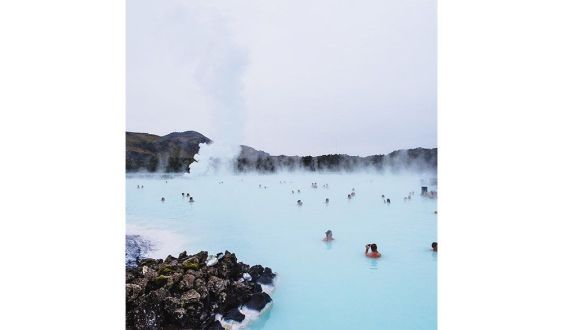
Another example of a challenge: the outdoor public swimming pools, with geothermal water and some almost boiling hot pots, which are part of the customs of the citizens of Reykjavik. Going for a swim at six or six-thirty in the evening is like going for a beer. If you want more calm, a morning swim is ideal, only dotted, from afar, by the courses of schoolchildren. The baths and temperature contrasts that restore body and spirit to a peaceful weightlessness prepare you for the wind, the cold, and the meals and beers you want to taste. Pub life is sensed as pleasant due to the familiarity that is breathed. And food is usually a sure thing: either in a grocery store or in a restaurant you can find some salmon and cod that will prolong the voluptuousness of the bath. The port still retains a modest and dilapidated appearance that can be transformed in a flash with urban voracity. Walking and heading to a restaurant and trying a flamed fish or a tender horse is not to be missed. And getting close to the part of the port that does not seem made to be visited and wandering through the residential neighborhoods—Verstubær or Gandar, with the Catholic church facing Tungata and a spacious park—, feeds the impression of stepping on a specific tip of the world, an unknown extreme.
In Reykjavik, the complete image is hardly what it seems at first glance. Even the northern lights make you wait. So much geothermal activity surely must indicate a certain subterranean effervescence, a kind of telluric temper. Perhaps this is the magic and the ultimate challenge it proposes. Perhaps it is no more than a mirror of the stories of trolls that cover the social imaginary—and exhibitions and souvenirs—. They are so embedded in its skin that in the end you too would swear you have seen trolls.
Add The New Barcelona Post as your preferred Google source for free
Stay informed with the latest news.