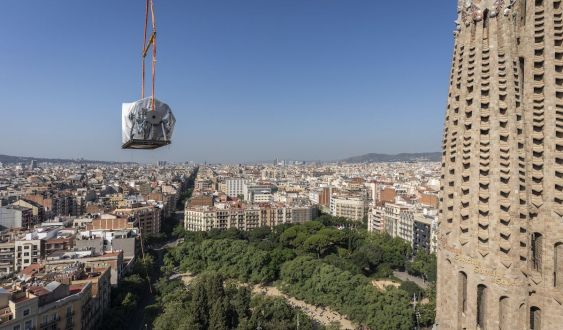
I make my umpteenth visit to the temple with the desire to check if the enthusiasm it provokes in me is as justified or if it could be nuanced. Doubt is an essential part of faith and the Scriptures, just as the temptation of the Devil is also part of them, and therefore it is worth facing it (again), especially if we are before an expiatory temple. Expiatory of sins, it is understood: who sins more? Those of us who cannot tire of looking at it with its irregular grandeur, or those who forgive its life, death, and Glory? A visit to the latest works carried out may bring us closer, like the stairs of the towers, like the stars of Mary and the figures of the apostles, to the truth.
I do not believe it is necessary to reopen the controversy about whether Gaudí's designs are being followed or not: the museum clearly exhibits fragments of lanterns from the original model of the Glory façade, various precise photographs of the large original models, the reconstructed capitals of the columns of the central nave of the apse, the drawings made by the disciples and collaborators of the Great Architect of the Universe, and the last plan drawn under his direction.
Óscar Tusquets, who signed the manifestos of the seventies against the continuation of the works, saw it in time (there is always time), after seeing the central nave finished, after visiting the temple in depth and perfectly verifying that Gaudí's designs, despite the malignant flames, remained intact. That if anything could be criticized about the works, it was the extreme loyalty and exquisite following of the Gaudian legacy; that there is rigorous research behind every decision, especially starting from the complex geometries on which the temple is based (hyperbolic paraboloids, regular polygons that spiral, replication of the molecular behavior of nature, etcetera).
Surely, Tusquets points out, Gaudí made this commitment to geometry once he had learned from the problems he had had with the façade of La Pedrera. But the fact is that, once these geometric rules (complex but basic) are defined, they do not accept interpretations and can only follow one path. Like genetics. Like truth. No, it cannot be changed or interpreted: it can be seen or not seen, with total freedom.
I said it wasn't necessary, but I've fallen again. Praise be to God, all so that the foundations and pillars of the matter are clear. The long queues of tourists from all over the world who gather there (as already designated and pointed out by Gaudí) do not give importance to Jesus or the Scriptures, but they also do not know that the very vision of the work brings them directly to an indisputable truth, in the form of beauty, and that is enough.
The payment of the entrance fee, moreover, means that a minuscule piece of stone will be possible thanks to them. All this, in addition to obtaining an unconscious and added expiation of some sin, of course. Nor did Cerdà know that, despite the advantages of his grid, its unbearable and socialist monotony would be conveniently expiated and corrected by the brushstrokes of color, imagination, and good taste contributed by the modernists. Gaudí first: in a sickly, tireless, simultaneous, and constant manner, he added all possible good ideas to the grid to make it clear that the lack of soul is not a general defect of Catalans.
What at first was to be a simple neighborhood parish, in Gaudí's hands became the most imposing church in the worldAs for the Sagrada Familia, also located in the heart of the Eixample, at first it was to be a simple neighborhood parish but in Gaudí's hands it became the most imposing, original, tall, surprising, and revealing church in the world. It only remains for the Easter-less puppets who cannot see it, when they walk around the corners of the Eixample, raise your eyes to the sky.Some of them, I know because it has to do with an ingrained bad faith, will always remain within the same downcast gesture of the evolutionary scale.
By the end of the year, for those who look up, the central tower will be finished (with a visitable upper cross by elevator) and it is now the tallest building in the city. Afterwards, between one and eight years to finish the Glory facade, which I pray it is true that it will go into Barceló's hands. And meanwhile, right now, the Assumption chapel, located next to the presbytery (Provença sea side, for the secular locals), the roofs of the side naves at the height of the Passion and Nativity naves, the transept hall, the underground baptistery and, evidently, the Glory facade (Mallorca mountain side), if God helps, either in the form of an agreement with the neighbors or a providential lightning bolt, are underway.
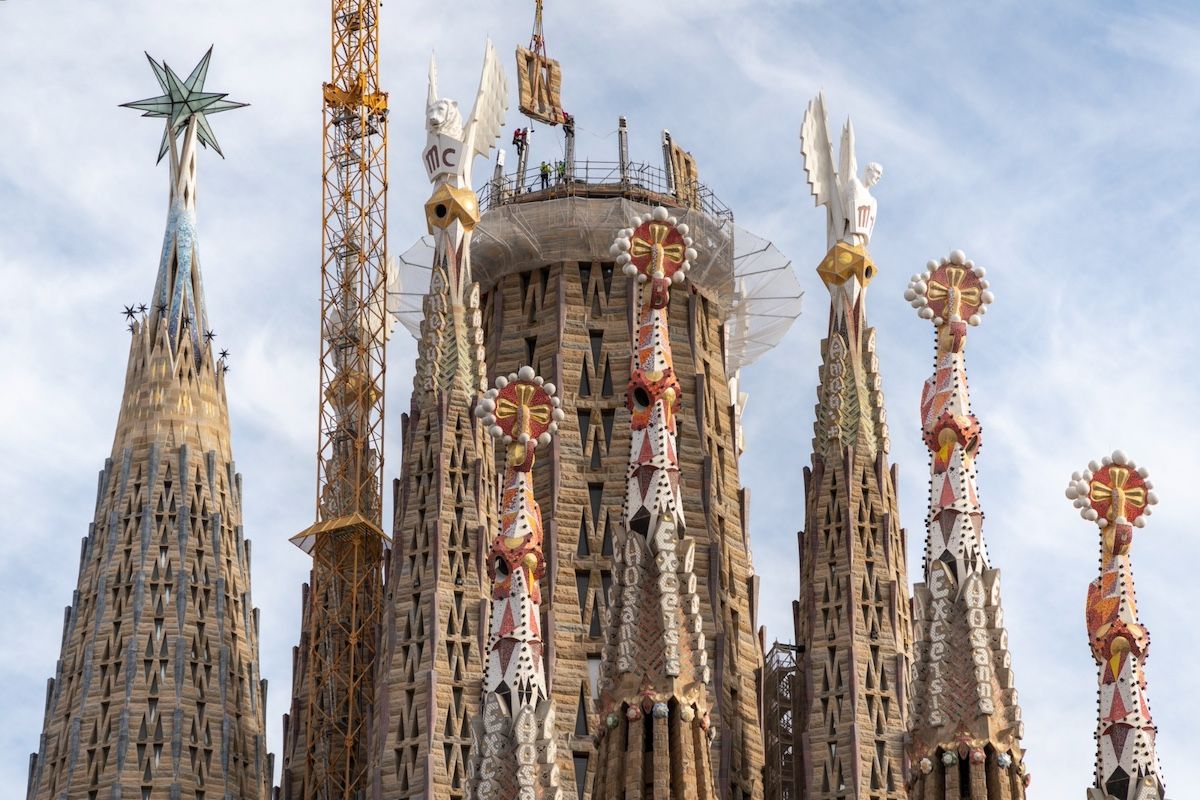
When it is finished, not only will this country show that when it wants to, it knows how to finish the job, but it will also do so with a spirit as universal as it is radically autochthonous. The country's capital can settle for nostalgias in the form of four testimonial towers, whimpering about what could have been, or else grow, rise, assume the sins or defects and aspire to more. Always counting on solid foundations, and with unalterable codes. Although the project has all the time in the world, because its client is in no hurry, Gaudí never wished for it to be paralyzed.
I also have preferred parts of the temple and others that don't thrill me as much, exactly like the chapters of the country's history, but the conservative, resigned, small, and grumpy alternative of the opponents leads (as always) to total defeat.
Do you want a Sagrada Familia to demolish? Look for the Sagrada Familia church in Igualada, an exact chicken farm with a corrugated iron roof, a work by the also mistaken Oriol Bohigas. Truth is hard to define, but it is recognized immediately when seen: the opposite of truth, too. Meanwhile, as Gaudí said, the people make the temple and are reflected in it.
Add The New Barcelona Post as your preferred Google source for free
Stay informed with the latest news.
