
It is difficult to imagine the exact degree of admiration Wolfgang A. Mozart professed for the masters of a past, if not remote, then stylistically distant, surpassed by new compositional trends. Much less undeniable is that, in 1789, he was not in a position to refuse the commissions presented to him, urged by his pioneering ---and ultimately fatal--- condition as a freelance, without any patron to guarantee his livelihood. Baron van Swieten, who had already asked Mozart for an intervention in the score of Acis and Galatea ---considering him "capable of dressing Händel's music with enough propriety and good taste to make it appreciated by the modern public as well"--- would entrust him with a total of four adaptations, including that of Messiah. The popular oratorio, not particularly successful at its Dublin premiere in 1742, would achieve greater recognition at the end of Händel's life, and posthumously.
Even if at first glance there are reasons to think that the modifications made by Mozart are not decisive in terms of structure or content ---as they basically concern the instrumentation of certain passages, with richer sonorities and the protagonist irruption of clarinets---, it is not difficult to perceive a less baroque atmosphere; especially in the context of Robert Wilson's staging, untimely and as such undisguisedly alien to epochal codes. The German text used, also composed of passages from the Old Testament that anticipate the coming of the Messiah, approaches in spirit the Lutheran translation, with which ---one might think, not in vain--- Bachian reminiscences emerge. At the same time, the convinced Catholic that Mozart was had added a new register to his spiritual life with his entry into the Masonic lodge of Vienna in 1784, which his father would join a year later.
Without incurring any type of incompatibility ---the lodge was governed by the Zinnendorf Rite, declaredly Christian and Trinitarian--- his adherence allowed him to glimpse another type of knowledge; a brotherhood subject to secret norms, but oriented towards the search for wisdom with ecumenical aspirations and the transcendence of particular beliefs, as he would make clear in The Magic Flute. Curiously, the instrument displayed in the title was not the most exploited by Mozart in those years. Yes, however, the clarinet, the artisan of an alchemical power that appears in Sarastro's aria "O Isis und Osiris," and to which he dedicated a memorable concerto, a string quintet, an obbligato role in the countess's introductory aria, in the initial chords of the Masonic Funeral Music and, of course, in his Der Messias, Kv. 572.
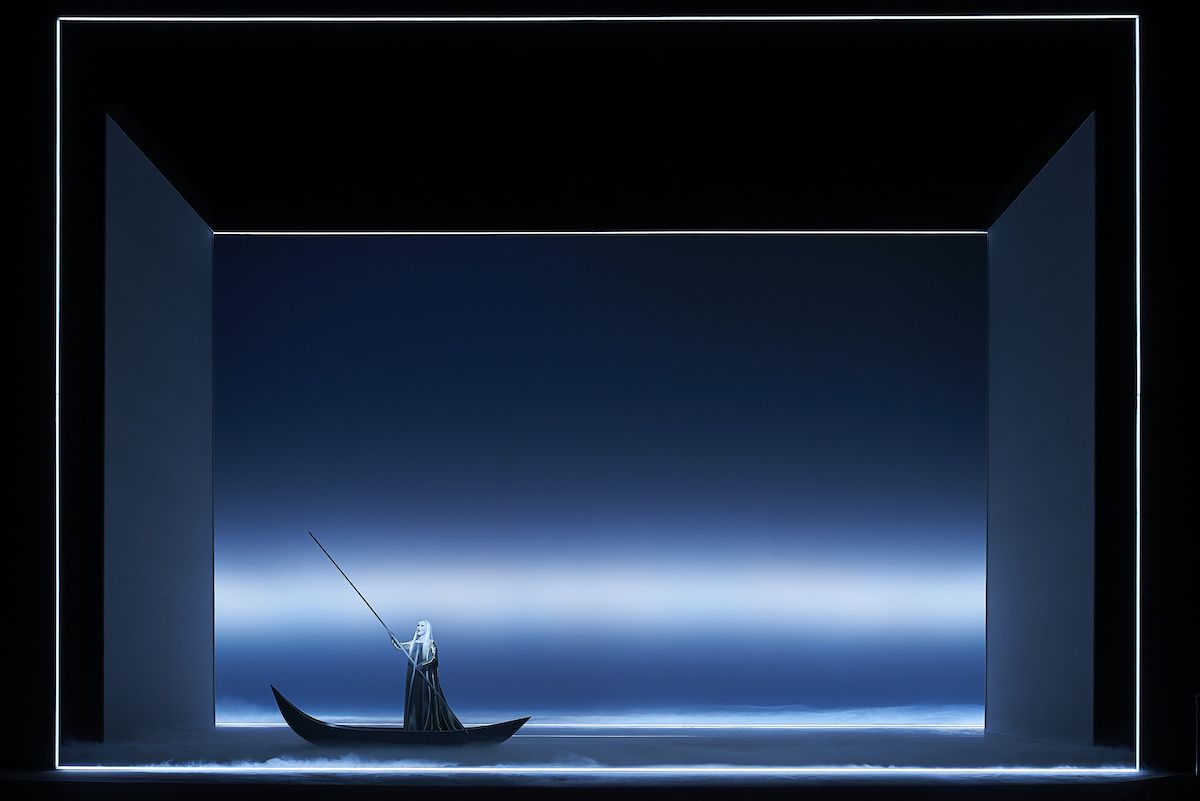
Theological-musical paradox in Wilson's staging
Robert Wilson's staging, first seen at the Mozartwoche in Salzburg in 2020, challenges the official line with its hyper-aesthetic and pregnant ---eventually uncomfortable--- images, transformed through an iconography in dialectical tension with the Christian message. We can hear passages aligned with the hard core of the salvation proposal, biblical quotes or paraphrases ---some inspired by Paul's letters--- that speak of the power of weakness, of a health that springs from the wound, or of how the weight of sin is lightened by divine law; but the actions that unfold on stage do not illustrate what is sung, and if they do, it is against the grain, vividly inviting us to take perspective. Images of unquestionable power, frantically oscillating ---like a demagnetized compass--- between the sublime and the kitsch, without it always being possible to determine which side one is on. This impossibility can be annoying, as it blurs the clarity and distinction of the line separating faith and reason; a true Moebius strip in which the need to believe ---to transcend or perpetuate oneself with dignity--- feeds back into the no less human need to create, to find solace in art or in the appreciation of beauty, as a possible path to spiritual health.
Sir Malcolm Sargent, who conducted Messiah countless times, declared that "it will always be as impossible to give a definitive interpretation of Handel's work as to produce a Shakespeare play completely satisfactory for posterity." With a cast led by soprano Julia Lezhneva, alongside mezzo-soprano Kate Lindsey, tenor Richard Croft, and bass Krešimir Stražanac ---in addition to dancer Alexis Fousekis, who opened the performance--- the show also stood out for the performances of the Liceu choir. It performed on stage, and occasionally also from the pit, alongside an orchestra ably conducted by Josep Pons, who avoided emphasizing the baroque accents of the new score, in favor of that more classical and timeless reading conceived by the Mozartian spirit. Everything unfolds in a strange and placid manner in these dreamlike settings, without a strong focal point, until the appearance of soprano Julia Lezhneva; herald of the coming with an angelic attire and a finally powerful song, ambivalent in its impossible whiteness and therefore terrible, as Rainer Maria Rilke had sung.
"Images of unquestionable power, oscillating frantically between the sublime and the kitsch, without always being able to determine which side one is on"Against all odds, falsely naive scenes acquire an edifying dimension through surprising decontextualization, like the one where a girl in nineteenth-century attire mocks the wicker man who tries to scare her, while the bass ---in a kimono and oriental characterization--- intones solemn warnings about the power of Christ. Not to mention the hardly tolerable incorporation of the burlesque to the show, which pushes the viewer to the condition of voyeur intercepted, discovered in its immodest yearning for purification. In the background, that string of unconnected episodes traces a consistent frieze in its fundamental purpose, musically and visually conveyed as magmatic eruptions of the water vapor waves that constitute the seas and skies of a fluctuating stage: manage to shake the viewer, perhaps to take them out of their comforting belief ---if not about the word of God, about what it must be The Messiah so that it functions as a work of art---, as the message of salvation had indeed intended in its origins, unacceptable for the statu quo spiritual.
The comedic register of a cabaret master of ceremonies feels reasonably out of place, like the arrival of an astronaut amidst the glacial explosion previously projected in a loop, while the glorious Hallelujah resounds. Or like the angelic soprano filling a glass of water that overflows, while singing, only to end up pouring the content over herself. Highly inappropriate, essentially inadequate in a work whose fundamental intention is to celebrate the possibility of eternal life; a possibility inaugurated by the incarnation, as recalled in the final stretch with that other Pauline dictum that states that death entered through one man, and through one man came the resurrection. Lest it be unclear, the Adam/Christ dialectic is made explicit, putting the reliability of the pre-established discourse into crisis. Robert Wilson rehearses a theological-musical paradox based on images that remain in the retina and find no possible correspondence, a counter-discourse that collaborates with the necessary updating of the Law.
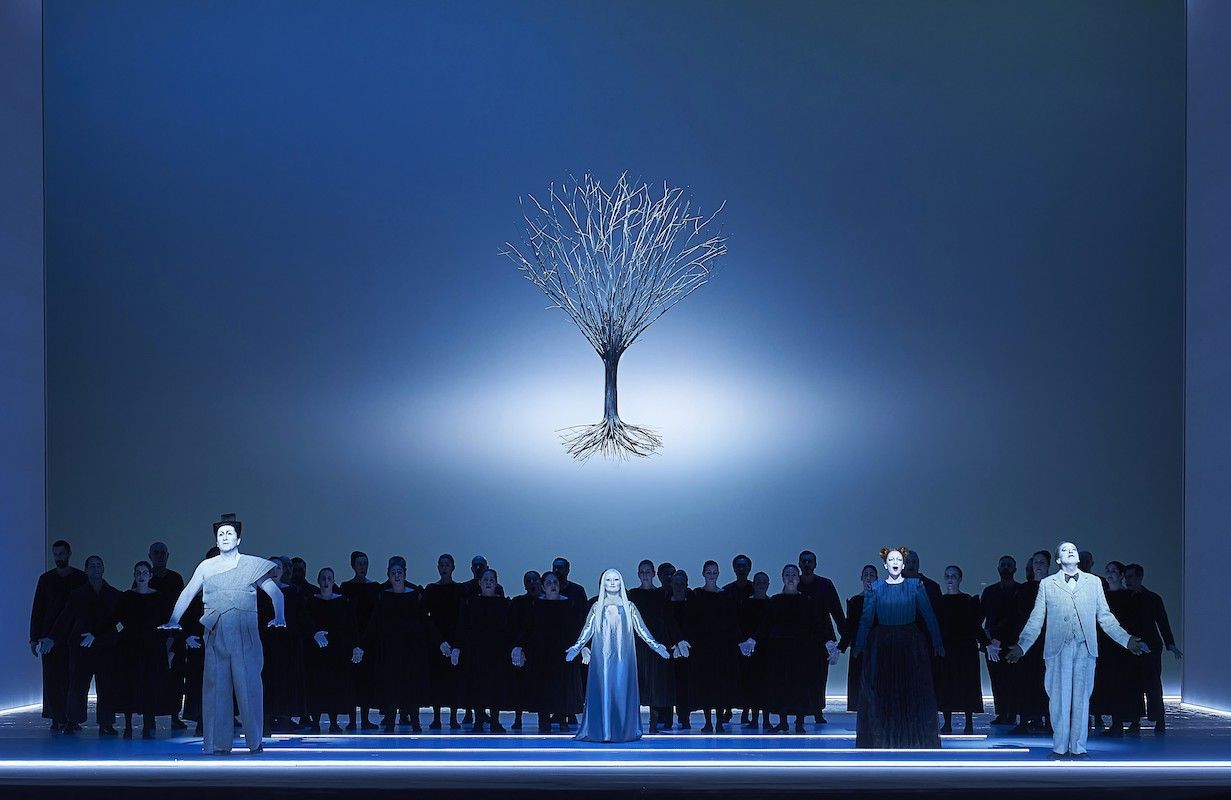
Coda
A kind of via negativa, that one, which resonates in the work of Pseudo-Dionysius. A first-order authority during the Middle Ages due to his status as a follower of Paul ---inadvertently fake, as he could by no means have known him in the Areopagus--- and who denounced the "unworthy offense to divine powers" committed by anyone who considered "celestial beings to be men of gold, luminous, radiant with beauty, sumptuously dressed, harmlessly flaming, or in other similar forms with which theology has represented them." The staging of this Messiah, overabundant in images, nevertheless renounces its representative dimension, and even the use ---not infrequently abusive--- of symbolism. The tableaux in transformation narrate the inherent inadequacy of all narrative; a paradoxical lesson in iconoclasm that captures attention and at the same time makes explicit the risk of fixation on an object of veneration.
Thus, the logs flying over the stage, a tempting handhold to avoid the force of the currents, seem to exhibit the idolatry that the prophet Zarathustra, in a blatant distortion of the spiritual paradigm, had pointed out with his oracular style: "When the water has timbers to cross it, when little bridges and parapets jump over the current: truly, there no one believes anyone who says: «Everything flows»". The no less critical presence of the wicker man, which takes us to the illuminated film of 1973 (The Wicker Man), transforms the notion of evil, and its origin: the tree, responsible for those logs, inverts its position -suspended in the air- during the final Amen, showing how roots are branches, branches roots. And the earth, where "the worms that will eat my eyes, but even so I will be able to see you" dwell ---sang Lezhneva, a terrible angel---, the foundation of spiritual sustenance.
Add The New Barcelona Post as your preferred Google source for free
Stay informed with the latest news.
