
Many of us remember what we were doing, where we were on the morning of January 31, 1994, when the Barcelona Coliseum burned irremediably due to a spark from a welding of the curtain that was supposed to protect it in case of fire. The date is approaching when 30 years will have passed since the unfortunate event, in a season ---the current one--- that the Liceu presented with the motto of Irreversible Cracks, with the well-intentioned aspiration to "recognize irreparable cracks and dream that knowledge, art, and opera help us lighten the vital burdens we carry." The capacity of art to exorcise demons, to allow internal conflicts ---perniciously silenced--- to surface is undoubtedly its greatest and imponderable virtue. It has been written about the sub limine affection of music ---the way it incites moods, semiconsciously--- and in the case of opera, being endowed with explicit narrativity, working with the traumatic seems all the more viable.
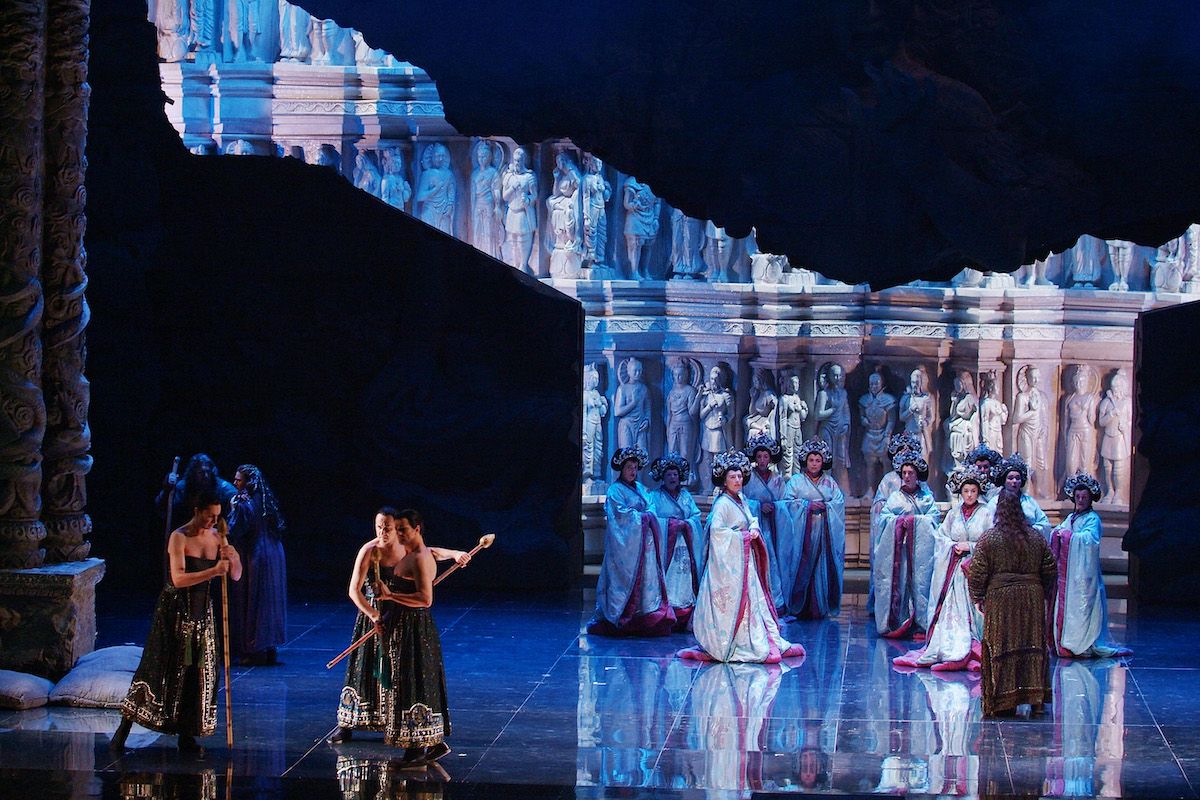
Turandot sounds again at the Liceu, after a futuristic version or one close to manga aesthetics ---as Víctor García de Gomar specified--- in an ill-fated season, 2019/20, which could not develop as expected due to the global pandemic. In the current one, the bet is classic and as such spectacular, sumptuous in golden garments that kaleidoscope, with an enormous number of participants and Babylonian-sized sets. The magnificent staging with which Núria Espert, in 1999, revived the illusion of opera lovers is recovered, after the trauma of the fire that devastated the Liceu and forced five years away from the stage. This title, one of the most popular and appreciated, confronts the viewer with a story of mythical aftertaste, in which love and violence tacitly coexist in interpersonal relationships, with an emotional language that today ---I want to think--- would seem unacceptable to us.
The plot is well-known: Princess Turandot enforces with an iron fist a law that reigns in Beijing and intimately concerns her person, according to which she has the right to execute any suitor who, with the intention of marrying her, fails to solve three enigmas. She will share a remote justification for her bloody tendency in the second act ---she will recall it in the third--- when she refers to the atrocious murder of a princess like her, "thousands of years ago." Custodian of that aggression, she actualizes the reparation of the original wound with ritual violence, as if to suture a trauma that, in reality, is re-fed. She, the pure one ---a term that appears on several occasions--- must never be "possessed by anyone," and the numerous court that accompanies her ---with the executioner Pu-Tin-Pao at the head and the insufferable, supposedly comical Ping, Pang, Pong--- facilitates the fulfillment of her expectations. In this sense, Puccini's music oscillates between a bombastic register and the lightness of a necessarily biased approach to the East, fertile in motivic chinoiseries.
The staging is classic and as such spectacular, sumptuous in golden costumes that kaleidoscope, with a high number of participants and sets of Babylonian dimensionsThe composer did not finish the opera in his lifetime, as was evidenced at its Milanese premiere, by Arturo Toscanini, on April 25, 1926. In this sense, and despite the existence of a libretto and the fact that the story would be adapted by other creators, the person responsible for the revival ---Bárbara Lluch, Núria Espert's granddaughter--- shared on social media the possibility of an open ending. In her collaboration with the Liceu, Lluch not only maintains the spectacular nature of the sets ---with a wall made of an enormous sculpture that cracks horizontally, in a powerful beam of light that reveals for the first time Princess Turandot--- but rather bets on the final most expected, which will not disappoint syrup lovers… although to do so one must sign the pact of fiction two or three times and suspend all contact with reality: the attitude of the princess, who until the last scenes rejects the skillful Calaf, is incomprehensibly transmuted as a result of a kiss neither granted nor desired. At no point does the plot suggest anything different.
To pace and make the narration of an impossibly impossible love story credible, Puccini's music sounded resounding and nuanced, more than convincing thanks to the direction of Alondra de la Parra. Undoubtedly one of the best pieces of news, to see the level that the Liceu orchestra can reach in the hands of a conductor who already brought the audience of the Palau de la Música to its feet. The response of those of us who had the privilege of attending the general rehearsal ---some familiar faces among the fortunate audience, such as the promising and already awarded Barcelona soprano Serena Saénz, or the unexpected and heartfelt presence of Núria Espert herself--- was incontestably enthusiastic, as is to be expected in the performances that run from November 26 to December 16.
The attitude of the princess, who until the last scenes rejects the skilled Calaf, is incomprehensibly transmuted as a result of a kiss neither granted nor desiredThe truth is that, along with a powerful chorus, the cast of singers in the first shift showed an interesting level. Notably, Vannina Santoni's Liù emerged, perhaps because she is the most plausible and tragic character (even if she sacrifices herself for love, so that her beloved can love another). Michael Fabiano, in the role of the lovestruck Prince Calaf, demonstrated his stature ---as on other occasions, on this very stage--- acting as an incomprehensibly blinded heartthrob before the overabundance of red flags. Elena Pankratova's Turandot, haughty and distant, struck hurtfully in her outbursts of anger. Fire and ice are the elements invoked to convey an affective ambivalence that is difficult to resolve, as a metaphor for the transubstantiation that, nevertheless, will take place.
CODA: ENDEMIC MISOGYNY AND LOVE-PASSION
The eroticizing unavailability ("no one will ever possess me") is counteracted by the obscene acquisition of that princess with issues as a prize ("you are mine"), a dialectic that champions the realization of desire in the form of domination, and whose supreme fiction is the idea of reciprocity. Is there even a possibility of her falling suddenly in love, similar to Calaf's experience, leading her to relinquish the "privileges" of femme fatale imposed by the male gaze? If we consider the case of the Tristanian filter ---a medium of a fatality that precedes time--- it seems pertinent to ask whether, more than an explanation of love, it perhaps symbolizes the impossibility of determining a rational cause. Similarly, however much it can be understood that fire melts ice, the reality of trauma ---like the question of the cause of fire--- pulsates deep within, all the more indeterminable from the resolution of the enigmas and the establishment of a supposedly balsamic love, without a why. A love that feeds the rift by silently conveying the fallacious message that there is nothing left to resolve.
Add The New Barcelona Post as your preferred Google source for free
Stay informed with the latest news.
